

Kia to debut made-in-Singapore EV5 as part of Apac EV strategy
South Korean carmaker to take on Chinese EV brands with less expensive, mainstream offerings for the region

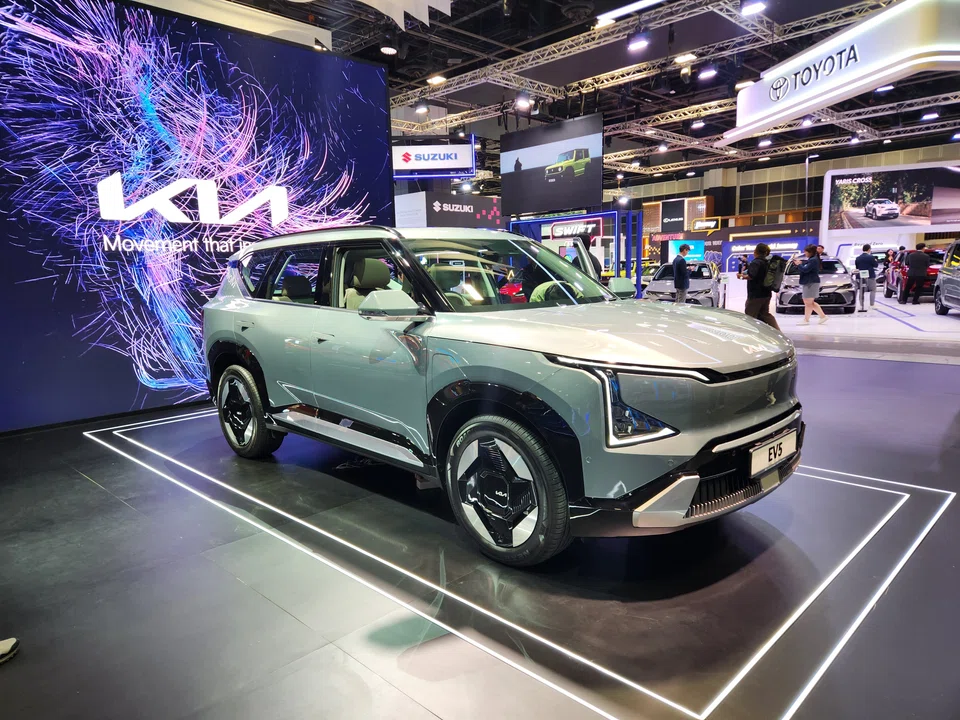
SOUTH Korean carmaker Kia will launch its first made-in-Singapore car, an electric sport utility vehicle (SUV), at the Singapore Motorshow on Thursday (Jan 9).
The EV5 will be built at the Hyundai Motor Group Innovation Center Singapore in Bulim Avenue, with the first deliveries to begin in April. Its pricing starts at under S$200,000 with a Certificate of Entitlement (COE).
Hyundai Group is the parent company of Kia and Hyundai. The facility currently produces the Hyundai Ioniq 5 and Ioniq 6 electric vehicle (EV) models for the Singapore market, as well as an Ioniq 5 robotaxi for export to the US.
The EV5 is being produced in China and South Korea. It was aunched in China in November 2023 at 149,800 yuan (S$27,942), less than its 249,900 yuan Tesla Model Y competitor.
In October 2024, the model debuted in Australia at A$56,770 (S$48,282), cheaper than Tesla’s Model Y at A$58,700.
In Singapore, a Tesla Model Y with a Category B COE costs around S$200,000.
Made in Singapore, for Singapore
Individuals familiar with the matter said that the EV5 produced here will be available in two versions: A more powerful one which would require a Category B COE, and a Singapore-only version with less than 110 kilowatts of power, making it eligible for the less-expensive Category A COE.
EV market leaders BYD and Tesla have gained market share by similarly introducing Category A models specific to Singapore. These have become their best-selling models in the Republic.
Kia Asia-Pacific told The Business Times that in the face of regional competition, its strategy is to focus on models that are more price-competitive, including mainstream, lower-cost ones.
“The Asian market has become highly competitive as Chinese brands enter the scene and price competition intensifies. In response, Kia is adjusting its approach by prioritising models that have been optimised for each market.”
In Singapore, Kia’s EVs have been at the pricier end of the market. For instance, as at Dec 18, its EV9 large multipurpose vehicle (MPV) cost S$289,999 without a COE – more expensive than some EVs by BMW and Mercedes-Benz.
Kia declined to disclose whether it costs less to produce the EV5 in Singapore than in China or South Korea, but said that it is “always looking for ways to enhance manufacturing flexibility and to improve on cost efficiency”.
The decision to produce here was made after reviewing the plant’s capabilities in meeting Kia’s standards, it added.
Parrying on price
The EV5 should be less costly to make than Kia’s earlier EV models.
Unlike the EV6 and EV9 models that use nickel-cobalt-manganese lithium batteries, the EV5 uses less expensive lithium-iron phosphate batteries, similar to many Chinese-manufactured EVs.
It also runs on Kia’s N3 eK engineering platform, which is less expensive than the platform used by the EV6 and EV9.
Kia said that alongside infrastructure readiness, driving experience and affordability are key factors in driving EV adoption in the region.
Therefore, Kia’s next model, the EV3 small SUV, will be more compact and less expensive than the EV5. With a claimed range of around 600 km, it opens a new segment to the brand and is a “crucial part of Kia’s strategic plan” to be a leader in the EV sector.
The EV3, launched in Europe last November, is scheduled for launch in Singapore later in 2025.
Kia’s 2024 global sales set a new record of 3.1 million units, with 2.5 million of those being overseas markets. It has set a target of 3.2 million units for 2025.
TRENDING NOW

LTA proposes combining car COE categories, adding rebate-surcharge system

StarHub to acquire MyRepublic’s mobile business amid ongoing telco consolidation

DBS, OCBC, UOB rout lops billions off STI as inflation, rate concerns spook investors

Grab CEO’s wife Chloe Tong on life with Anthony Tan and finding her purpose

