Labour demand shows signs of easing in Q1 as job vacancies fall for 4th straight quarter

Tessa Oh
Tessa Oh

Published Thu, Jun 15, 2023 · 10:30 AM
    • Job vacancies have fallen for the fourth straight quarter to 99,600 in March. While the ratio of job vacancies to unemployed persons has declined from December, it has remained high at 2.28.
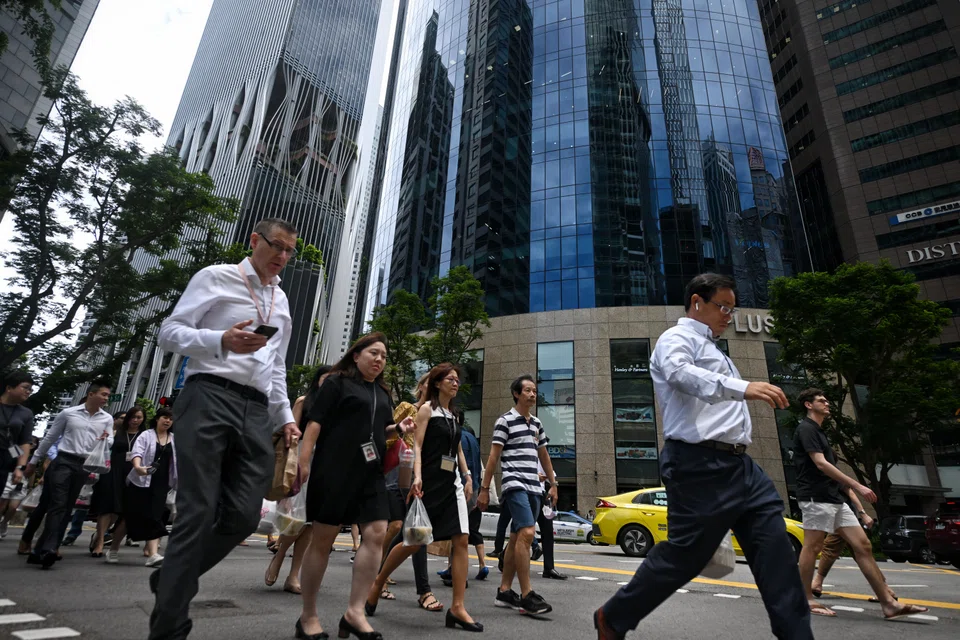
    • Job vacancies have fallen for the fourth straight quarter to 99,600 in March. While the ratio of job vacancies to unemployed persons has declined from December, it has remained high at 2.28. PHOTO: BT FILE

    WHILE Singapore’s labour market remains tight, there are some signs of cooling labour demand in the first quarter, said the Ministry of Manpower (MOM) in the latest Labour Market Report on Thursday (Jun 15).

    Both the number of job vacancies and the ratio of job vacancies to unemployed persons “remained high but have both eased”, while employment growth moderated from the previous quarter, said MOM.

    “It is unsurprising that the domestic labour market has begun to soften slightly,” said OCBC chief economist Selena Ling, noting that the external economic environment has turned more challenging due to the recent bank failures in the US, the ongoing semiconductor downcycle, recent market disappointment on the strength of China’s reopening, and more hawkish surprises from major central banks.


    With businesses becoming more cautious, “hiring intentions and employment growth have begun to moderate and may ease further in the coming months”, she added.

    Additionally, early second-quarter data shows that the manufacturing, financial and trade-related services sectors remain in contraction, noted Maybank economist Chua Hak Bin. He expects total employment growth for 2023 to be around 100,000 – a “healthy, more sustainable pace”, though “sharply lower” than the more than 230,000 last year.

    Job vacancies fell for the fourth straight quarter to 99,600 in March. While the ratio of job vacancies to unemployed persons declined from December, it remained high at 2.28.

    MOM said the vacancies in March were spread across different industries, and were found mainly in growth industries such as information and communications (8,100), health and social services (7,800), professional services (7,700) and financial services (6,300).

    There were 3,820 retrenchments in Q1, up from the 2,990 in the previous quarter, but still below the peak seen in 2020, said MOM. The uptick in layoffs was driven mainly by the electronics manufacturing, information and communications, and financial services sectors.

    In the months ahead, manufacturing firms may still be under some pressure to reduce headcount in the near term, until there are “signs of a convincing turnaround in Singapore’s electronics cycle”, said DBS economist Chua Han Teng.

    National Trades Union Congress assistant secretary-general Patrick Tay also foresees that layoffs will continue to climb into the second quarter and “may snowball into the second half of the year with weakening global demand and headwinds in certain industries such as electronics manufacturing, and restructuring or consolidation in the ICT (information and communications technologies) space”.

    Given that Singapore’s economy is not in a recession, OCBC’s Ling does not anticipate widespread retrenchments. But “downside risks are there, particularly since the US Federal Reserve is now signalling possibly two more rate hikes to come, which may inflict more pain (on) borrowers”.

    On the ICT and financial services sectors specifically, Ling noted that both vacancy rates and retrenchments rose, suggesting that there is some ongoing churn, with pockets of growth opportunities in areas such as artificial intelligence and cybersecurity. It could also hint that there is a skill mismatch in these industries.

    In its report, MOM cited reorganisation or restructuring as the reason for close to half of the layoffs, while 19.4 per cent of retrenchments were due to recession or downturn.

    Among residents who were retrenched in the third quarter, 71.7 per cent were able to find new jobs by Q1. “The rate of re-entry has fared well compared with the pre-pandemic level of 65.9 per cent,” said MOM.

    Total employment, excluding migrant domestic workers, grew by 33,000 in the first quarter, just slightly lower than the 43,500 rise recorded in the previous quarter.

    Non-resident employment grew by 30,200, moderating from the quarter before. Similarly, resident employment was up 2,800, expanding at a slower rate than the previous quarter.

    Nevertheless, non-resident employment exceeded its pre-pandemic level for the first time in the first quarter, reaching 1.7 per cent above pre-Covid levels as at March this year.

    Resident employment grew most robustly in the sectors of financial services, public administration and education, professional services, and health and social services. Meanwhile, non-resident employment growth was mainly in construction and manufacturing.

    Unemployment rates have remained slow, at 1.8 per cent overall, and at 2.6 per cent for residents and 2.7 per cent for citizens.