

Law firms big and small must adopt AI, and bosses must lead the charge: Edwin Tong
Firms cannot simply instruct their IT departments to procure a tool and consider the job done, says the law minister

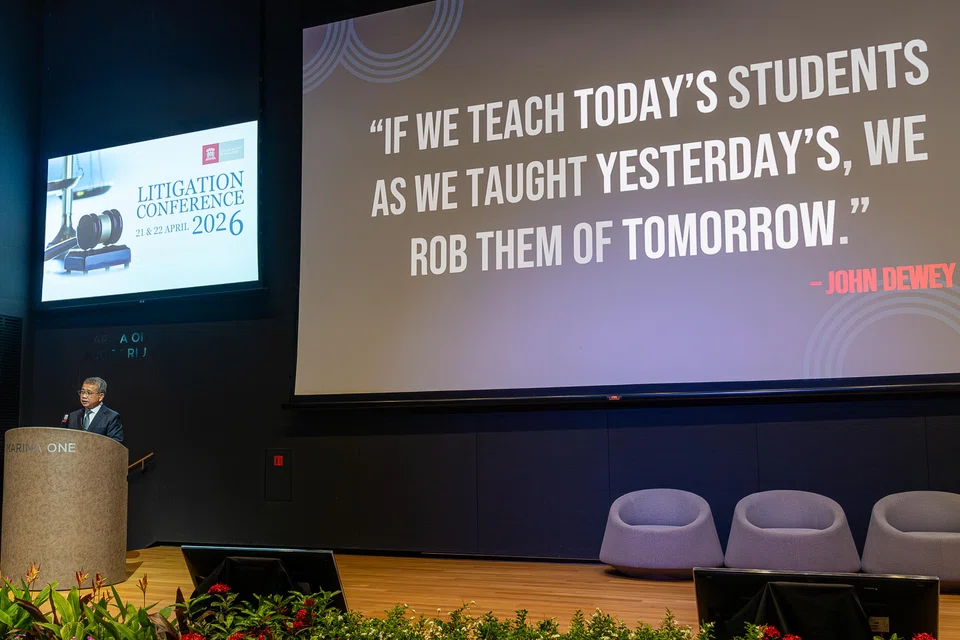
[SINGAPORE] Local law firms of all sizes must embrace artificial intelligence in their practices, but the push cannot be left to junior staff – it has to be led by those at the top, said Law Minister Edwin Tong on Tuesday (Apr 21).
“We want to ensure that firms of all sizes, not just the largest, can benefit from (AI tools), and that the overall standard of litigation practice continues to rise across the board in a sustainable fashion,” said Tong at the Litigation Conference 2026, an annual gathering for dispute resolution lawyers.
The government will do its part, through initiatives such as the Legal Innovation and Future-Readiness Transformation pilot, which helps firms identify pain points in their workflows, select suitable AI tools and integrate them into practice.
Tong said 15 firms, of which 11 have disputes practices, have joined the pilot to date.
Yet, at the same time, tech adoption and integration “must be a product of mindset and workplace culture changes, both of which need to start from the top”, the minister noted.
He added: “In that way, tech adoption is non-delegable. Leaders of law firms and other organisations must lead by example.”
Firms cannot simply instruct their IT departments to procure a tool and consider the job done, he said. “It must work for you and not the other way around.”
Nascent, but rapidly evolving
AI is already reshaping how litigation is prepared and delivered, said Tong.
Today’s systems can already review and summarise thousands of discovery documents in minutes, generate first drafts of pleadings and submissions, and surface relevant case law across jurisdictions.



These are tasks that used to take days, weeks or even months of manual work, he said.
More advanced applications are also emerging. In some jurisdictions, noted Tong, AI tools are already handling low-value, high-volume disputes such as consumer claims and debt recovery with minimum human intervention.
Advanced systems are beginning to stress-test legal arguments by running different factual permutations against case law; and in complex commercial disputes, AI is being used to simulate potential outcomes and identify pressure points earlier in the case life cycle.
These developments are in turn changing what clients expect, added Tong. Many are already using AI internally to generate chronologies, position papers and document summaries – and increasingly expect their external counsel to validate and strengthen these outputs.
“Clients are beginning to question why they should engage firms that are not using AI effectively.”
This will only accelerate the shift away from time-based billing towards value and outcome-based pricing, said the minister. It will also have an impact on legal training and professional development.
“Clients will no longer pay for lawyers to do what AI can do in a matter of minutes,” he said.
Human touch
Yet, for all its disruption, “human judgment continues to command a premium” in legal work, noted Tong. “Even as AI capabilities expand, the role of the litigator, in my view, remains indispensable.”
Oral advocacy, cross-examination, and real-time judgment calls under pressure remain distinctly human skills. “The role of AI in litigation is not substitution, but augmentation,” he added.
To support firms with adopting AI effectively, the Ministry of Law (MinLaw) has published a guide on the responsible use of generative AI in the legal sector, covering professional ethics, confidentiality and transparency obligations.
MinLaw is also considering allocating a portion of Continuing Professional Development points to AI-related courses.
More broadly, there must be a fundamental shift in how law schools equip its graduates for today’s AI-enabled legal sector, said Tong.
“Importantly, law schools can no longer purely be academic institutions in this space,” he said. “They must be closely connected to practice, working alongside law firms and legal technology providers to ensure students are equipped for how legal work is actually being transformed.”
Otherwise, local law graduates will not be able to compete with their “AI-enabled competitor”, he noted.
There must also be a shift in who is doing the teaching, said Tong. For instance, legal AI and information engineers could be included in the law teaching faculty.
The government will explore these changes “very carefully and very deliberately” in consultation with stakeholders involved in legal education.
Decoding Asia newsletter: your guide to navigating Asia in a new global order. Sign up here to get Decoding Asia newsletter. Delivered to your inbox. Free.
Copyright SPH Media. All rights reserved.
TRENDING NOW

MSCI proposes standalone status for Indonesia; Jakarta stocks plunge 8%

Palm oil stocks slide after Singapore begins looking into which firms responsible for haze

High Court rules against Julius Baer’s Singapore trust arm in US$50 million family trust dispute

Why is the haze so bad in South-east Asia this year?

