
LTA, EDB to push on with autonomous vehicle development despite ST Engineering’s withdrawal from bus trials
Bryan Kow
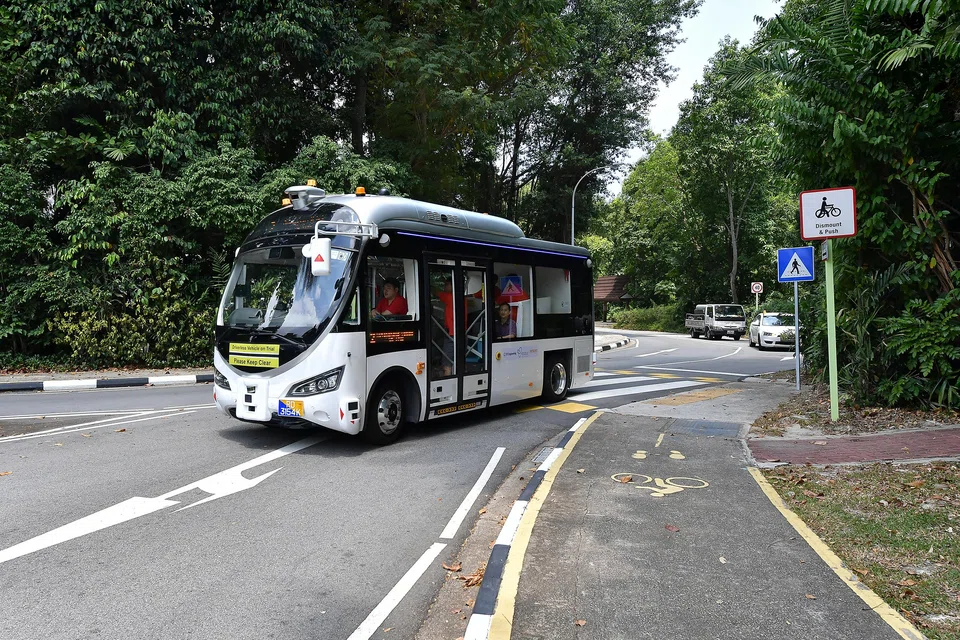
THE Land Transport Authority (LTA) and Economic Development Board (EDB) said on Friday (Feb 24) they would continue to work with partners and stakeholders to facilitate autonomous vehicle (AV) trials and deployment.
This followed ST Engineering’s announcement on Friday that it is withdrawing from the development of autonomous buses, given the “significant” financial resources required.
LTA and EDB said in response to queries from The Business Times (BT) that the AV industry is “currently facing difficult times” and companies have surfaced challenges in their discussions with the agencies under the AV Call-for-Collaboration (CFC).
The CFC was launched in 2019 with the view to deploy AVs as a form of public/shared transport.
“LTA and EDB are deliberating the next steps for the CFC,” the agencies said. Submissions were received from multiple companies, and discussions are ongoing with shortlisted consortia. “We will continue to work with our partners and stakeholders to facilitate AV trials and deployment.”
ST Engineering had participated in several trials of autonomous buses in Singapore, including a 2019 deployment on Sentosa, and a 2021 trial with local public transport operators SBS Transit and SMRT to run revenue services at Singapore Science Park 2 and Jurong Island. But it is withdrawing from further AV development, parking a project begun in 2015.
Speaking during ST Engineering’s results briefing on Friday, chief executive officer (CEO) Vincent Chong said the financial resources needed for continuing its AV bus development are significant – estimated at more than S$150 million in the next five to seven years.
President of urban solutions at ST Engineering, Chew Men Leong, told BT in a separate interview that the company had transformed a concept into a prototype, and was building a business case to determine how to bring the project to commercialisation.
The resources required for further development meant that co-investment support was needed, though.
“The investment climate isn’t that favourable at this juncture, especially for technology, and also the market does not seem to be quite ready,” he said.
The company declined to disclose how much has been invested in AVs to date.
Chong, however, added: “We are also disciplined in withdrawing from projects when the financial conditions are no longer conducive for further investments.”
Beyond costs, certain processes and systems would be necessary to have a proper operating system, noted Hoe Yeen Teck, senior vice-president and head of mobility and autonomous solutions at ST Engineering.
Indeed, LTA and EDB said further investments would be needed to take AV technology to larger-scale deployments.
“Near-term commercial viability will thus be challenging, both globally and in our local AV landscape”, the agencies added.
The Singapore government has been exploring the use of self-driving vehicles to enhance the Republic’s transport system for nearly a decade. LTA and the Ministry of Transport had said in October 2015 that “self-driving vehicles will transform Singapore’s transport landscape”.
Chew – who was LTA’s CEO between October 2014 and November 2016 – said automating bus services could mitigate “perpetual” manpower challenges. But getting to the stage of fleet deployment is “not so much a technology challenge (as) it is the issue of actually getting sufficient resources for us to invest”.
ComfortDelGro Corporation is another locally-listed entity with a stake in AV development. It has set up a S$30 million Autonomous Vehicle Centre of Excellence to build its capabilities, said Tammy Tan, chief corporate affairs officer.
“We remain open to exploring new trials with others as AV technology continues to evolve,” she added.
LTA and EDB said they would partner stakeholders to develop the necessary policy and legislative frameworks to support the deployment of AVs in the longer term. “These are key enablers to achieve greater public acceptance of AV technology, when the conditions for commercial viability are met.”



