

As ‘margin for error’ narrows, strategic decisiveness is key for businesses in fragmented world: DPM Gan
Singapore is doubling down on its role as a trusted hub for businesses seeking stability and growth

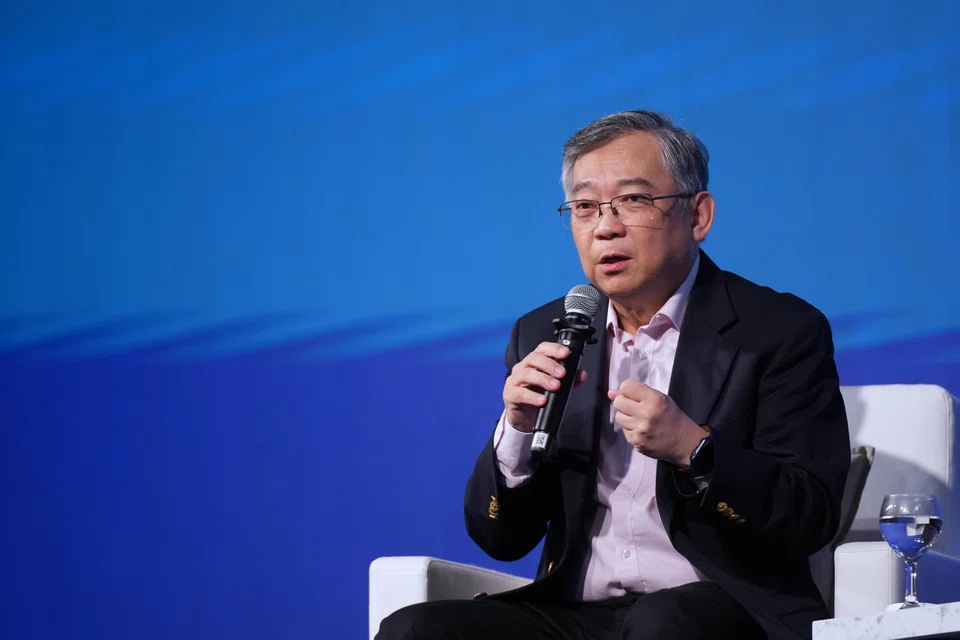
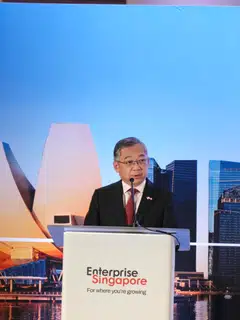
[SINGAPORE] Strategic decision-making and the ability to execute effectively will be a key competitive advantage as the margin for error narrows for businesses in an increasingly fragmented world, Deputy Prime Minister Gan Kim Yong said on Wednesday (Apr 22).
For Singapore, the question it raises is how the government can support businesses in navigating near-term uncertainties while seizing longer-term opportunities, said Gan at CNBC Coverage Live 2026, an event bringing together global leaders and entrepreneurs.
Gan said the country’s Economic Strategy Review will refresh its blueprint to do exactly that, positioning Singapore as a trusted partner for businesses across these two fronts.
This approach is anchored on three priorities: keeping businesses connected across markets, helping firms deploy technology effectively and enabling companies to position early in the energy transition.
Underpinning all three, added Gan, is trust. This allows businesses to operate with confidence across markets, systems and partners, he said.
Staying connected
On trade connectivity, Gan said Singapore is building bridges across regions, strengthening linkages between the Asean nations and partners including the European Union and the Comprehensive and Progressive Agreement for Trans-Pacific Partnership.
Singapore is also investing in infrastructure, systems and standards to allow goods, capital and data to move efficiently across markets.
“We are moving beyond helping companies enter markets,” he said. “We want to help them operate across multiple markets, building partnerships, diversifying revenue, and managing supply chains across geographies.”
AI deployment at scale
On technology, Gan reiterated the government’s focus on deploying artificial intelligence at scale rather than mere access.
SEE ALSO
Measures previously announced during Budget 2026 – including having AI missions in key sectors, a “Champions of AI” programme to help leading firms redesign workflows, and a new AI park to bring together companies, talent and capabilities – were all geared towards that goal, he said.
“The gap will not be between those who have access to technology and those who do not,” said Gan.
“It will be between those who can deploy it effectively, and those who are reluctant or refuse to adapt,” he said.
Energy transition
On energy, Gan said Singapore would help businesses participate in the longer-term energy transition while navigating near-term uncertainty.
At the regional level, initiatives such as the Asean Power Grid will enable clean energy to be developed and traded across borders.
Singapore is also building a supporting ecosystem in financing, standards and platforms so that capital can flow and investments can be made with confidence.
Harnessing trust
Beyond these three priorities, Gan flagged trust as the fourth and increasingly important dimension.
Singapore will develop a broader ecosystem of trust-based services spanning risk management, cybersecurity, AI governance and testing and certification.
“Trust can no longer be assumed; it has to be built, verified and maintained,” he said, adding that Singapore aims to serve not just as a regional hub but as a trusted partner in how businesses operate cross borders and systems.
This trust calculus also shapes Singapore’s geopolitical posture, said Foreign Minister Vivian Balakrishnan in a separate dialogue at the event.
Trust, he said, was “the pride of the realm” – a way of lowering transaction costs and underpinning Singapore’s reputation as a reliable partner in an uncertain world.
Asked about the increasing global fragmentation, Dr Balakrishnan attributed the backlash against globalisation not to the system itself, but to domestic discontent with its outcomes – inequality, job displacement and economic prospects.
This has fuelled a political repudiation of open trade in many countries, he said.
He cautioned that these same risks apply to AI; if technology generates growth without distributing its benefits broadly, it could trigger a similar political backlash.
When asked whether Singapore would be forced to choose between the United States and China, Dr Balakrishnan said: “We will refuse to choose.”
He added that Singapore conducts its affairs based purely on its own long-term national interest, and that saying no to either Washington or Beijing, when necessary, is itself party of maintaining credibility with both.
“If I have to say no to Washington or Beijing or anyone else, we don’t flex on that. But they will also know that when we say no, it’s not at the behest of the other side,” he said.
Decoding Asia newsletter: your guide to navigating Asia in a new global order. Sign up here to get Decoding Asia newsletter. Delivered to your inbox. Free.
Copyright SPH Media. All rights reserved.
TRENDING NOW

Two Singapore-listed palm oil firms named in Greenpeace report on Indonesian plantation fires
Singapore Airlines flight returns to San Francisco after ‘unruly’ passenger incident

Singapore looking into which companies responsible for haze-causing fires: PM Wong
Deluge IPO 3.86 times subscribed ahead of SGX debut

