MAS could ease policy in April, after Singapore core inflation slowed sharply to 0.8% in January: economists

Headline inflation was also lower than expected at 1.2%, but official forecasts stay unchanged 

Summarise
Paige Lim
Published Mon, Feb 24, 2025 · 01:00 PM — Updated Mon, Feb 24, 2025 · 11:41 PM
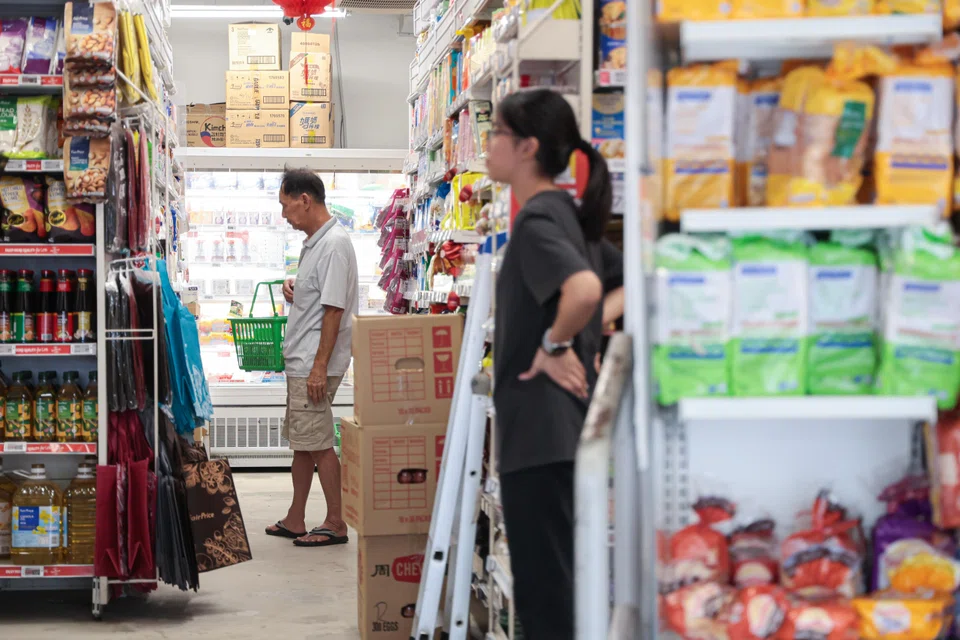
    • Lower inflation was recorded for the majority of categories in January.
    • Lower inflation was recorded for the majority of categories in January. PHOTO: BT FILE

    SOME economists expect another easing of Singapore’s monetary policy in April, after core inflation fell sharply to 0.8 per cent in January, according to Department of Statistics data on Monday (Feb 24).

    Several economists also lowered their inflation forecasts. However, official full-year forecast ranges for both core and headline inflation remained unchanged in a joint release by the Monetary Authority of Singapore (MAS) and the Ministry of Trade and Industry (MTI).

    January’s core inflation, which excludes accommodation and private transport, was significantly below both December’s 1.7 per cent rate and the median forecast of 1.5 per cent by private-sector economists in a Bloomberg poll.

    DBS economist Chua Han Teng noted that the 0.9-percentage-point decline, compared to December, “was a magnitude not seen in years”.

    He attributed this to broad-based moderation and base effects from the fading impact of past goods and services tax (GST) hikes. The GST rate was raised by one percentage point on Jan 1, 2024.

    Headline inflation was 1.2 per cent in January, down from 1.5 per cent in December and lower than economists’ median forecast of 2.4 per cent. Both core and headline inflation were at the lowest rates since 2021.

    Inflation readings for past months were affected by the rebasing of the consumer price index (CPI) for general households, from 2019 to 2024. This is done every five years to reflect resident households’ latest consumption patterns.

    However, OCBC chief economist Selena Ling said this was unlikely to have contributed to the softer January readings. She noted that in the last rebasing across December 2019 and January 2020, core and headline inflation were “relatively stable”.

    On a month-on-month basis, overall CPI fell by 0.7 per cent in January, while core CPI dropped by 0.2 per cent.

    Maybank economists Chua Hak Bin and Brian Lee said the sharp month-on-month fall “was a surprise”, as this was not due to a year-ago base effect from the GST hike. Instead, it was driven by absolute falls in three segments: electricity and gas prices, accommodation and services.

    More easing ahead?

    Economists were mixed on what January’s surprise low means for monetary policy.

    Maybank’s Chua and Lee noted that the sharp fall “reaffirms” their view that MAS will likely ease again, probably at the April meeting.

    MAS’ last policy decision on Jan 24 was for a slight reduction to the slope of the Singapore dollar nominal effective exchange rate (S$NEER) policy band, in the first loosening move since 2020.

    Ling said January’s core inflation may pave the way for more easing in April, possibly through a further flattening of the slope.

    The Maybank economists also lowered their 2025 core inflation forecast to 1.1 per cent, from 1.4 per cent before, and headline inflation forecast to 1.3 per cent, from 1.6 per cent.

    They expect price pressures to remain “benign” for the rest of the year, adding that US tariffs and a broader global trade war “could intensify the deflationary shock by diverting excess capacity and shipments to the rest of the world, including Singapore”.

    UOB associate economist Jester Koh maintained his call for MAS to stay pat for the rest of 2025, but acknowledged that risks have tilted towards further easing “should the core inflation momentum decelerate further”.

    He, too, lowered his core and headline inflation forecasts, with both now at 1.3 per cent, instead of 1.7 per cent before.

    In contrast, RHB associate research analyst Laalitha Raveenthar maintained her forecasts at 1.8 per cent for core inflation and 2.3 per cent for headline inflation.

    She expects MAS to keep policy unchanged in the upcoming quarters, given the “resilient economic backdrop and tame inflation pressures”.

    “With the heightened uncertainties from the external front, we believe a wait-and-see approach may be needed before deciding policy parameters,” she added.

    MAS and MTI maintained their 2025 forecasts for core inflation to average between 1 and 2 per cent, and headline inflation to be between 1.5 and 2.5 per cent. But they added: “The outlook for inflation remains subject to uncertainties in the external environment.”

    Imported inflation is expected to remain moderate, with favourable supply projections for key food commodities and oil prices set to decline. Escalating trade friction could drive inflation elsewhere, but the impact on Singapore’s import prices is likely to be offset by disinflationary drags from weaker global demand.

    On the domestic front, wage rises should be gradual, while enhanced government subsidies will continue to dampen services inflation, they added.

    Key CPI categories

    Lower inflation was recorded for the majority of categories in January.

    Accommodation inflation slowed, with smaller increases in both housing rents as well as housing maintenance and repair costs. So too did services inflation, with falls in the costs of general, vocational and higher education, as well as outpatient and inpatient care services.

    Two categories had negative inflation in January: retail and other goods, as well as electricity and gas.

    But private transport prices bucked the trend, rising 2.8 per cent compared to a 0.9 per cent decline the previous month. This was due to higher car prices.