

MAS holds policy steady in October, expected to continue doing so in 2026
Better-than-forecast growth means ‘no urgency’ to change monetary policy settings, say economists

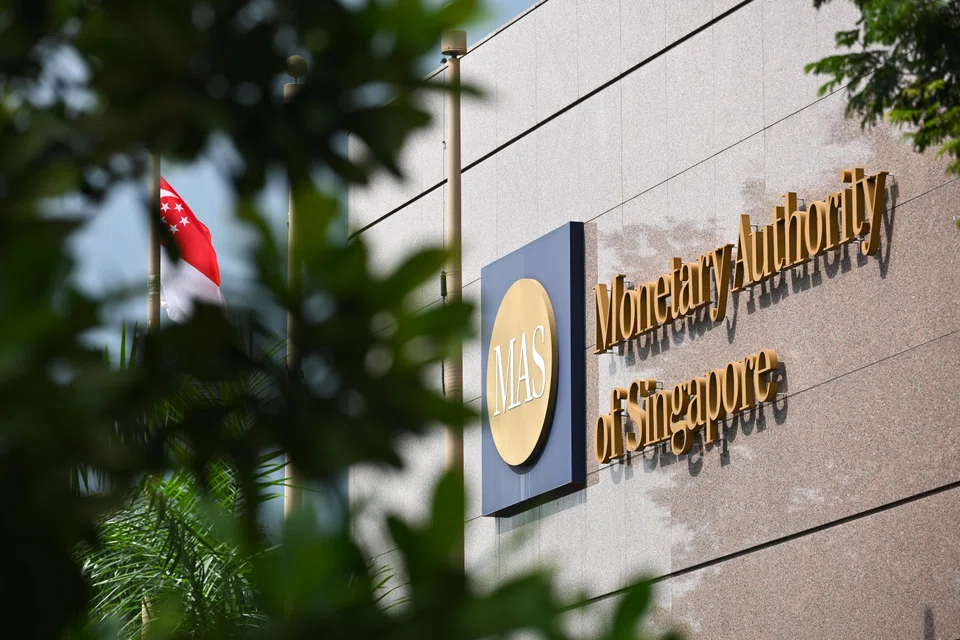
[SINGAPORE] Stronger-than-expected growth may give the Monetary Authority of Singapore (MAS) more policy space going into 2026, said private-sector economists, after the central bank held settings steady for the second consecutive quarter.
An easing of monetary policy in 2026 remains possible but is not widely expected, with most economists expecting no change.
DBS analysts Chua Han Teng and Philip Wee, for instance, “see no urgency” for MAS to adjust its policy stance.
At its quarterly policy meeting on Tuesday (Oct 14), MAS chose to maintain the prevailing rate of appreciation of the Singapore dollar nominal effective exchange rate (S$NEER) policy band, with no change to its width and the level at which it is centred.
This was after it kept settings unchanged in July as well. Prior to that were two consecutive easings in January and April, with the slope of the policy band reduced slightly.
On Tuesday, MAS noted that the S$NEER was close to the top of the policy band in August, but has eased in recent weeks as appreciation pressures ebbed.
Singapore’s economic growth has “turned out stronger than expected”, with the output gap – the difference between real and potential gross domestic product – expected to stay positive through the rest of the year.
But this gap is expected to close in 2026 as growth slows to a “near-trend pace”, said MAS.
As for inflation, the central bank narrowed its full-year 2025 projections. Core inflation is expected at “around 0.5 per cent”, while the headline inflation forecast range was tapered to between 0.5 per cent and 1 per cent.
Both were previously forecast to be between 0.5 per cent and 1.5 per cent for the year – a range which MAS now expects for core and headline inflation in 2026 instead.
It noted that inflation is currently low, driven by falling imported prices and easing domestic unit labour cost growth.
Price increases are also being moderated by soft consumer demand, intensified competition in certain sectors, and enhanced government subsidies for essential services.
Singapore’s core inflation, which excludes accommodation and private transport, eased to 0.3 per cent in August from 0.5 per cent the month before. Headline inflation slowed to 0.5 per cent, compared with 0.6 per cent previously.
Looking ahead, MAS said that core inflation “should trough in the near term and rise gradually over the course of 2026 as temporary factors dampening inflation fade”.
Tuesday’s announcement was in line with economists’ expectations. In a Reuters poll, 10 of 14 economists thought settings would remain unchanged. Similarly, among the 11 polled by The Wall Street Journal, nine thought MAS would keep its settings.
More optimistic
Several economists noted that the central bank struck a more optimistic tone compared to its last meeting in July.
For instance, MAS previously said growth momentum should moderate “while the drags on demand exerted by policy uncertainty intensify”. While the central bank again noted in its latest statement that growth should moderate, it added: “However, the extent of the downturn should be contained.”
Maybank economists Brian Lee and Chua Hak Bin pointed to this as an example of greater optimism.
Similarly, UOB economist Jester Koh saw an emphasis on optimism around growth, as well as a possible hint at “reflationary prospects” heading into 2026.
Previously, he expected MAS to ease in January. Following the latest statement, he now expects policy settings to be maintained in the new year.
He noted that the central bank on Tuesday said it was “in an appropriate position to respond effectively to any risk to medium-term price stability” – it used the word “effectively” in a similar line in its July statement.
Together with MAS’ observation of the S$NEER level staying stable, this suggests a preference to conserve policy space, Koh added.
For 2026, HSBC and Maybank expect monetary policy to be unchanged for the full year, while RHB expects it to stay unchanged for the first half.
Option to ease
In contrast, while Barclays economist Brian Tan notes a “growing risk” of MAS holding policy unchanged into the next year, his base case is for a final slope reduction in April.
HSBC also acknowledged that the slope may be flattened if economic conditions deteriorate more quickly than expected, while the DBS economists see MAS keeping “the option of an insurance easing in 2026”. They highlighted that even though the impact of US tariffs has been “contained”, downside risks remain.
These include contentious US-China trade relations and US tariffs on semiconductors and pharmaceuticals, which “keep alive the risk of a sharper-than-expected slowdown in the world economy”.
OCBC chief economist Selena Ling likewise noted that Singapore’s economy is “currently in a good place”, but supply shocks – particularly from geopolitical developments – could raise import and shipping costs.
Conversely, if global growth proves more hesitant and falls short of projections, core inflation may remain subdued for longer.
“This suggests that policymakers are essentially data-dependent, without a preset policy path,” she said. In that context, each monetary policy statement review is “live” and further policy easing in 2026 cannot be ruled out.
TRENDING NOW

Britain’s mansion tax shows the difficulty of targeting wealth

Once staunchly pro-China, Malaysian Chinese businesses are now distancing themselves from Beijing

The only common thing in S-E Asia is that we all eat rice: Cisco’s Asean president

Singapore data centre operator DayOne opts for US IPO at likely US$20 billion valuation

