Companies, investors must continue adapting to megatrends amid pandemic
Top CEOs say businesses should test boundaries if they are to stay ahead of trends such as climate change, urbanisation, the rise of Asia's middle class, and the growth of Asia as a global economic powerhouse.
 Add BT as a preferred source
DeeperDive is a beta AI feature. Refer to full articles for the facts.
CLIMATE change, urbanisation and the rise of Asian economies - these are powerful, transformative trends that are expected to impact the way we do business. These megatrends are not receding amid the Covid-19 pandemic, but are in fact accelerating. And with these trends come implications for companies operating in many sectors.
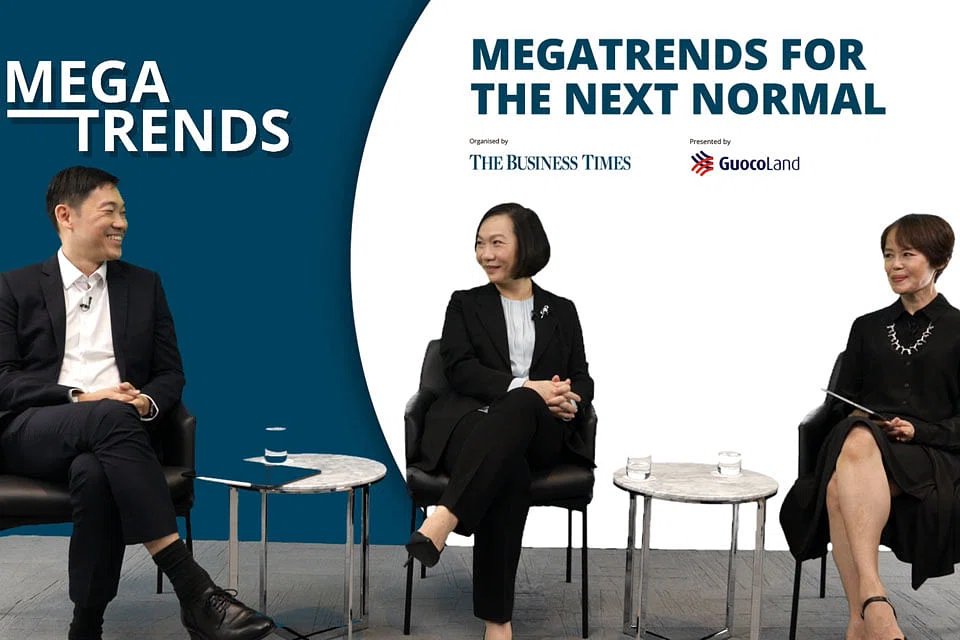
Those were the thoughts of GuocoLand's chief executive Cheng Hsing Yao and OCBC's chief executive Helen Wong at a webinar titled "Megatrends for the Next Normal", held on Wednesday morning.
The event is the first in a series on megatrends organised by The Business Timeswith property developer GuocoLand as the presenting sponsor. The session was moderated by Genevieve Cua, wealth editor at BT, and hosted at Guoco Tower.
Mr Cheng pointed out, for instance, that the Covid-19 pandemic has taught people to be more aware of "intangibles" such as relationships and their personal well-being. Such "qualitative aspects" will also be reflected in their consumption, he added, and will drive them to consume more responsibly.
Added Ms Wong: "The pandemic has created an environment where people want to think about the future, a lot more."
Indeed, the pandemic has made it more pressing for companies to think about the challenges and opportunities that megatrends present. "Even as we speak, the short-term changes brought about by the pandemic will disrupt us in the long term, in how we work, play, and live," said BT editor Wong Wei Kong. "The Business Times, together with GuocoLand, is pleased to bring you a series of discussions around these very important issues."
Navigate Asia in
a new global order
Get the insights delivered to your inbox.
Climate change
Singapore companies would not be strangers to the megatrend of climate change. The Singapore Green Plan 2030 charts the Republic's green targets over the next decade and spells out certain priorities, such as solar energy deployment, cleaner transport and green buildings.
Green buildings are increasingly a necessity for developers such as GuocoLand to attract tenants and investors, Mr Cheng said.
But he noted that he is also looking beyond practices such as green building certification. For instance, GuocoLand is eyeing ways to introduce more floral biodiversity in its buildings and to ensure its buildings fit in with their surrounding environments.
"Going forward, we will perhaps pay more attention to things like data carbon, (and) look at the construction process to see how it can be more resource efficient," he added.
"I think it has to be a more holistic approach. So that's why when we build and develop, we always try to think about what we are bringing to the neighbourhood and whether our development actually enhances the urban environment."
From the perspective of a financier of buildings, Ms Wong noted that issuers and borrowers today have a better understanding of what it takes to be qualified, and international standards are clearer. More investors are also wanting to buy into green assets. And companies that are greening up their operations would also "want the financing to be classified as green", she said.
OCBC, as a bank, sits at the intersection of supply and demand for green financing, and is doing more of such business. Last year it completed more than 30 sustainability-linked transactions across different industries.
"As banks we are catalysts to influence the change in going green," Ms Wong added.
Urbanisation
Somewhat linked to the megatrend of climate change is the megatrend of urbanisation, which is now being influenced by environmental and social pressures.
Urban buildings are major producers of carbon emissions. But Mr Cheng said that it is important to consider more than just carbon emissions in operations.
The sector should instead take a "full cycle approach" incorporating sustainability considerations from the design process, through to construction and then into operation.
Better buildings will also be more than just green buildings, according to him.
GuocoLand is currently running a test-bedding programme with 20 technology startups to test various building technologies. These include air monitoring systems, building inspection systems and even the use of robotics for cleaning.
"The investment into green buildings or intelligent buildings has multiple benefits beyond the environment," said Mr Cheng. These include productivity and cost efficiency.
Mr Cheng also cautioned against a knee-jerk reaction to the pandemic in the planning of residential and commercial spaces. Although more people are working from home, this does not mean there will not be a need for offices or that homes must be bigger to accommodate home work. "What is more important is how spaces are designed to be adaptable for living, working and entertaining," he said.
Added Ms Wong: "You still need to meet physically, still have that opportunity to come back to the office, and to brainstorm, to innovate, to meet with more people."
Buildings, therefore, should be designed to facilitate innovation and discussions.
Mr Cheng explained that offices would need to be more attractive as places to work. "You want to have the best quality possible," he said.
At Guoco Tower, for instance, air filters and ultraviolet germicidal irradiation combine to ensure high quality air even indoors.
Asia as an economic powerhouse
Asia is the "growth engine of the world" and Singapore is an important hub for trade flows within and out of Asia, said Ms Wong. Part of Asia's rapid growth as the world's economic powerhouse comes from increasing trade flows within Asia, a megatrend with some important reverberations.
For instance, Ms Wong noted that a rise in trade flows is accompanied by a rise in the documentation needed to support such trade. "The documentation involved in trade is actually very tedious," she said.
Technology can help, she added, pointing to the Singapore Trade Data Exchange (SGTradDex), which brings together financial institutions, buyers, sellers and movers of goods on a single platform. Ms Wong said that SGTraDex has the potential to help prevent fraud.
Another outcome of Asia's economic rise is that Singapore is gaining in importance as a hub for the region. This hub status can bring great economic benefits, but has to be handled carefully to ensure such benefits are felt by all the country's residents.
As Singapore capitalises on hub opportunities, talent is an important factor for the nation to keep its competitive edge. Mr Cheng said that Singapore's small size and limited workforce make it necessary to remain open to international talent.
Ms Wong, too, pointed out that hubs have a "natural tendency" to attract talent, which can actually make Singapore stronger.
Asia's economic growth could also widen the wealth gap, said Mr Cheng. He is, nevertheless, optimistic about Singapore's ability to surmount the challenges posed by inequality. "I think if across all the strata of the society we carry that streak that we always do our part, no matter how big or small, within the company or individually, to contribute towards helping the ones who are less advantaged than us, I think that quality in addition to all the government policies will be very useful."
Rise of Asia's middle class
A parallel megatrend to Asia's economic growth is the emergence of a large Asian middle class with greater spending power.
But Mr Cheng noted that Asia's middle class will likely be thinking about more than just conspicuous consumption. "In a way, what they buy - whether it's properties or products - is also a kind of a representation of their personal value systems and their identity," he said, adding that he sees greater emphasis being placed on meaningful or purposeful acquisition.
According to Ms Wong, the pandemic has changed investment priorities. Many investors are actively looking for investments in an environment with low interest rates and high levels of liquidity, as governments pump money into economies. "That actually paves a way for people to understand a lot more about investing and about managing wealth, so I see that trend continuing."
As companies think about how best to manoeuvre these various megatrends amid a pandemic, Ms Wong said that it will be important for both managers and employees to emphasise agility and adaptability. Those who are agile enough to manage change and open enough to embrace change will emerge as winners.
Mr Cheng added that it will also be important to show resilience through various disruptions. "This probably will not be the last major disruption."

Decoding Asia newsletter: your guide to navigating Asia in a new global order. Sign up here to get Decoding Asia newsletter. Delivered to your inbox. Free.
Copyright SPH Media. All rights reserved.