

More companies intensifying overseas expansion efforts after ‘better-than-expected’ 2025: panel
Singapore SMEs should also look into making sustainability a core part of their strategy as it helps with saving costs


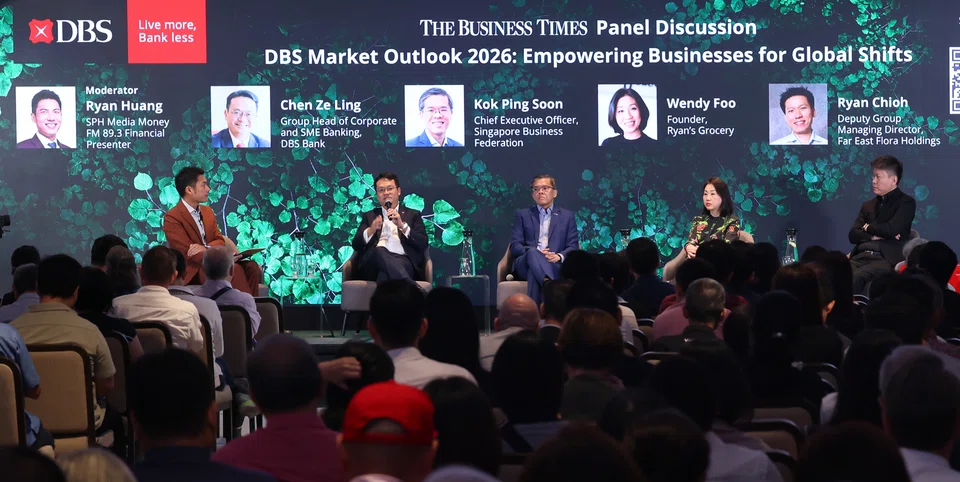
[SINGAPORE] A rebound in confidence, supported by stronger growth data and easing trade fears, has prompted more businesses to consider overseas expansion, even as they navigate persistent cost pressures and geopolitical fragility, said a panel discussion at the DBS Market Outlook 2026 event on Dec 4.
While the intent to expand overseas has always been there, DBS group head of corporate and small and medium-sized enterprise (SME) banking Chen Ze Ling said companies now see the need to build a resilient supply chain and customer base.
“The whole idea of diversification to mitigate risk and to seek more markets has become really at the front of everyone’s considerations,” said Chen, who is also a managing director at the bank.
This was also reflected in the Singapore Business Federation’s (SBF) National Business Survey 2025, released in November.
Overseas expansion was among the top three things businesses wanted to do more of in the next 12 months, alongside business process re-engineering and supply chain diversification.
“These additional steps that companies want to do give us certain confidence. It reflects the reordering and restructuring that’s ongoing, and I think it demonstrates a certain sense of resilience… that companies have the ability to adapt and move forward,” said SBF chief executive Kok Ping Soon.
'%3e%3cpath%20d='M12.1475%2025.5262C13.7713%2025.4295%2014.94%2023.913%2014.94%2021.8832C14.94%2019.5359%2013.474%2018.093%2011.5917%2018.093C11.3745%2018.093%2010.9582%2018.093%2010.8393%2018.1413V25.2086L11.8891%2025.5745C11.8891%2025.5745%2012.207%2025.5262%2012.1475%2025.5262ZM11.4934%2017.6281C13.2567%2017.6281%2014.3843%2016.4292%2014.3843%2014.4501C14.3843%2012.372%2013.275%2011.2973%2011.4339%2011.2973H10.8393V17.6305H11.4934V17.6281ZM6.66078%2025.6482L7.39265%2025.5492C8.02617%2025.4502%208.26403%2025.3053%208.26403%2025.1097V11.6149C8.26403%2011.4193%208.1451%2011.3709%207.23484%2011.249L6.68137%2011.173L6.6219%2010.7588H11.9508C15.7153%2010.7588%2017.0624%2012.0797%2017.0624%2014.1578C17.0624%2015.9666%2015.7748%2017.1909%2013.4969%2017.6305V17.7041C16.111%2017.948%2017.6571%2019.5382%2017.6571%2021.7636C17.6571%2024.3318%2015.8937%2026.0417%2012.1109%2026.0417H6.60132L6.66078%2025.6482Z'%20fill='%232B2B2B'/%3e%3cpath%20d='M20.6287%2025.6505L21.5596%2025.5515C22.1725%2025.4779%2022.4104%2025.3076%2022.4104%2025.112V11.249H21.9346C20.073%2011.3479%2018.982%2013.0095%2018.408%2014.6227L18.1907%2015.5018H17.6555L18.1701%2010.7588H29.3837L29.6421%2015.4787H29.1664L28.9491%2014.6227C28.3728%2012.8645%2027.3047%2011.2743%2025.5002%2011.249H24.9856V25.1856C24.9856%2025.3812%2025.1251%2025.4548%2025.9965%2025.5515L26.7695%2025.6505L26.829%2026.0417H20.5693L20.6287%2025.6505Z'%20fill='%232B2B2B'/%3e%3c/g%3e%3cdefs%3e%3cclipPath%20id='clip0_5242_21648'%3e%3crect%20width='24'%20height='16.8'%20fill='white'%20transform='translate(6%2010)'/%3e%3c/clipPath%3e%3c/defs%3e%3c/svg%3e)
Fellow panellist and founder of Ryan’s Grocery Wendy Foo said she hopes to bring her business overseas in 2026. Her company expanded to Vietnam in 2019, but closed its stores there the following year due to the Covid-19 pandemic.
“It’s time we really look into the market,” she said. “After Covid, we are more stabilised in terms of supply and everything, so we thought next year will be the year.”
Also on the panel was Ryan Chioh, deputy group managing director of Far East Flora, who said his company’s first overseas venture to Hong Kong “didn’t do well” due to different cultural norms and a population that was not as “Internet-savvy”.
In 2010, Far East Flora entered Malaysia and was “quite successful”, he added, with the market growing and the company pumping in further investment.
He said what determines market viability comes down to market size, access to capital and human capital, among other key factors.
Chen said there are two ways DBS helps its customers move into a new market: by providing banking services and being a “partner” through the Bridging Business Horizons programme that it is offering in partnership with SBF, supported by Enterprise Singapore.
Kok added that SBF is also stepping up its overseas missions as it plans to carry out more than 20 trips to different parts of the world.
Chen also said that there are different models that companies can explore when heading overseas.
“Instead of operating in (other countries), you can think about trading with (them), you can think about having partners, you can talk about franchisee models,” he said, adding that there are different levels of commitment depending on one’s value proposition.
Better year than expected
Panellists agreed that 2025 has turned out better than they had anticipated, with the doomsday scenario they had braced for soon after “Liberation Day” not materialising.
This is as Singapore authorities upgraded their 2025 full-year gross domestic product forecast to “around 4 per cent”, from an August projection of 1.5 to 2.5 per cent. In April, they slashed their forecast to zero to 2 per cent.
SBF’s Kok said the optimism was driven by the front-loading of production and shipping before the US tariffs hit. Yet, cautious sentiment continues to linger, panellists pointed out.
Kok said there are three considerations. The front-loading effect will eventually dissipate, while the US-China trade truce remains unstable and sectoral tariffs stay uncertain.
Thirdly, regardless of tariffs, the underlying cost structure in Singapore has not changed, with businesses continuing to grapple with manpower, rental and utilities.
This year, cybersecurity has also emerged as a major concern, likely a result of increased scams.
He noted that SBF’s survey showed that 37 per cent of businesses believe the city-state’s economy in the next 12 months will worsen, compared to 14 per cent who believe it will improve.
But there are also signs of confidence, he said.
Following “Liberation Day”, four in five businesses said they expect a negative impact from US tariffs on their business. In a follow-up survey a few weeks ago, just three in five said the same.
At the same time, 40 per cent of respondents said there is no impact on their business, up from 14 per cent in the earlier survey, Kok noted, adding that this, too, is a sign of confidence.
Why SMEs can’t afford to ignore sustainability
Beyond the discussion on business expansion and sentiments, the hour-long panel also delved into broader themes such as technology adoption, the importance of collaboration, and sustainability in business.
On sustainability, Kok noted that Singapore SMEs are “lagging far behind” their global peers, and even large local companies, in adopting greener practices.
“The reasons are all the same: no time, no money, no talent,” he said.
Still, he outlined three practical reasons why SMEs should make sustainability a core part of their strategy, stating that “it’s not just good for the environment, it helps you save costs”.
First, large producers and buyers are increasingly imposing sustainability requirements on their supply chains, putting firms that fail to meet these standards at risk of being excluded.
Second, with the carbon tax set to rise from S$25 to S$45 per tonne of carbon dioxide equivalent next year, electricity prices are expected to increase.
Kok noted that while a four-room household may see an estimated S$8 uptick in its monthly bill, SMEs – which typically consume far more energy – can expect a much larger impact, making it in their interest to keep energy use in check.
Third, Kok said both consumers and prospective employees increasingly expect the companies they buy from, and work for, to be more sustainability-minded.
For Foo, sustainability is central to the Ryan’s Grocery’s brand, though she acknowledged that staying committed to it can be difficult for an SME.
The business insists on sourcing from regenerative, carbon-neutral farms – a choice that carries a premium, including the cost of buying carbon credits.
Locally, it tries to minimise waste by using butcher paper instead of plastic packaging, though this is more labour-intensive and customers sometimes prefer the convenience of vacuum packs.
Foo added that high operating costs, from manpower to electricity and logistics, make these choices harder to maintain, and the business has had to streamline storage and encourage larger delivery orders to keep operations viable.
Still, she said the company is working to “educate customers” and show that “every little bit of compromise” – from both the business and consumers – helps support its sustainability efforts.
Picking up on the challenges faced by SMEs, DBS’ Chen stressed that business owners do not need to navigate the sustainability journey alone.
He pointed to the bank’s ESG Ready programme as an example of how companies can be guided step by step regardless of their starting point.
The initiative takes a milestone-based approach, he said, with dedicated managers working one-on-one with firms to understand their objectives and identify suitable partners, solutions and training.
“We encourage everyone to be on the journey (to become sustainable), because Singapore is steering towards (a low-carbon future), consumers are changing domestically, and global supply chains are also making the shift,” said Chen.
Brought to you by:

Decoding Asia newsletter: your guide to navigating Asia in a new global order. Sign up here to get Decoding Asia newsletter. Delivered to your inbox. Free.
Copyright SPH Media. All rights reserved.
TRENDING NOW

Once staunchly pro-China, Malaysian Chinese businesses are now distancing themselves from Beijing

Britain’s mansion tax shows the difficulty of targeting wealth
Three hats, one goal: How Ng Kian Swan runs sustainability at NUHS
COE review: The gap between luxury and mass-market cars isn’t the only one worth bridging

