More monetary policy tightening moves on the cards this year, but economists split on July vs October decision
April’s revisions seen as pre-emptive; inflation pass-through from Iran war yet to show up in data

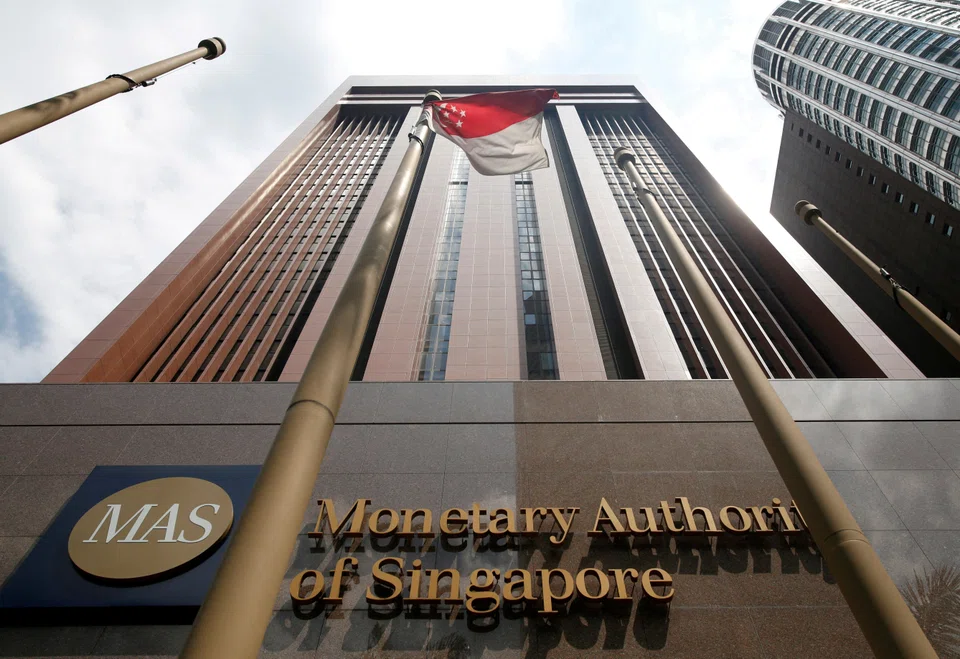
[SINGAPORE] With inflation risks from the Iran war oil shock still building, economists expect the Monetary Authority of Singapore (MAS) to tighten monetary policy further this year – though analysts are divided on whether the central bank will act as soon as July or wait until October.
This came after MAS on Tuesday (Apr 14) steepened the slope of the Singapore dollar nominal effective exchange rate policy band while keeping its width and centre unchanged.
The central bank also raised its core and headline inflation forecasts to 1.5 to 2.5 per cent for 2026, from 1 to 2 per cent previously.
Several economists described the move as pre-emptive, given that the March inflation data – the first to capture the impact of the Middle East energy shock – has not yet been released.
MAS’ decision amounts to a “policy normalisation”, as it reverses the slope reductions made in January and April 2025, said DBS senior economist Chua Han Teng.
But MAS stopped short of more aggressive action as it would want to maintain policy flexibility, given the considerable risks posed to both inflation and growth from the oil crisis, he added.
UOB associate economist Jester Koh noted that price indicators, such as core inflation and the import price index, remain below the levels seen ahead of the off-cycle tightening in January 2022, when MAS last raised the slope by a similar magnitude.
“This consideration is compounded by the need to guard against looming imported inflation risks, with price increases already reported across several energy-related items domestically, including petrol, point-to-point transport services, electricity and gas tariffs, and airfares,” Koh said.
July or October?
Maybank economists Chua Hak Bin and Brian Lee said they see “higher than even odds” of another 50-basis-point (bps) steepening in July.
They argued that the Middle East conflict will have a disproportionately larger impact on inflation than on growth, with price pressures likely to overshoot in the second and third quarters.
The global artificial intelligence capital expenditure tailwind that has driven Singapore’s recent growth remains intact, while fiscal support – including an additional S$1 billion package and ample firepower from the estimated FY2026 Budget surplus of S$8.5 billion – will help cushion the growth drag, they said.
UOB’s Koh expects MAS to tighten further at the October review via another 50-bps steepening to 1.5 per cent per annum, but said the move could be brought forward to July.
In his view, more aggressive measures such as an upward recentring of the policy band would likely be reactive rather than pre-emptive. It could come into consideration only if the central bank makes a “confident, data-driven assessment” that full-year core inflation could meaningfully exceed 2.5 per cent.
Jeff Ng, head of Asia macro strategy at Sumitomo Mitsui Banking Corporation, also expects further tightening in July or October, either via a further slope increase or a recentring of the band to its prevailing level.
Other economists believe any further tightening moves will come only in October.
HSBC analysts Yun Liu and Joey Chew said MAS does not sound “overly hawkish” as it is exercising caution over a more downbeat growth assessment. They expect the central bank to take time to assess the impact of the current tightening before acting again.
The next steps will depend on whether inflation expectations broaden beyond imported goods, whether global financial conditions tighten further, and whether AI-related investment is negatively affected, Liu said.
Standard Chartered chief economist Edward Lee expects MAS to remain on hold in July, though the balance of risks remains tilted towards further tightening. He said the key consideration would be how persistent and pervasive the oil price shock proves to be.
RHB economists Barnabas Gan and Laalitha Raveenthar similarly expect settings to remain unchanged in July, with the balance of risk tilted towards further tightening later in the year if Middle East tensions continue to drive up energy prices.
Bank of America analysts Ang Kai Wei and Abhay Gupta, who previously expected MAS to tighten again in July, revised their call to a pause.
They said MAS appeared inclined to proceed one step at a time amid two-sided risks to both inflation and growth, and that the bar for further tightening was now higher than previously thought.
Ang and Gupta also believe MAS views the risks to its growth outlook as more significant than those to inflation at this stage, which could in turn lead to the output gap turning negative at some point.
Triggers that could prompt another move include signs that core inflation may stay above 2 per cent into the second half of 2027, or that demand-pull pressures are stronger and broader than anticipated, the analysts said.
Growth and inflation
MAS said Singapore’s imported prices of crude oil, natural gas and fuel have risen sharply and will directly add to electricity and gas as well as transport-related consumer price inflation in the months ahead.
Even if supplies from the Middle East are restored, global energy prices are likely to remain elevated for some time, the central bank warned. It noted that deliveries will be lagged, supply will take time to recover fully, and governments seeking to rebuild energy reserves will add to pent-up demand.
“As higher energy costs pass through supply chains worldwide, a broader range of Singapore’s import costs will increase,” MAS said.
The central bank also flagged significant uncertainty around the outlook for shipping flows through the Strait of Hormuz.
It noted that accumulated energy supply shortfalls and higher input costs will continue to weigh on the Singapore economy, dragging on energy-dependent industries such as petrochemicals and transport.
HSBC’s Liu expects core inflation to rise more meaningfully in H2 2026, and forecasts it will average around 1.8 per cent for the year, while Maybank sees core inflation at 1.9 per cent – all at or above the midpoint of MAS’ new forecast range.
These uncertainties are likely to weigh on growth as well. MAS said gross domestic product growth in 2026 is likely to step down from the above-trend pace recorded in 2025, with the positive output gap narrowing.
Advance estimates from the Ministry of Trade and Industry showed that the economy expanded 4.6 per cent year on year in the first quarter, though it contracted 0.3 per cent on a quarter-on-quarter seasonally adjusted basis.
An update to the earlier GDP forecast of 2 to 4 per cent will be provided in May.
MAS – which uses the exchange rate rather than interest rates as its main policy tool – has held its settings steady since July last year, after two consecutive easings in January and April 2025. At its last policy meeting in January, the central bank flagged that geopolitical developments could pose upside risks to inflation.
Oil prices have surged about 40 per cent since the US-Israeli military strikes on Iran began on Feb 28, and the subsequent effective closure of the Strait of Hormuz. Brent crude was back above US$100 a barrel on Sunday, after US President Donald Trump threatened a naval blockade of Iranian ports, before retreating to about US$98 a barrel during Asian trading hours on Tuesday.