

More workers in Singapore opt for jobs for which they are overqualified: MOM, NTUC studies
Workers take up jobs that do not fully use their qualifications for reasons such as stability, flexible hours

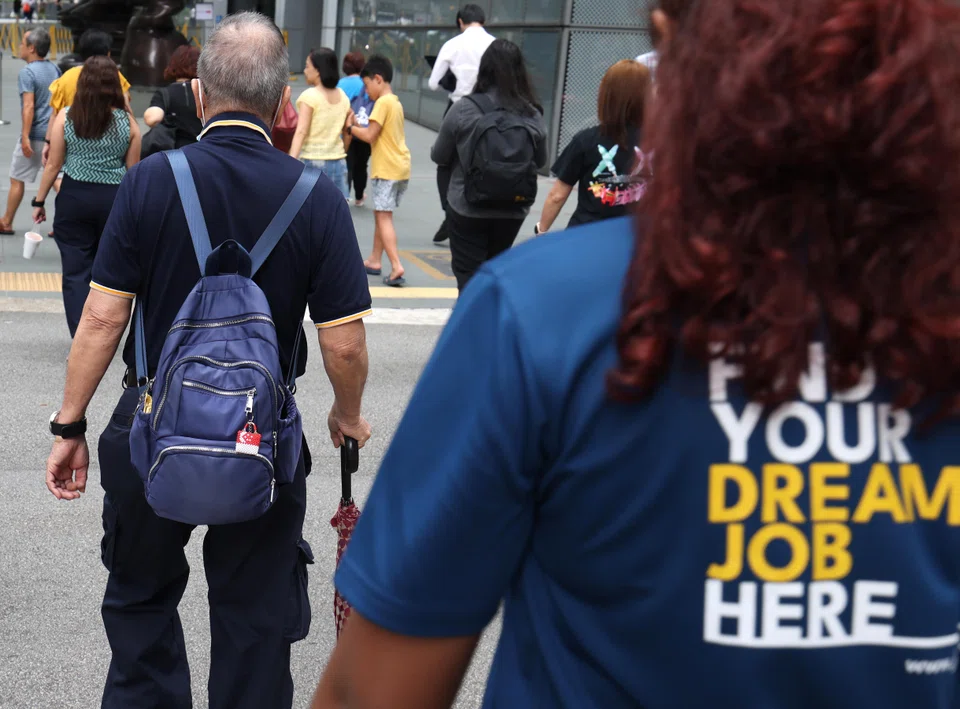
[SINGAPORE] A rising share of workers in Singapore are overqualified for their jobs, but the vast majority are in such roles by choice, according to two studies released on Tuesday (Apr 14) by the Ministry of Manpower (MOM) and the National Trades Union Congress (NTUC).
Overqualification, or qualification-related underemployment, is when a worker has a higher educational qualification than what is needed for the job.
In 2025, 19.4 per cent of resident workers in Singapore were overqualified, up from 16.3 per cent in 2015.
But about nine in 10 of them were voluntarily in such roles. Overall, only 1.7 per cent of workers were involuntarily overqualified.
Involuntary overqualification has been “low and stable” at below 3 per cent over the last decade, “suggesting limited structural mismatch in the labour market”, said MOM.
Across age groups, those aged below 30 accounted for the largest share of overqualification: 21.3 per cent of the involuntarily overqualified and 17.6 per cent of those voluntarily so.
Of this age group, 29.7 per cent were overqualified. Younger workers who are involuntarily qualified are “likely still building the experience for more desirable higher-level positions”, said MOM.
“However, as they age and accumulate experience, they eventually move into jobs which match their qualifications,” the ministry added, noting that the incidence of overqualification falls to 21.1 per cent for those in their 30s.
The MOM study draws on data from the annual Comprehensive Labour Force Survey. The measure of overqualification, developed with the International Labour Organization, compares a worker’s education level with that typically required for their occupation.
SEE ALSO




For instance, managerial and professional jobs are mapped to university degrees; degree holders are thus considered overqualified if they are not in such jobs.
Underemployed by choice
Overqualification is more common in high-income countries with higher levels of educational attainment. Nonetheless, Singapore’s overqualification rate of 19.4 per cent is below the 21.6 per cent average for high-income countries.
This is even though tertiary-educated workers make up a higher share of Singapore’s workforce, at 64 per cent compared with the 41.2 per cent average for high-income countries.
With 64.2 per cent of jobs in Singapore needing higher education, overqualification “is unlikely to be due to the lack of suitable well-matched jobs by education”, said MOM.
Rather, most overqualification is voluntary, accounting for 17.7 percentage points of the 19.4 per cent who are overqualified.
The top reasons cited for voluntary overqualification were job stability (31.1 per cent), the ability to use their skills (25.3 per cent), interesting work (24.4 per cent) and pay meeting expectations (16 per cent).
These were followed by suitable working hours (15.4 per cent) and flexible schedules (14.3 per cent). Highlighting these two reasons, MOM noted: “These workers may potentially be matched to roles that better align with their qualifications if more flexible work arrangements were available.”
The ministry also flagged the possibility that some workers are unaware of roles that would better match both their qualifications and career preferences.
Education and skills
While MOM’s study focused on qualification-related underemployment, NTUC also looked at two other forms: underemployment when a job does not fully use a worker’s skills, and when a worker is in a job outside their field of education.
In contrast to the MOM study, which looked at objective differences between occupation and education, the NTUC study relied mainly on self-assessment. It surveyed 1,100 citizens and permanent residents in October 2025.
Among employed respondents, the most common form of underemployment was being employed outside one’s field of study, with 31.4 per cent reporting this.
Self-assessed qualification-job mismatch was reported by 23 per cent; skills-job mismatch by 22.5 per cent; and qualification-occupation mismatch, which is similar to MOM’s measure, by 20.3 per cent.
Similarly, the vast majority were underemployed by choice, at 85.5 per cent.
Patrick Tay, NTUC assistant secretary-general, said: “Many workers are making deliberate career decisions that prioritise flexibility, fulfilment or life-stage needs. This reflects a labour market that offers diverse pathways rather than one that is structurally misaligned.”
Skills gaps
The MOM study also looked at the employer perspective. For 79.6 per cent of vacancies in 2025, academic qualifications were not the main hiring consideration.
This suggests that qualification mismatch does not directly mean a worker will be disadvantaged in the hiring process, said the ministry.
However, 24.3 per cent of employers reported a gap between employees’ skills and what the job requires.
In a joint press release on the surveys, MOM and NTUC noted this difference in perspective, saying: “While a segment of workers report being in roles that do not fully utilise their qualifications, employers continue to face challenges filling roles requiring specific skills.
“This suggests the key issue is not excess qualifications per se, but ensuring that workers’ skill sets remain aligned with evolving job requirements.”
Decoding Asia newsletter: your guide to navigating Asia in a new global order. Sign up here to get Decoding Asia newsletter. Delivered to your inbox. Free.
Copyright SPH Media. All rights reserved.






