

Is Singapore’s unemployment rate in a ‘Goldilocks’ state?
In economic terms, frictional unemployment and some labour turnover are necessary for a dynamic market, say economists.
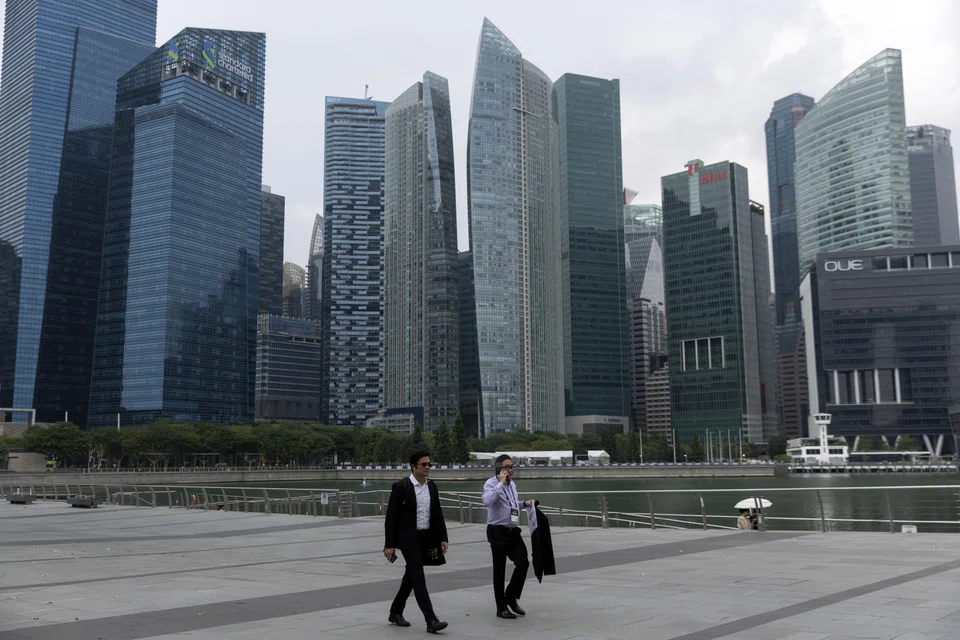
ROBUST job creation has stoked inflation fears in the United States, while China is plagued by hordes of young people out of work. In contrast, Singapore has maintained an unemployment rate that, as Maybank economist Brian Lee noted, “remains near an eight-year low”.
Is Singapore’s unemployment rate in a “Goldilocks” state, neither too little nor too much?
“The tight labour market stems from factors such as a pandemic-induced shortage of foreign workers and last year’s ‘Great Resignation’ phenomenon,” he told The Business Times.
“That said, labour market tightness has been easing gradually with the return of more foreign workers and cooling labour demand.”
For now, Singapore’s job market seems in good shape, although watchers warn that a low unemployment rate is not the be-all and end-all for a healthy economy.
The unemployment rate reflects the share of those who are not working but are actively looking and available for work, out of the labour force as a whole. Singapore’s seasonally adjusted overall unemployment rate stood at 1.9 per cent in June, while resident unemployment was 2.7 per cent.
Terence Ho, associate professor at the National University of Singapore’s Lee Kuan Yew School of Public Policy, said that Singapore’s unemployment rate is relatively low by global standards.
This is due to factors such as “robust job creation in a well-diversified economy”, job matching and retraining schemes, and wage subsidy incentives to hire older and disabled workers.
Full employment
Prof Ho, who was previously manpower planning and policy division director at the Ministry of Manpower, described full employment as “the sweet spot where labour resources are fully utilised – although it is not “zero unemployment”, since there will always be workers between jobs.
“What constitutes full employment may vary from country to country depending on the profile of the workforce, employment laws and institutions,” he explained.
Across the Pacific, the US economy is grappling with a mismatch between industrial hunger for manpower, and workers’ reluctance to take on certain roles.
The US added some 336,000 non-farm jobs in September, even as the unemployment rate stayed flat at 3.8 per cent, according to seasonally adjusted data. The persistent demand for workers has been seen as putting upward pressure on wages – a notable source of sticky inflation prints.
Watchers told BT that the US job growth comes on the back of unemployment levels that have been consistently lower than the non-accelerating inflation rate of unemployment, which is also known as the “non-cyclical” or “natural rate” of unemployment.
“By this measure, the labour market has been running hot since late 2021,” said Lee. “The phenomenon of ‘not enough’ unemployment in the US arises from a labour supply issue; millions of Americans have chosen not to return to work after the pandemic, either because of early retirement, poor health or the need to care for children or other family members.”
Prof Ho added: “In a labour market that is persistently too tight, businesses may not be able to find the manpower they need and investment could suffer. There could also be inefficiency or lower productivity as businesses may be forced to hire less skilled or productive workers.”
Unlike the US, however, Singapore’s job market is distinguished by a relatively hefty share of foreign workers, at about one-third of the labour force.
In contrast, just 18.1 per cent of the US workforce in 2022 was foreign-born, including immigrants. OCBC chief economist Selena Ling called this group of workers a “relief valve” for Singapore, “given our ageing population”.
“The way that the Singapore labour market policy operates is that non-residents are meant to take the brunt of labour market adjustments, both upwards and downwards,” said labour watcher Walter Theseira, associate professor of economics at the Singapore University of Social Sciences.
“We simply have very little capacity to provide additional manpower from residents, and we also want to protect residents first in a downturn. Hence, our resident employment is more stable than actual overall employment would be.”
‘Funemployment’
The Straits Times recently reported that “a new generation of Singaporeans says unemployment can be fun”, as white-collar 20-somethings take to embracing “funemployment”.
But, calling such joblessness “only fun if it’s for a period of time and is the equivalent of a career break or sabbatical”, OCBC’s Ling noted that “the implied assumption is that these Gen Zs can return to the workforce when they choose to”.
“In economic terms, frictional unemployment and some labour turnover is necessary for a dynamic market. But structural unemployment, whether due to skills obsolescence or labour mismatches, is of greater concern to policymakers,” she added.
Prof Ho observed that youth unemployment is generally much higher than overall unemployment, since younger workers typically spend more time on job hunts and also job-hop more often.
“Countries with a relatively young workforce profile may tend to have higher unemployment rates,” he said. “However, very high youth unemployment as experienced in parts of Europe and China is a concern as it could indicate that job creation is inadequate.”
Indeed, China has shown that high unemployment can be a warning sign for the economy.
While overall urban unemployment was 5.2 per cent, the youth unemployment rate hit 21.3 per cent in June – the last month that official numbers were made available for those aged 16 to 24.
Peking University economics professor Zhang Dandan suggested in an article for Caixin in July that the true youth unemployment rate could be as high as 46.5 per cent, if young people who are not actively seeking work are included in the headcount.
“China’s rising youth unemployment is not by choice, but due to the weaker economic growth,” said Ling. Analysts have been trimming their outlook for Chinese growth this year.
New Zealand-based academic Christian Yao wrote in The Conversation on Oct 8 that youth unemployment in China “is particularly alarming” and a “crisis”. If left unchecked, the joblessness could lead to social unrest and mental health challenges, he said.
Too little unemployment?
Still, the low unemployment rate in Singapore is not the end of the story.
“Singapore likely has too much of the problem of low unemployment because workers find themselves needing to take marginal jobs to make ends meet,” said Prof Theseira.
“We also have a significant group of workers, such as experienced professionals, managers, executives and technicians, who (are) unable to secure good jobs and find themselves underemployed or out of the labour force.”
People who are not actively looking for work are not counted in the unemployment rate, while Singapore’s underemployment rate measures only part-timers who want to take on more work.
And there are other indicators of economic health, with Prof Ho pointing to readings such as job vacancies; the retrenchment rate; the employment rate, which can reveal economically inactive adults; and the long-term unemployment rate, a proxy for structural unemployment.
He also cited the need to keep an eye on wage growth, both at the median level and for lower-income groups such as the 20th percentile of workers.
Deputy Prime Minister Lawrence Wong last month announced that Singapore may introduce “appropriately sized” benefits for retrenched workers, despite the government’s long-time wariness about unintentionally discouraging the jobless from working.
Prof Theseira, who has mooted schemes such as automatic unemployment insurance, told BT that unemployment support policy will have to address goals such as “income support for the worst hit to allow them the flexibility to reskill and find better work”, as well as measures “for higher skilled workers to explore new opportunities or return to the labour force”.
TRENDING NOW

MAS allocates S$1.45 billion to five asset managers in third EQDP batch: Chee Hong Tat

‘My grandfather’s legacy’: Sherman Kwek lays out three-year plan for CDL to drive returns

He built the Vingroup empire. Now South-east Asia’s richest man is handing some key roles to his sons
‘How many will survive?’: Bubble fears arise as China’s humanoid robotics face reality check

