No place for populism and political opportunism in Singapore: DPM Wong
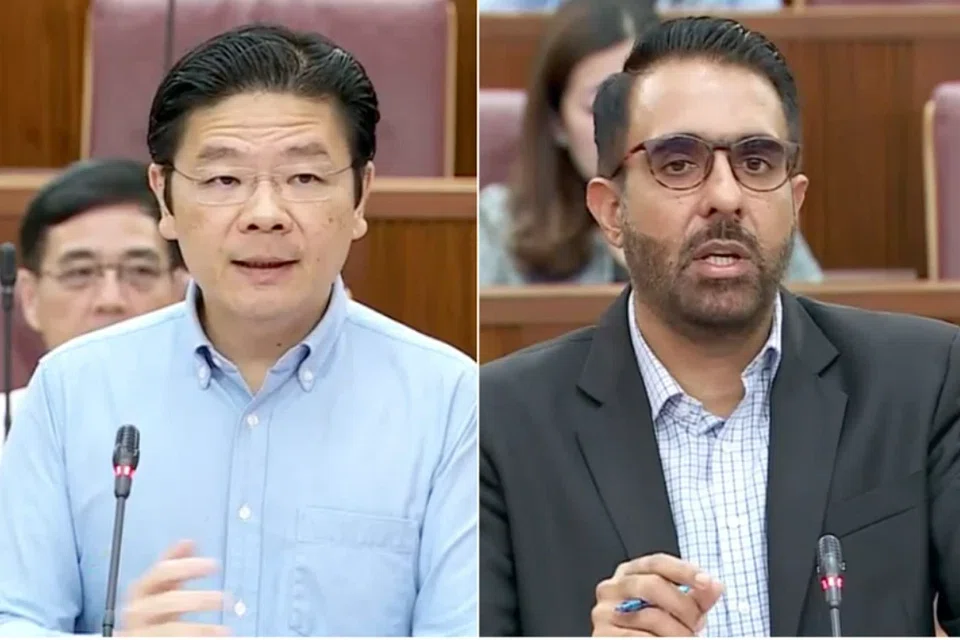
DEPUTY Prime Minister Lawrence Wong stressed – on Friday (Apr 21) after the end of five days of debate in Parliament on the President’s Address – that there is no place for populism and political opportunism in Singapore.
He was responding to Leader of the Opposition Pritam Singh who agreed on the point made.
Earlier on Monday, Wong had called on the Opposition to offer a serious alternative agenda and be upfront about the trade-offs, instead of putting forth opportunistic or populist ideas that chip away at trust in the Government.
Responding on Friday, Singh (Aljunied GRC) said that if all the Workers’ Party (WP) was doing was putting forward populist, unrealistic policies, the Government would not be considering variations of the WP’s ideas on issues such as anti-discrimination legislation, minimum wage and redundancy insurance.
Wong replied that while he and Singh may have to “agree to disagree” on how he characterised WP’s proposals, he had made a broader point on the evolution of Singapore’s democracy. This was because he was worried about how developed democracies abroad have become divided and polarised.
“If you look at many of these countries, populism has taken root; and populism has damaged greatly their societies, divided and polarised their people,” he said, explaining that populism is politics that distorts the facts for political advantage and will damage Singapore in the long term.
He added that the Government rejects populism and upholds honesty and integrity in policymaking.
Should it fall short of these standards, he said, he expects the Opposition to call it out. Likewise, if the Opposition proposes ideas and policies that the Government feels are populist, it would highlight its concerns.
Wong said: “Both sides of the House, we stand for a democracy that is maturing, a serious Government and a serious Opposition. We say yes to all that. But we say no to populism and political opportunism ever taking root in this House and in Singapore.”
Singh agreed with Wong that calling each other out ought to work both ways, and accepted Wong’s concerns about Singapore’s democracy, saying: “Certainly the Workers’ Party, and I hope the Opposition in general, will be mindful going forward and work towards the betterment of Singapore and Singaporeans.”
He added that he did not expect the DPM to use his speech on the President’s Address to “attack and accuse the Workers’ Party of advancing opportunistic or populist ideas to chip away, bit by bit, the trust in Government”.
“It is a most unfair charge levelled at the Workers’ Party which in reality, chips away at the integrity of our parliamentary democracy as an important platform for the exposition and contestation of ideas,” he said.
Singh added: “Our manifestos have not been an amalgamation of broad statements of purpose and glossy pictures, but specific proposals, with a view to better the lives of Singaporeans.”
He listed some examples including the live streaming of parliamentary debates, charging for the use of plastic bags and pairing families with general practitioners.
Wong had also said on Monday that every election from now on will be about who forms the Government, and not just what percentage of the votes the People’s Action Party (PAP) receives and how many seats the opposition wins.
Singh said that on the issue of the WP displacing the PAP and forming the Government, the reality is that the WP has a long way to go.
Instead, he said, its medium-term goal is to occupy one-third of the seats in the House.
This is to ensure that the Constitution cannot be arbitrarily changed, he said, noting that amendments to the Constitution require a two-thirds majority, currently 63 MP votes.
He added that WP’s intention is not to block all the changes to the Constitution proposed by a PAP Government unless they are assessed to be detrimental to Singapore.
Singaporeans want an opposition to check the PAP because, he said, “we all know that ‘ownself check ownself’ is not realistic. The inherent nature of power makes it unrealistic”.
Singh concluded by saying: “The Opposition must be focused and continue to endeavour, work for and defend the interests of Singaporeans and Singapore, as equal and fellow Singaporeans – together in the same boat, rowing in the same direction – be it in or out of this House.”
Responding to him, Wong pointed out that in politics, things can happen very quickly even if Singh says “it takes time, you’re not ready to form the next Government, you take one step at a time, one-third”.
“So I’m glad Mr Singh is mindful that there is an important role for the opposition to play,” he said.
“And I think he should start thinking about how he and the WP can indeed, perhaps not sitting (on his) side of the aisle, but on this side of the aisle in future, down the road, what sort of agenda you would offer Singaporeans and what you would do if you were to form the Government.” THE STRAITS TIMES
Decoding Asia newsletter: your guide to navigating Asia in a new global order. Sign up here to get Decoding Asia newsletter. Delivered to your inbox. Free.
Share with us your feedback on BT's products and services