

Oil spill in Singapore waters last month unlikely to raise shipping costs: Chee Hong Tat
The government has done initial pilots and tests to develop safety protocols for alternative fuels too
 Add BT as a preferred source
DeeperDive is a beta AI feature. Refer to full articles for the facts.
THE oil spill off Singapore’s southern coast last month is unlikely to cause an increase in shipping costs, since it was not a “structural or systemic” issue, Transport Minister Chee Hong Tat said in Parliament on Tuesday (Jul 2).
“It is affecting two vessels in this case and not something that is structural or systemic, unlike – for example – what’s happening at the Red Sea, where that kind of incident... will affect global shipping costs,” he said. “The ships have to then detour and go a longer distance.”
Coastal businesses that have been affected will also get rent deferrals, said Minister for Sustainability and the Environment Grace Fu.
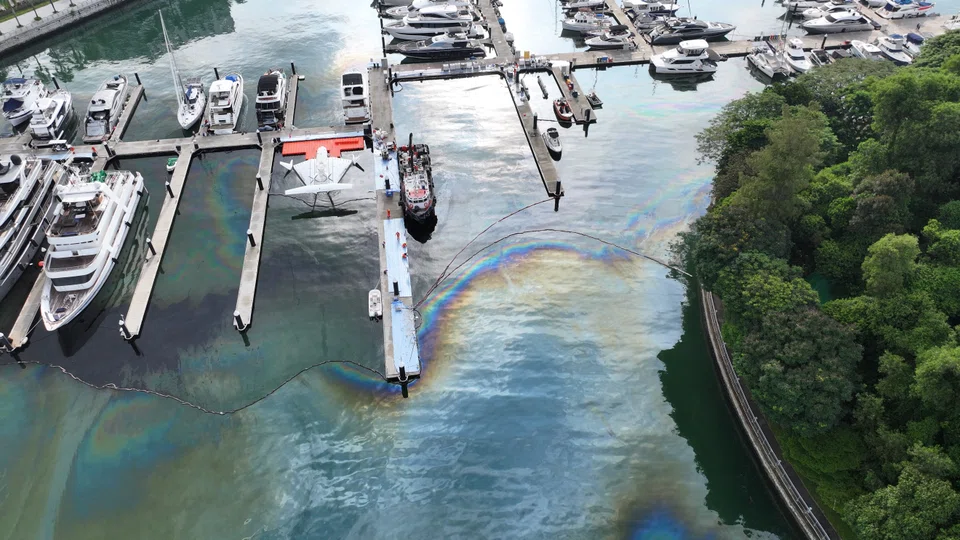
On Jun 14, more than 400 tonnes of low-sulphur fuel oil leaked into Singapore waters after a dredger lost control and hit a stationary bunker vessel at Pasir Panjang Terminal.
Liang Eng Hwa, Member of Parliament (MP) for Bukit Panjang, asked if the incident would raise shipping costs or had wider implications on the economy.
Chee replied that Singapore’s swift and effective response helped to ensure the oil spill did not damage its reputation as an international hub port and maritime centre. Port and shipping operations for other vessels were unaffected even on the day of the incident, he added.
Navigate Asia in
a new global order
Get the insights delivered to your inbox.
Clean-up work is in the second phase, focusing on “difficult-to-reach” areas, while the remaining fuel oil is still being removed from the damaged vessel, Chee said in a ministerial statement. Some 40 parliamentary questions were filed on the subject.
He noted that Singapore’s clean-up methods and operations are guided by international experts from ITOPF, a non-profit organisation that provides technical advice on such incidents.
As for affected businesses, rent deferrals will be offered on a case-by-case basis to help them with their cash flow, Fu told the House in a separate ministerial statement.

“We understand the frustration and inconvenience that businesses have experienced due to the oil spill,” said Fu, who is also Minister-in-charge of Trade Relations.
“That is why Sentosa Development Corporation, which manages Sentosa and businesses on the Southern Islands, and other agencies such as NParks that collectively manage the beachfront along East Coast Park, have been proactively reaching out to their tenants.”
Large sections of beaches along East Coast Park and Sentosa remain closed while clean-up operations, expected to take three months, are ongoing.
Different businesses are affected to different extents, said Fu. Some are completely unable to operate due to the sea-based nature of their activities, while others on the backshore of the beaches have been able to resume to various degrees.
“We cannot take a standard approach or one standard solution for the businesses, (but) government agencies will be very prepared to listen to the plight of businesses and see how we can best help them,” she said in response to a question from Progress Singapore Party’s Non-Constituency MP Hazel Poa.
As for Singapore’s fish farms, they remain unaffected, said Fu. Nonetheless, as a precautionary measure, the Singapore Food Agency has been taking seafood samples from coastal fish farms in the East Johor Strait for food safety tests. It is also monitoring the quality of imported fish and seafood.
“The test results continue to indicate that our local fish and imported fish are safe for consumption,” Fu said.
There has also been no impact on Singapore’s water supply, she added, with sensors at the city-state’s five desalination plants showing no abnormalities in the quality of seawater.
In a third ministerial statement, Minister for National Development Desmond Lee said more than 1,500 individuals have signed up to help with oil spill management efforts, with over 700 volunteers deployed as at Jul 1.
He outlined plans to engage nature groups and the community to keep them updated on recovery efforts, the impact on biodiversity as well as coastal clean-up efforts.
As for preventing future oil spills, the government has taken steps to enhance the safety of vessels and bunkering operations, and implement practices such as mandatory safety training for vessel crew, said Chee.
Even so, it is not possible to completely eliminate the risk of oil spills, he said. “Therefore, we have prepared for and maintained our readiness to respond in a prompt, coordinated and effective manner when such incidents occur.”
The government will continue to update and improve its standard operating procedures and contingency plans with learning points from this incident, he added.
With maritime decarbonisation meaning a shift to alternative fuels such as liquefied natural gas, methanol and ammonia, the government has also done initial pilots and tests to understand the risks involved, said Chee.
This helps the development of safety protocols, as the risks involved are very different from those in a traditional oil spill.
Decoding Asia newsletter: your guide to navigating Asia in a new global order. Sign up here to get Decoding Asia newsletter. Delivered to your inbox. Free.
Copyright SPH Media. All rights reserved.
TRENDING NOW

‘Boring’ is the new black: The stars are aligning for a Singapore stock market revival
Near sell-out launches in March boost developer sales to 1,300 units after four slow months

China pips the US if Asean is forced to choose, but analysts warn against reading it like a sports result

Genting Singapore’s Lim Kok Thay receives S$7.5 million pay package for FY2025

