
Penalties for pollutive light commercial vehicles push buyers to switch to heavier vehicles instead

Heavier vehicles are not subject to the Commercial Vehicle Emissions Scheme

Derryn Wong
Published Mon, Oct 21, 2024 · 05:00 AM
    • The automotive industry has responded to emissions penalties applicable to light goods vehicles by introducing similar models classified as heavy goods vehicles instead.
    • The automotive industry has responded to emissions penalties applicable to light goods vehicles by introducing similar models classified as heavy goods vehicles instead. PHOTO: BT FILE

    AFTER penalties were introduced for pollutive light commercial vehicles, Singapore’s population of heavy goods vehicles (HGVs) has risen – as these are not subject to the scheme.

    The Commercial Vehicle Emissions Scheme (CVES) was introduced in April 2021 to encourage the adoption of less polluting light goods vehicles (LGVs), with incentives for these and surcharges for more polluting ones.
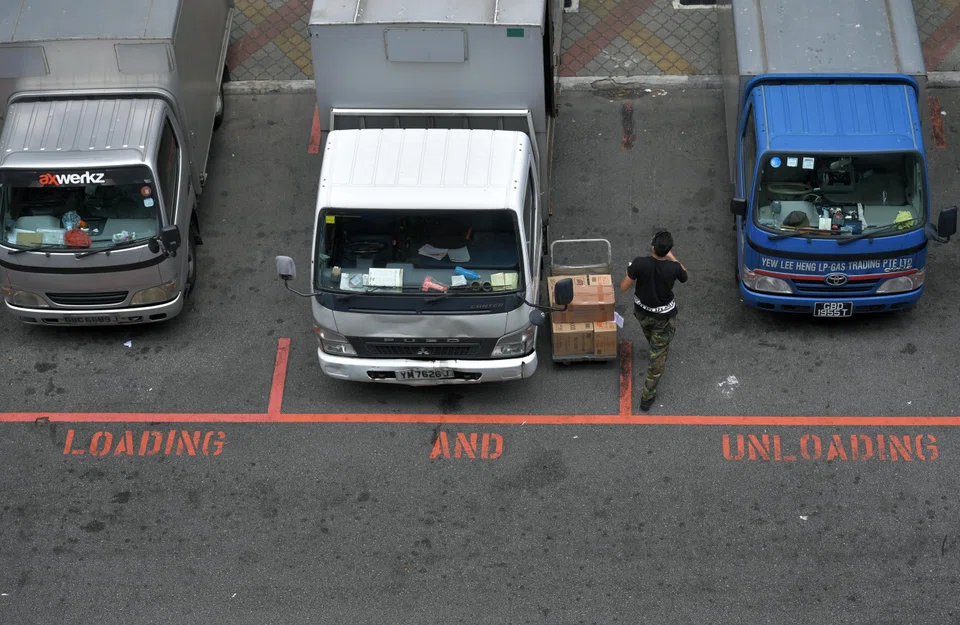
    But this has prompted some companies to switch to heavier vehicles, which do not fall under the scheme – including former LGVs that have been reintroduced as HGVs.

    Edward Tan, executive director of the Hong Seh Group, said: “CVES has changed the whole dynamic of the commercial vehicle market since 2021. Now we see more diesel-powered HGVs registered, and the result is the opposite of what CVES is trying to achieve.”

    Crossing the borderline

    The CVES bands LGVs – defined as having a maximum laden weight (MLW) of up to 3,500 kg – according to their emissions. Originally, less pollutive vehicles in Bands A and B received incentives of S$30,000 and S$10,000, respectively, while Band C vehicles faced a S$10,000 surcharge.

    From April 2023, incentives were lowered to S$15,000 for Band A and S$5,000 for Band B, while the Band C surcharge was raised to S$15,000.

    Since 2021, there has been a sharp increase in petrol and electric LGVs, which are cleaner than diesel-powered vehicles and can receive Band A and B incentives.

    Electrified goods vehicles formed 53.1 per cent of new LGV registrations in 2023, up from just 0.4 per cent in 2020. The share of petrol goods vehicles rose to 34.4 per cent, from 18 per cent before.

    Accordingly, the share of diesel vehicles plummeted to 12.4 per cent, from 81.6 per cent in 2020.

    Yet the overall LGV population has fallen, with HGV numbers rising instead.

    After growing from 2013 to 2021, the LGV population fell 2.3 per cent to 97,445 in 2023. LGVs also form a decreasing share of new commercial vehicle registrations: an annual average of 46.7 per cent from 2021 to 2023, down from 63.1 per cent in 2015 to 2020.

    Meanwhile, HGV growth has been driven by the category at the borderline: vehicles with an MLW of 3,501 kg to 7,000 kg. Their population reached 22,228 in 2023, up 17.7 per cent from 18,885 in 2020, before CVES.

    The rise at the borderline is driven by former LGV models that are now approved as HGVs, said dealers. After CVES was introduced, some dealers withdrew LGV models that were close to the 3,500 kg MLW limit, then reintroduced them as HGVs.

    Two major examples are the Toyota Dyna and the Hino Dutro, said dealers. These 10-foot (3 m) diesel-powered lorries were reintroduced with a higher MLW so they could be classified as HGVs.

    The director of a commercial vehicle dealer told The Business Times: “A 10-foot lorry is traditionally not an LGV, but a 14-foot lorry is. Now the Dyna is still a 10-footer, but its MLW is higher so it’s now classified as a HGV.”

    This move is not illegal, added the director. “They are tailoring the product to fit the market. It is like carmakers launching models with less power to meet more popular Category A Certificate of Entitlement power output rules.”

    In response to queries, the Land Transport Authority said that for vehicle approvals, applicants must furnish certifications and test reports for the vehicle’s corresponding category. Besides the MLW criterion, HGVs must meet additional requirements such as having lateral protection and front underrun protection.

    The National Environment Agency (NEA) noted that the MLW of a goods vehicle is determined by the manufacturer.

    Heavier polluters

    Two Toyota Dyna 10-foot lorries. The vehicle on the left is a light goods vehicle, while the one of the right is a heavy goods vehicle that does not pay Commercial Vehicle Emissions Scheme penalties. PHOTO: DERRYN WONG, BT

    While CVES has prompted shifts within the LGV category, dealers said that the rise in HGVs would increase pollution as most HGVs are diesel-powered. In 2023, diesel vehicles made up 93.1 per cent of HGV registrations.

    “CVES is only applicable to LGVs. By limiting it to just one weight class of goods vehicles, the result is more heavy diesels on the road, and that goes against the idea of CVES in the first place,” said Hong Seh Group’s Tan.

    Toyota and Hino are the top sellers of HGVs in Singapore, respectively accounting for 32.4 per cent and 25.7 per cent of new HGV registrations from January to August this year – most of these being Toyota Dyna and Hino Dutro lorries.

    A spokesperson for Inchcape Singapore, the authorised distributor of Toyota and Hino commercial vehicles, said that cleaner HGV options are limited as there are few heavy electric lorries. The spokesperson added: “If we are unable to provide our customers with the appropriate models, they may be forced to continue using older vehicles, which are less fuel-efficient, produce more emissions, and have a larger environmental footprint.”

    Current switching

    In response to queries, NEA said that some HGV models in Singapore are variants of LGV models which have been available overseas for some time. “HGVs are not covered by the CVES as cleaner and market-ready alternatives… are still limited, unlike cleaner LGVs which are more widely available and market-ready.”

    But Hong Seh Group’s Tan noted that since 2021, there have been more electric commercial vehicles, especially from China. “There are at least six electric alternatives available in the 10-foot lorry and HGV segment in Singapore now.”

    Associate Professor Walter Theseira from the Singapore University of Social Sciences said that it was “undesirable” to have rules that differ too much across similar vehicles with different weights, as this could lead to the unnecessary upsizing of vehicles.

    “I am usually cautious about policies that create such discontinuities in tax or other treatment, and prefer policies that have some tapering to discourage gaming of the system thus,” he noted.



