

Pig farming, livestreaming: Singaporeans find new opportunities in China
Ang Eng Guan has been running a pig farming business in Shandong’s Weifang for over 30 years
 Add BT as a preferred source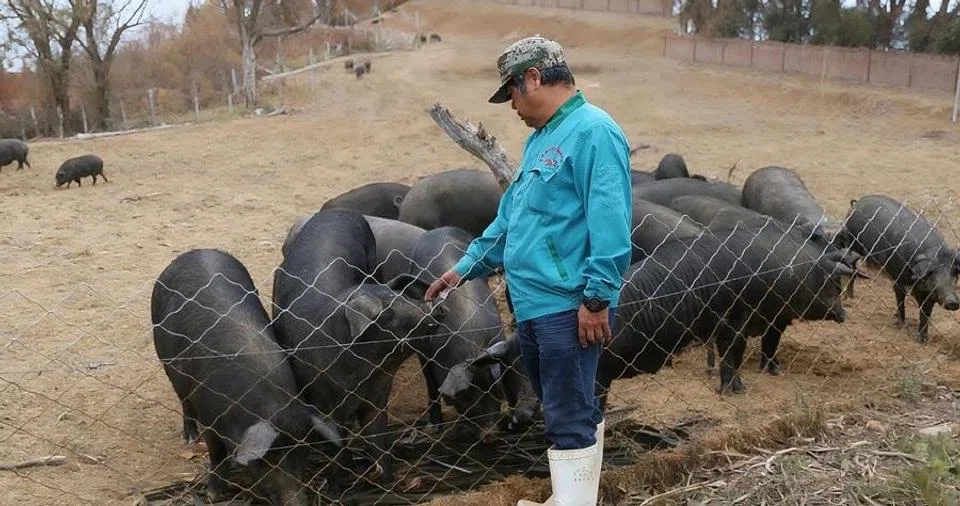
DeeperDive is a beta AI feature. Refer to full articles for the facts.
“MY WISH has always been to have Singaporeans taste black pork raised by fellow Singaporeans.”
Ang Eng Guan, the second-generation owner of Qiaoxin Group, has been running a pig farming business in Shandong’s Weifang for over 30 years. He hopes that one day he can market his own black pork back to his hometown of Singapore. He told Lianhe Zaobao that his company rears free-range black pigs that bask in the sun and roam freely, while being fed a specially formulated feed to ensure better meat quality and flavour.
Venturing into China
Ang, who was born in the 1960s, traces his cross-border pig farming venture back to the footsteps of his father, Ang Bock Chwee. The elder Ang once ran a poultry and pig farm in Lim Chu Kang, Singapore, but was forced to seek a new path after the government phased out pig farming entirely in the 1980s due to land use and environmental concerns. He thus travelled to Shandong’s Weifang in 1992 to start afresh. Back then, the younger Ang was still working in Vietnam. Persuaded by family and relatives, he decided to join his father in 1994.
When the Angs went to China, diplomatic ties between Singapore and China were still relatively new. This year marks the 35th anniversary of their establishment.
Economic and trade relations between the two countries remain close, attracting many Singaporeans to explore business opportunities in China. One such example is post-80s generation Kelvin Ng, who has carved out a career in China’s Internet sector.
Ng, who once served as the regional director (Beijing) of the Singapore Economic Development Board, told Lianhe Zaobao that entrepreneurship had always been part of his life plan, although he was initially unsure whether to venture into the internet, logistics or education sector.
Navigate Asia in
a new global order
Get the insights delivered to your inbox.
In 2019, he made the bold decision to give up his “iron rice bowl” and joined the Chinese educational technology company Qingbeidaoyuan Technology as a partner. In 2022, he struck out on his own and founded Yellowkastle Technology, focusing on providing livestream e-commerce solutions for merchants and brands.
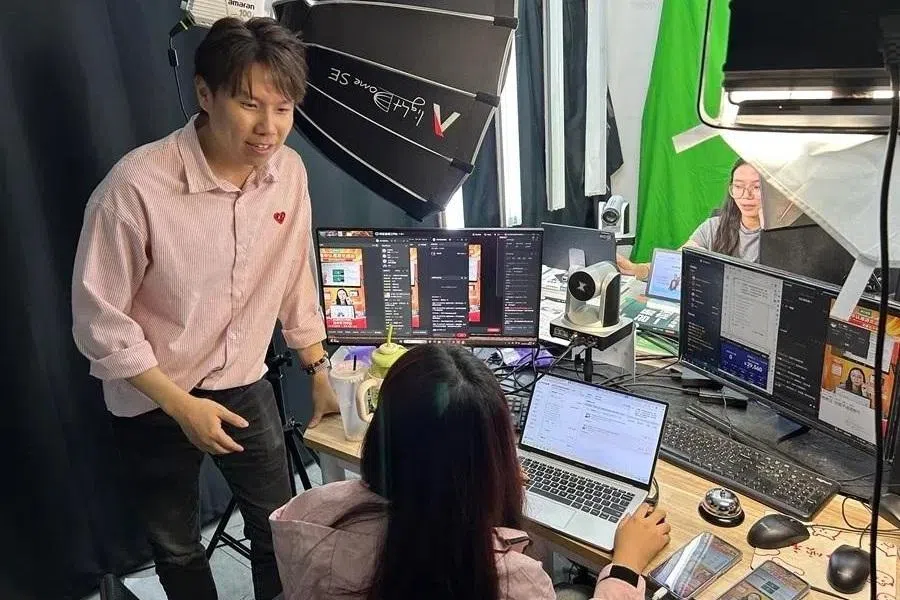
Within just two to three years, Yellowkastle Technology’s livestreaming sessions have sold a plethora of products from textbooks, learning devices, children’s toys and air purifiers to skincare products and bed linens. Ng admitted that he started by learning on the job, but now fully grasps the logic and system behind the business, “We have mastered how to make great videos,” he said. “Our ad bidding and placement are highly precise.”
Better opportunities in second- and third-tier cities
With China’s massive market of 1.4 billion people, Singaporean entrepreneurs can make their mark there as long as their products and services are strong. When interviewed, Warren Wee, vice-chair and secretary general of the Singapore Chamber of Commerce and Industry in China (SingCham), noted that while Singaporeans often joke about being kiasu (Hokkien for being afraid to lose) or kiasi (Hokkien for being afraid to die), their cautious, meticulous and rule-abiding approach is actually seen as a strength in China’s business circles.

Established in 2001, SingCham serves as an important bridge for Singaporeans doing business in China. It now has over 1,300 members, with its headquarters in Beijing and working groups in Shanghai, Chongqing, Guangxi, Guangdong, Sichuan, Jiangsu, Fujian and Shandong.
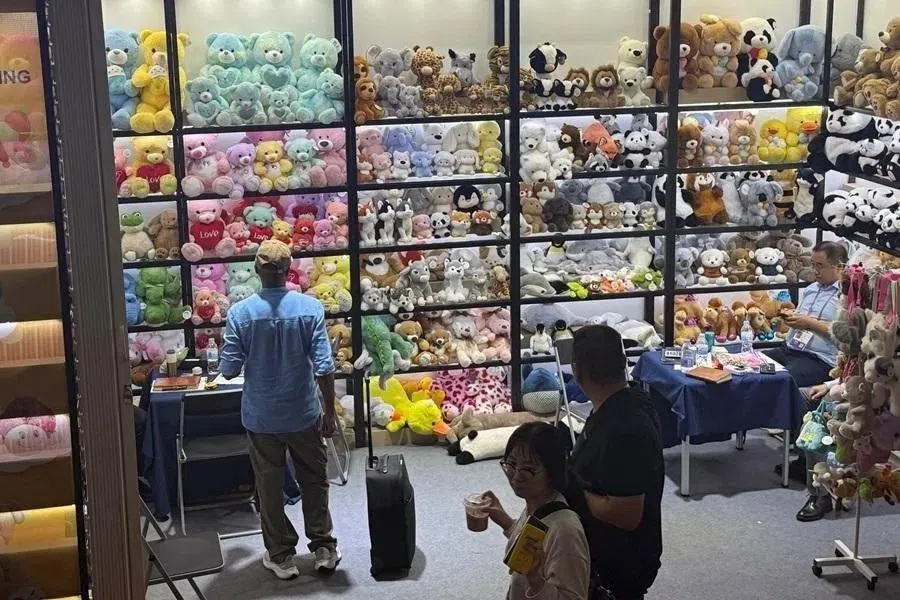
Wee, who has been in the commercial interior design industry in China for 23 years, observed that economic growth in first-tier cities such as Beijing, Shanghai, Guangzhou and Shenzhen has relatively slowed in recent years, with consumer markets becoming saturated and labour and rental costs remaining high. He therefore advises Singaporean entrepreneurs to look towards China’s second- and third-tier cities, to accurately identify their target customer base, avoid testing the waters blindly, and be mentally prepared for a long-term commitment.
Weifang, where the Angs have set up their business, is a second-tier city in Shandong. From starting a feed factory to building their own pig farms, they expanded the business step-by-step. When China became a member of the World Trade Organization (WTO) in 2001, it not only spurred the country’s opening up and economic reform but also boosted the duo’s confidence in investing in China. The younger Ang admitted, “Before China joined the WTO, we were very cautious.”
To date, Qiaoxin Group has invested more than 300 million yuan (S$55 million) in China, operating a 500 mu (approximately 0.33 square kilometres) agricultural demonstration base and a 25 mu chilled meat processing facility. As the first company in Shandong to sell pollution-free pork, it has maintained strict quality control over the years, earning a strong reputation and a stable customer base.
Turning challenges into opportunities
However, given China’s rapidly changing market environment, achieving stable growth is no easy task. Singaporean entrepreneurs must seize opportunities and stay adaptable in order to turn challenges into chances.
Outbreaks of African swine fever across China in 2018 posed a major challenge to Qiaoxin Group’s operations. Ang Eng Guan said that over the past few years, the company reduced its farming scale to minimise infection risks, with annual output cut from a peak of 30,000 pigs to between 15,000 and 18,000. It also stopped direct sales and switched to a self-production, self-sale model to prevent outside vehicles and personnel from approaching or coming in contact with the pig farm.
Involution has plagued various Chinese industries in recent years, and the pig farming sector is no exception. Due to fierce competition in the white pig market, Ang Eng Guan is slowly shifting the company’s focus towards rearing black pigs. He explained that black pork is of better quality and fetches higher prices, which brings bigger profits. However, as black pigs are fattier and slower-growing than white pigs – and are also raised free-range with more physical activity – their breeding cycle is longer, which increases production costs.
Ng’s entrepreneurial journey was also filled with challenges. Qingbeidaoyuan Technology had initially focused on providing online lessons for tertiary institutions in second- and third-tier cities, but China was hit by the Covid-19 pandemic shortly after he joined the company. More than a hundred partner institutions suspended classes to run their own online courses, dealing a heavy blow to the company’s core business and putting its finances under strain. Subsequently, Chinese officials rolled out the “double reduction” policy in 2021, which further cracked down on the private tutoring sector, forcing the company to pivot towards publishing educational guidebooks.
Responsible for the company’s online operations, Ng admitted that initial offline sales of the guidebooks were poor – only about 1,000 copies were sold in six months. Later, he decided to try livestreaming on the Chinese short video platform Douyin and it unexpectedly became a hit, with daily sales soaring to 3,000 copies. This opened his eyes to the immense potential of short videos and livestream e-commerce in China.
Notwithstanding, the outlook of livestream e-commerce, as an emerging industry, is still volatile and fast changing. Ng is now searching for the next breakthrough. “Our current products are doing fairly well,” he said, “but we are still pushing hard – our goal is to grow the business to the scale of billions.”
This article, translated by Grace Chong, was first published on ThinkChina.sg, an English-language digital magazine under Lianhe Zaobao.
Decoding Asia newsletter: your guide to navigating Asia in a new global order. Sign up here to get Decoding Asia newsletter. Delivered to your inbox. Free.
Copyright SPH Media. All rights reserved.
TRENDING NOW
‘Boring’ is the new black: The stars are aligning for a Singapore stock market revival
Near sell-out launches in March boost developer sales to 1,300 units after four slow months

China pips the US if Asean is forced to choose, but analysts warn against reading it like a sports result
Genting Singapore’s Lim Kok Thay receives S$7.5 million pay package for FY2025

