

Planned COE supply hikes in 2025 may not mean lower premiums
Uncertainties remain over deregistrations and the spread of additional COEs

IN 2024, Certificate of Entitlement (COE) supply started to recover from the lows of recent years. The question for 2025 is whether continued hikes in supply will be enough to bring down premiums, which have stayed relatively high since 2022.
COE supply seems poised to expand by at least 17 per cent in 2025, boosted by older vehicles exiting the market; the government’s continued cut-and-fill approach; and the injection of additional COEs.
But the picture is muddied by the fact that the number of deregistrations is hard to predict, and uncertainty over how many of an announced 20,000 additional COEs will come in 2025.
Meanwhile, demand could increase as owners of those older vehicles seek replacements, while electric vehicles (EVs) continue to attract buyers.
Passenger car COE supply revs up
Estimates for passenger car COE supply in 2025 from four industry observers range from 48,000 to 52,000, representing at least a 17 per cent rise from the estimated 2024 full-year figure of 41,000.
This rise is part of an expected medium-term trend, as more cars nearing the 10-year COE lifespan are de-registered and the government continues efforts to bolster supply.
Indeed, 2025 is the beginning of Singapore’s peak COE supply, said Dr Victor Kwan, senior lecturer at the Singapore University of Social Sciences.
The peak is expected to be reached around 2026 and 2027, and taper off after 2028.
COE quotas are announced every three months. The zero-growth policy for passenger cars means that their COE quota for each period is the average number of vehicles de-registered in the preceding 12-month period.
“There is a sizeable first tranche of about 39,000 cars around nine years of age that marks the beginning of peak COE supply. We will start getting these de-registrations in 2025,” noted Dr Kwan.
“There are bigger tranches of 80,000-plus cars coming after that. These tranches are what everyone has been waiting for.”
As at November, 39,572 cars – 6 per cent of the car population – are nine years and older, but not yet 10 years old.
Another 80,984 cars (12.3 per cent) are eight years and older, but not yet nine years old, and 86,273 or 13.1 per cent are seven years and older, but not yet eight years old. The latter is the largest single age group of existing cars.
COE prices have trended upwards since 2018 due to dwindling supply, with the lowest supply in 2023.
The organic supply from de-registrations will be boosted by government moves: the continued cut-and-fill approach and an additional injection, beginning in February, of 20,000 COEs over a few years.
These initiatives “give assurance to car dealers and the buyers that there will be a stable rise in supply between now and the peak of 2026”, said Transport Minister Chee Hong Tat earlier this month.
Since May 2023, the Land Transport Authority (LTA) has been boosting the COE supply through the cut-and-fill method of bringing forward additional quota from guaranteed future de-registrations.
Big unknowns loom
But observers caution that these supply boosts are complicated by two major unknowns.
First, it is unclear how the 20,000 COEs will be distributed over time and over categories.
Automotive consultant Say Kwee Neng said: “(The LTA) has not stated the specific distribution of the 20,000 COEs, over how many years, over which categories, et cetera. So there is so much that is unknown about this expansion in COE supply, and we are actually in the dark about how to assess its overall impact on the market.”
Most observers to whom The Business Times spoke expect the 20,000 COEs to be front-loaded, since 2025 is almost certain to see a smaller organic COE supply than 2026.
“I expect LTA to distribute the bulk of the additional 20,000 COEs in 2025, and less thereafter,” added Say.
“(LTA) should give at least 5,000 COEs in 2025, to help feed supply,” said Sabrina Sng, managing director for Lotus, Polestar and insurance at dealership group Wearnes Automotive.
“There is no point in releasing them too far down the road,” she added.
Second, actual de-registrations are hard to predict.
After the COE lifespan of 10 years is reached, a car must be de-registered – so its COE returns to the system. Alternatively, a car could have its COE revalidated, meaning it does not become part of the supply.
In the first 10 months of 2024, COE revalidations were at the highest since 2020.
Higher COE premiums also incentivise revalidation.
In fact, Chee cited the unpredictability of de-registrations as a reason for not determining the distribution of additional COEs yet, saying: “(Deregistrations are) why we can’t fix too far in advance how much we intend to use from the 20,000 or from the cut-and-fill, because you won’t know before what the de-registration number is until closer to the date.”
Demand driven by Category A, replacers
Even as the size of the supply boosts remains unclear, demand is expected to stay strong.
This will be boosted by strong sales of EVs, especially popular models in the mainstream COE Category A, as rebates continue.
“EVs will continue to be the driving force for new car sales as the number of EVs in Category A continues to grow,” said Dr Kwan.
In 2024, EVs rose to one-third of new car registrations, a new high.
In September, the EV Early Adoption Incentive and the Vehicular Emissions Scheme were extended until 2025. Under these schemes, EVs enjoy a combined rebate of up to S$40,000, and most will see the same level of rebates next year as they do in 2024, said LTA.
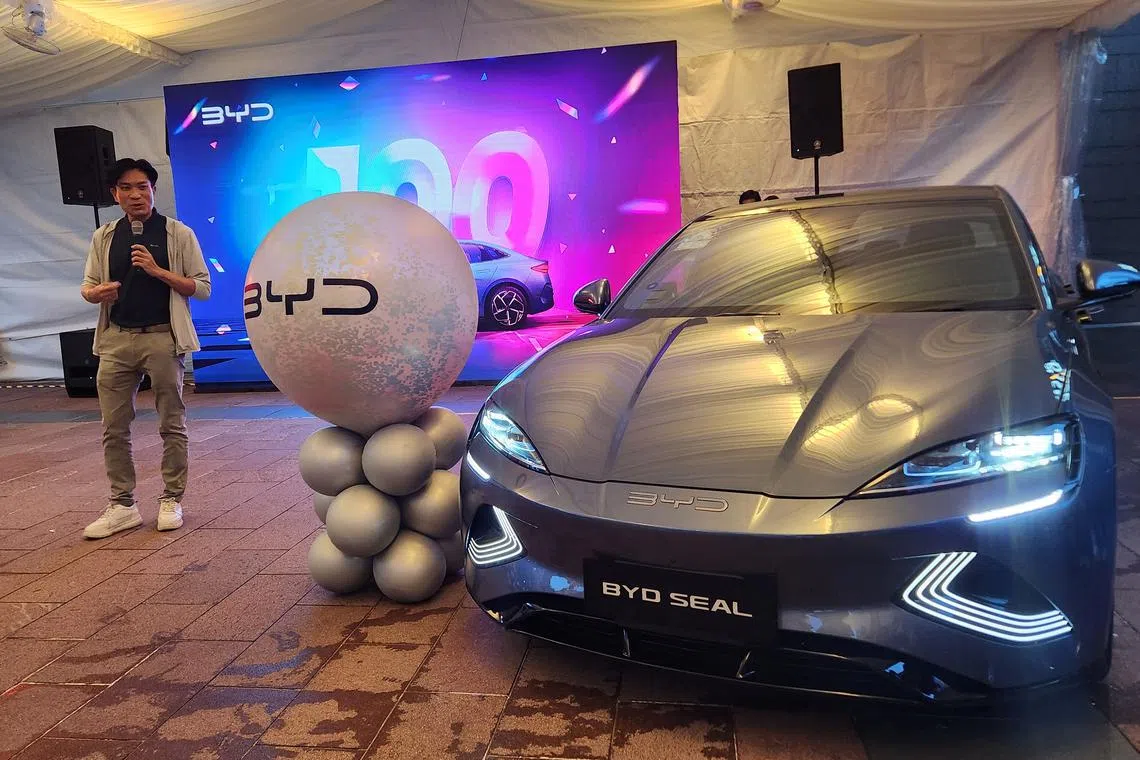
These rebates, together with models available in the less expensive Category A, have helped drive EV sales, especially for leading EV-only brands BYD and Tesla.
In 2022, BYD had no Category A models. It now has four, which constitute the majority of its sales. This has helped drive it to second place on the list of best-selling brands here in November 2024, up from 12th in 2022.
Likewise, Tesla’s Category A Model 3 debuted in May and now makes up most of its sales, which has driven the brand to fifth place, up from 10th in 2023.
With BYD and Tesla’s success, Dr Kwan added that it was likely most EV brands would be looking to introduce their own Category A models.
Demand for COEs will also be driven by those who have fed supply: owners looking to replace their ageing cars.
Sng said: “As increasing numbers of cars reach 10 years of age and are scrapped, the owners will need to replace their cars.”
She noted that demand precedes supply. “Before you scrap your old car, you must buy a new one and wait for the dealer to secure a COE, then register and deliver it before you can hand over your old car.
“If the government doesn’t do anything to help supply before these owners scrap, it could cause volatility in premiums.”
TRENDING NOW

Good Class Bungalow market activity picks up pace on ‘realistic’ pricing

Indonesia imposes US$116 million in fines over manipulation of Sinar Mas, Prajogo-linked stocks

Singapore identifies 7 firms responsible for haze fires, notices issued urging action: Grace Fu

Once staunchly pro-China, Malaysian Chinese businesses are now distancing themselves from Beijing

