Plans to release land for private hospital in eastern S’pore, first in almost 20 years: Ong Ye Kung
The proposed hospital would have a capacity for between 300 and 400 hospital beds
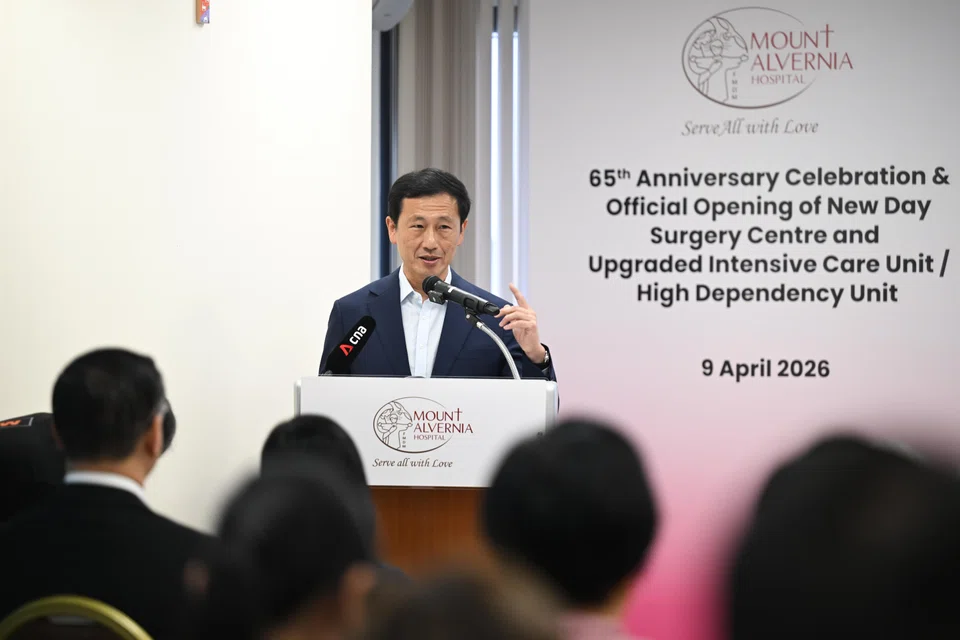
[SINGAPORE] To provide people with more lower-cost private healthcare options, the government intends to release a plot of land for a new, private not-for-profit acute hospital in eastern Singapore, Minister for Health Ong Ye Kung announced on Thursday (Apr 9).
This would be the first land release for a private hospital in almost two decades, should plans proceed as expected, he noted.
The proposed hospital would have a capacity for between 300 and 400 hospital beds, according to Ong, who shared this at an event marking the 65th anniversary of Mount Alvernia Hospital – currently the Republic’s only not-for-profit private acute hospital.
The authorities aim to arrive at a decision on the tender in the second half of 2026, Ong said.
His announcement comes after the Health Ministry in 2024 said it aimed to introduce a new not-for-profit private acute hospital model, aimed at increasing Singapore’s hospital bed capacity.
The move aims to address rising demand for healthcare services due to the country’s ageing population, MOH said then.
Ong said in 2024 that the model will be singularly licensed – meaning each hospital will be issued its own healthcare licence – to enhance governance.
The authorities aim to stipulate certain requirements in the tender documents so as to ensure lower costs, Ong said on Thursday.
“The first is bill size restrictions, so that the hospital bills are a certain percentile of the market, and cannot lead the market,” he noted.
SEE ALSO




The second stipulation meanwhile would be to adopt a fixed-price land tender approach, he added.
“Under such a model, bidders would then compete not based on how much they are prepared to pay for the land, but other qualitative factors, such as their care model, cost efficiency, approach to recruiting and developing manpower, and their commitment and policies towards affordable healthcare,” he said.
The last time the government tendered land for a private hospital was in 2008. This was for the 333-bed Mount Elizabeth Novena Hospital, which opened in 2012 at a cost of S$2 billion – some S$1.25 billion of which was for the acquisition of the land.
“In the process, public healthcare also lost many good healthcare professionals to the private hospital, which was painful,” Ong said.
“That experience has made the Ministry of Health very cautious about having more private hospitals, and for that matter, very cautious about private hospitals expanding.”
The strong coverage offered by private health insurance supports a private hospital operating model geared toward high-end care, fuelling further rises in private hospital costs, he noted.
More expensive private hospital charges and escalating private healthcare insurance premiums are driving patients to public hospitals, where typically more than 90 per cent of beds are occupied, Ong said.
This is even as private hospitals are “barely half occupied”, he noted, adding that it is neither desirable nor possible for public hospitals to be a monopoly.
Though 40 per cent of residents have healthcare insurance for private hospital care, half seek care in public hospitals, with the public sector taking in some 90 per cent of Singapore’s patients.
Ong noted this is contrary to a 1993 White Paper on Affordable Healthcare, which envisaged private acute hospitals making up to 30 per cent of hospital beds by 2010, so as to allow public hospitals to focus on providing care to the lower-to-middle income groups.
The government has taken steps to narrow the cost gap, such as by tightening the design of private healthcare insurance riders to focus on providing assurance against large hospital bills, he added.
He noted however not all private hospitals are high-cost, citing the example of Mount Alvernia, where certain unsubsidised treatments and diagnostic scans can be more affordable than those at public hospitals.
This has helped exert competitive pressures on public hospitals, he noted.
“But we only have one Mount Alvernia, and we wish for more private hospitals like you,” he said.
MOH has been consulting many stakeholders on the not-for-profit private hospital, with “encouraging responses” from potential operators as well as enthusiastic donors and philanthropists, said Ong.
“I believe we can make this a good project that will strengthen the healthcare ecosystem, and involve many stakeholders outside of public healthcare,” he said, noting though there are still “a few important issues to address”.
Mount Alvernia celebrated its 65th anniversary with a ceremony at its St Anne Mother & Child Centre, its dedicated 10-storey maternity and pediatric centre which opened in 2023.
The event also marked the official opening of its new day surgery centre – with four day-surgery operating theatres supporting ophthalmology and other surgical procedures – as well as an upgraded intensive care and high dependency unit, a 16-room critical care unit designed to provide specialised monitoring and treatment for patients with severe or complex medical conditions.
“The official opening of these new and upgraded facilities marks another step in our journey to meet the complex healthcare needs of our ageing population and caring for generations to come,” said the hospital’s chief executive officer Dr James Lam. THE STRAITS TIMES
Decoding Asia newsletter: your guide to navigating Asia in a new global order. Sign up here to get Decoding Asia newsletter. Delivered to your inbox. Free.
Share with us your feedback on BT's products and services