Plug-in hybrid registrations in Singapore double as mass-market brands gain share in segment
The latest figure of 215 in H1 2025 exceeds the total for last year

[SINGAPORE] Registrations of plug-in hybrid electric vehicles (PHEVs) in Singapore in the first half of 2025 more than doubled year on year.
There were 215 PHEVs registered, compared with 96 in H1 2024. The latest figure also exceeds the full-year total of 210 registrations in 2024.
This growth has been driven by more mass-market brands offering PHEVs at prices competitive with those of fully electric vehicles (EVs).
The proportion of mass-market PHEVs has also increased significantly.
In H1 2025, 80 PHEVs from mass-market brands were registered, representing 37.2 per cent of total registrations. A year earlier, there were 23 such registrations, representing 11 per cent of the total; in H1 2023, the proportion was just 6.8 per cent, with 18 mass-market PHEVs registered.
Luxury brands made up the rest of the registrations across these periods.
PHEV adoption is still small compared to that of EVs in Singapore. The 215 PHEV registrations in H1 this year represented just 0.9 per cent of the total of 23,957 vehicle registrations. EVs, meanwhile, took up 41 per cent with 9,822 registrations.
Some observers said PHEV adoption may improve in the future as EV subsidies are reduced, but others said that these vehicles will remain a niche choice.
Like conventional petrol-electric hybrid cars, which run solely on petrol, PHEVs are more efficient than cars with just an internal combustion engine (ICE), as they have a battery and electric motor to recover energy from braking or slowing down.
But, unlike petrol-electric hybrids, PHEVs have a larger battery pack that can be replenished by external chargers; some offer up to 100 km of fully electric range.
Proponents of the technology say PHEVs offer the benefits of EVs with the extended range and convenience of petrol cars.
Mainstream shift
While EVs and PHEVs have both been available in Singapore over the past 10 years, the adoption of EVs has far outstripped that of PHEVs since 2021, when EV-specific incentives were first introduced.
There is currently a maximum incentive of S$40,000 for EVs, and S$2,500 for PHEVs.
The lack of subsidies, combined with PHEVs’ larger battery packs adding to costs, means such vehicles have been more expensive than all other types of cars, keeping them a niche, luxury purchase – until now.
“PHEVs have become very well-priced, especially for Chinese manufacturers, as they have long experience in PHEV development, government assistance and massive economies of scale.”
Desmond Chan, editor of Sgcarmart.com
Over the past year or so, new PHEV models that are priced competitively against EVs have been introduced.
Chery’s 47 PHEV registrations in H1 2025, driven by its sole PHEV model – the Jaecoo J7 sport utility vehicle (SUV) – were the second-highest, behind Volvo’s 49. The Chinese carmaker had just three PHEVs registered in the same period a year earlier.
Priced at S$214,888, inclusive of the Certificate of Entitlement, the car is slightly more expensive than its EV rivals such as the Tesla Model Y (from S$204,578), but cheaper than conventional hybrids such as the Nissan X-Trail and Toyota RAV4 (from around S$250,000).
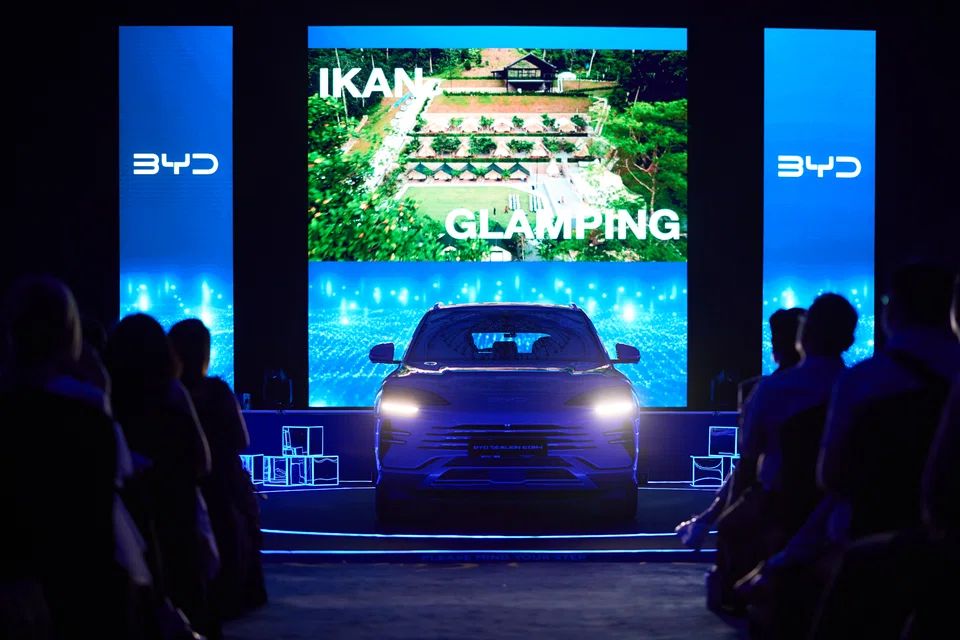
It is a similar case for BYD’s first PHEV for Singapore, the Sealion 6 DM-i SUV, introduced in July. At S$212,888, the price is comparable with that of the fully electric BYD Sealion 7 (from S$206,388) and the conventional hybrid Toyota Harrier (from S$215,900).
While BYD had just six PHEVs registered in H1 2025, that number should increase in the coming months as it has taken more than 100 orders for the Sealion 6 to date.
Other mass-market entrants include the GAC E9 large multipurpose vehicle, with 12 units, and the Mazda CX-80 large SUV, with eight.
Observers say new-generation PHEVs’ cost-competitiveness is a result of plunging battery costs and improved economies of scale, especially for brands from China.
As PHEVs have batteries that are much larger than those found in conventional hybrids, falling battery prices may also have contributed to their rise, said Desmond Chan, editor of automotive portal Sgcarmart.com.
EV battery costs plunged to US$115 per kilowatt-hour (kWh) in 2024 from US$715 per kWh a decade ago, indicated research firm BloombergNEF; they are expected to drop even more to around US$112 per kWh in 2025.
“PHEVs have become very well-priced, especially for Chinese manufacturers, as they have long experience in PHEV development, government assistance and massive economies of scale,” said Chan.
He added that PHEVs are popular in China, and that it is “a hyper-competitive market, which drives down prices further”.
According to car research firm ThinkerCar, 897,326 PHEVs were sold in China in the first quarter of 2025, making up 13.4 per cent of the market, up from 8 per cent in the whole of 2023.
Homing in on range
Two PHEV owners The Business Times spoke with said competitive pricing, a lower road tax, and superior range over previous PHEVs as well as current EVs were factors behind their purchase.
Interior designer Ngo Lee Kum, 44, who owns a Jaecoo J7, said: “The price was important, of course, but the car suits my lifestyle as I drive a lot for work...
“Singapore has a lot of start-stop driving, which is suitable for PHEVs, and a full tank gives me around 1,000 km of range, which can last me for a week.”
Chery quotes a range of more than 1,200 km for the SUV, with an electric range of 90 km.
Another PHEV owner, Wong Yat Foo, said he did not mind paying slightly more for his BYD Sealion 6 in July than an EV because of the added flexibility.
“I didn’t want to deal with the uncertainty of an EV running out of power,” said the 74-year-old. “With a PHEV, you have an alternative (to use petrol), so this is the best solution for me.”
“The growth in PHEVs isn’t large in absolute terms, since the base in 2024 was very low. The introduction of (the) BYD Sealion 6 could shift the market more in the near term, but I believe the bigger story is the continued rise of full EVs.”
Krzysztof Tokarz, CEO of Auteneo
He did not consider PHEVs previously, as the range of older models “was not great”. “But now, I can cover most of my travels on electric power if I charge it every few days.”
He also pointed out that PHEVs are subject to a lower road tax than EVs. The annual road tax for the Sealion 6 is S$1,066, compared with S$5,588 for the Sealion 7.
A higher road tax is levied on EVs to make up for fuel excise duties imposed on similar ICE vehicles.
Now plugged in or plugging away?
But observers are mixed on whether this will be a lasting upward trend for PHEVs.
Walter Theseira, associate professor of economics at the Singapore University of Social Sciences, said PHEVs need daily charging to be most efficient, as their batteries only allow for one or two days of fully electric travel.
This makes them less than ideal for most Singaporeans, who do not have access to personal car chargers.
“If you end up in a situation where you don’t charge them regularly, the efficiency isn’t great. You’re carrying around a couple hundred kilograms of dead weight (from the battery) – that’s a problem for efficiency,” he said.
Krzysztof Tokarz, chief executive officer of automotive research firm Auteneo, said: “The growth in PHEVs isn’t large in absolute terms, since the base in 2024 was very low. The introduction of (the) BYD Sealion 6 could shift the market more in the near term, but I believe the bigger story is the continued rise of full EVs.”
PHEVs are a transition technology for some until the infrastructure improves, or there is a battery breakthrough which solves range anxiety for more consumers, he added.
“Singaporeans are not buying EVs because they believe in electric mobility – it’s because of the incentives. And even though, technically, PHEVs should suit more Singaporeans, they aren’t as popular because the incentives are just not there.”
Automotive consultant Say Kwee Neng
However, automotive consultant Say Kwee Neng said PHEVs could see increased take-up if EV subsidies get reduced, as this could result in EVs becoming more expensive.
“Singaporeans are not buying EVs because they believe in electric mobility – it’s because of the incentives. And even though, technically, PHEVs should suit more Singaporeans, they aren’t as popular because the incentives are just not there,” he said.
“But if incentives for EVs are taken away, you can be sure their sales volumes will be affected. PHEVs may be able to fill up that gap, now that better-priced models are on the market.”
TRENDING NOW
Grab CEO’s wife Chloe Tong on life with Anthony Tan and finding her purpose
He built the Vingroup empire. Now South-east Asia’s richest man is handing some key roles to his sons
US says China to buy 10 million tonnes of coal in 2027 and 2028
Tokyo reverses baby bust with AI matchmaking and generous subsidies