

Pre-Gulf war survey sees improved hiring sentiment among Singapore employers
Poll by ManpowerGroup shows 45% of firms expect to raise headcounts

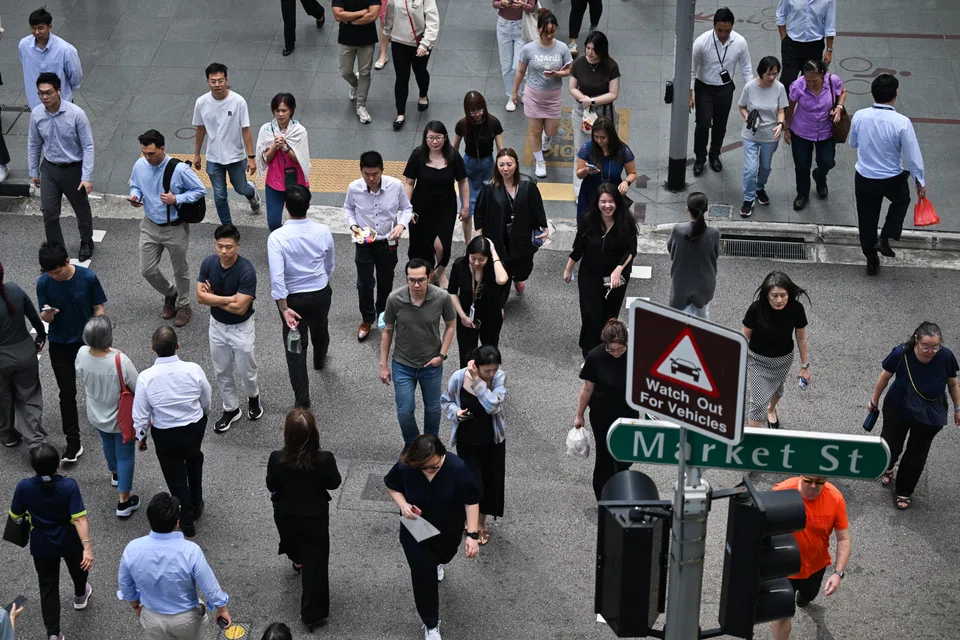
[SINGAPORE] Hiring sentiment across employers in Singapore rose for the second quarter of 2026, after two consecutive quarters of declines, according to the latest ManpowerGroup Employment Outlook Survey released on Tuesday (Mar 10).
For the quarter, some employers in the city-state recorded improved hiring sentiment, which is quantified using the metric of net employment outlook, or the difference between the percentage of employers planning to raise headcounts and those planning reductions. This was according to the survey of over 530 Singapore employers, conducted from Jan 1 to Feb 3 before the latest Middle East war broke out.
The seasonally adjusted net employment outlook for Q2 stood at 24 per cent, an improvement of 10 points from the previous quarter and a decline of three points from the year-ago period, as employers forecast staffing changes amid anticipated hiring increases driven by company expansion.
Close to half (45 per cent) of employers reported plans to increase their staff count between April and June, while 21 per cent anticipate staff reductions and 33 per cent plan to keep staffing levels unchanged, said ManpowerGroup.
Linda Teo, country manager of ManpowerGroup Singapore, said the improved hiring sentiment for Q2 reflects employers’ efforts to adapt to evolving business needs.
“While much of this momentum is being driven by companies expanding into new areas, organisations are also stepping up their search for fresh skills to maintain a competitive edge,” Teo said.
Noting that the search for fresh skills is especially salient in the information sector, Teo said: “Advancements in technology are creating demand for new expertise and supporting stronger hiring intentions as firms deepen their focus on technology‑led transformation and future capability building.”
Hiring sentiment was brightest for the information sector, which posted a net employment outlook of 41 per cent, an increase of 18 points from the prior quarter and 16 points year on year.
This was followed by the construction and real estate sector, with a net employment outlook of 39 per cent, and the manufacturing sector, at 26 per cent. Notably, the utilities and natural resources sector had a net employment outlook of minus 11 per cent.


Despite the quarter-on-quarter improvement, Singapore’s hiring sentiment came in lower than the global average, according to ManpowerGroup’s survey of over 41,700 employers across 42 countries.
Across the globe, net employment outlook for Q2 stood at 31 per cent, with 45 per cent of employers reporting plans to raise staff counts between April and June, and 13 per cent anticipating headcount reductions, ManpowerGroup said.
Hiring sentiment was brightest for India, which logged the strongest Q2 net employment outlook globally, of 68 per cent. This was followed by the United Arab Emirates at 60 per cent and Brazil at 55 per cent.
Uneven returns from AI adoption in Singapore
While Singapore outpaces the rest of the world in AI deployment across workforce strategy, returns from adopting the technology are uneven.
More than four in five employers in Singapore (82 per cent) are already using AI in hiring, onboarding or training new workers. This is above the Asia-Pacific and Middle East average (81 per cent), and the global average (67 per cent).
Learning and development ranked top as the area of work for which AI usage yielded the highest return on investment (ROI); its application was cited by 32 per cent of Singapore employers.
This was followed by scheduling or forecasting (17 per cent), team performance (12 per cent), talent acquisition (10 per cent), safety or compliance (9 per cent) and attrition prediction (8 per cent).
Two per cent of Singapore employers said they were unsure what AI application yielded the most ROI, while 10 per cent said they had not realised any ROI from using AI.
Despite widespread AI adoption in Singapore, only 4 per cent of employers said current AI solutions met expectations when used for hiring, onboarding and training.
Twenty-three per cent said AI solutions displayed poor soft-skill evaluation, and 22 per cent said the technology could not teach practical skills or judgement. Moreover, nearly one-fifth (18 per cent) said they did not use AI in hiring, onboarding and training.
Decoding Asia newsletter: your guide to navigating Asia in a new global order. Sign up here to get Decoding Asia newsletter. Delivered to your inbox. Free.
Copyright SPH Media. All rights reserved.
TRENDING NOW

Britain’s mansion tax shows the difficulty of targeting wealth

Once staunchly pro-China, Malaysian Chinese businesses are now distancing themselves from Beijing

The only common thing in S-E Asia is that we all eat rice: Cisco’s Asean president

Singapore data centre operator DayOne opts for US IPO at likely US$20 billion valuation

