

Pritam Singh re-elected, cementing his position as WP party chief
A group of unhappy cadres had earlier failed to force his resignation
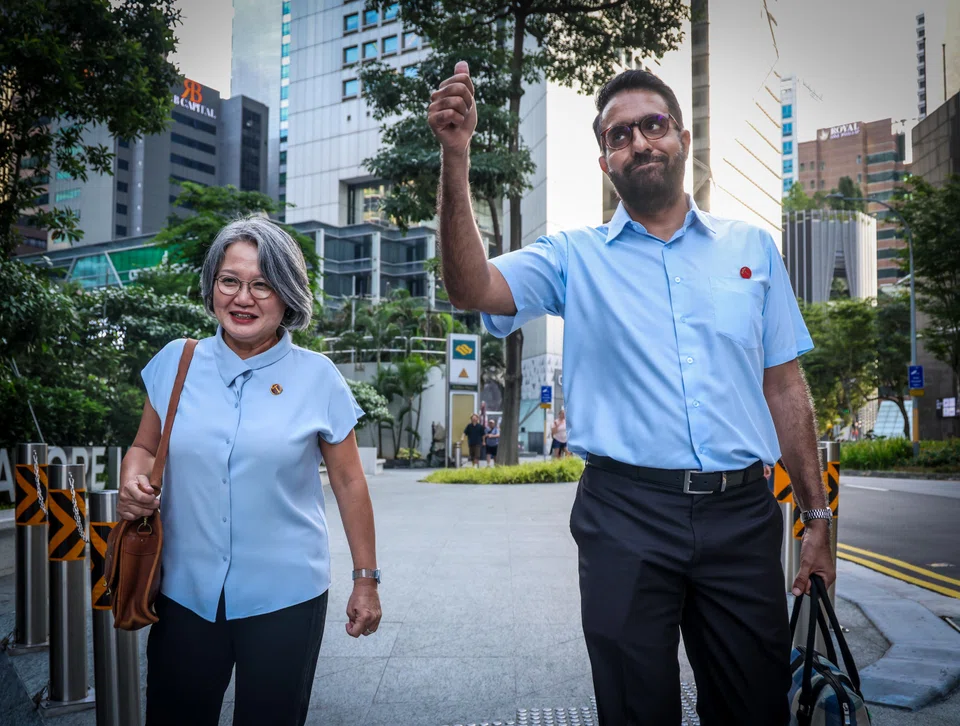
[SINGAPORE] Workers’ Party chief Pritam Singh returned unopposed at the party’s internal elections on Jun 28 after a group of unhappy cadres failed to force his resignation at an earlier meeting on the same day.
This solidifies his leadership of Singapore’s largest opposition party after several years of challenges stemming from former Sengkang GRC MP Raeesah Khan’s lies to Parliament in 2021, said analysts.
Speaking to the media after his reelection, Singh said: “The party understands that its purpose is to behave in a rational and responsible way and represent Singaporeans faithfully.
“And if we want to continue to do that, I think we have to close ranks as any reasonable and respectable political party ought to do.”
He added that the outcome of a secret ballot on his resignation showed “the party is pretty united”, while declining to reveal the vote’s exact figures.
Aljunied GRC MP Gerald Giam, who chaired that meeting, said Singh had secured “well in excess of a supermajority” of support from the party’s inner circle, who number slightly more than 100.
Party sources said Singh got about 80 per cent of the vote.
The meeting had a robust and civil discussion with only one round of voting, Giam said.
Cadres were able to raise their concerns and Singh delivered a statement and answered their questions. “There was a proper accountability, accounting for the question at hand,” he added.

The conference was triggered by a December 2025 letter signed by 25 unhappy cadres sparked in part by Singh’s legal troubles.
It had three items on the agenda: for Singh to account to cadres for his behaviour leading up to his court convictions; for him to step down; and for him to face a secret vote on his continued leadership if he did not step down.
Asked about the disgruntled cadres, Singh said that matters they raised had been dealt with.
He added: “I’m quite sure they respect the democratic process as we all do, and the decision was what the cadres decided it ought to be.”
“There was a petition, and it was a reflection of how we do things at the party, and I think it’s important for us to speak what’s on our mind, share our values, and that’s what the party did.”
Leading up to the vote, the unhappy faction had been searching for a challenger to Singh, amid uncertainty of former chief Low Thia Khiang’s continued support for his successor.
Early on Jun 28, Low laid these rumours to rest, telling the media that he continues to support Singh while making his way to the meetings which started at noon.
The special cadres conference was followed by the party’s usual biennial internal elections at 3 pm. There, WP chair Sylvia Lim was returned as well to a position she has held since 2003.
The party also elected 12 other members of its top decision-making body – its central executive committee (CEC). Most were reelected from the previous CEC.
Three of the 12 are not sitting MPs – Low, long-time CEC member Tan Kong Soon and the sole new addition, senior counsel Harpreet Singh. He ran as part of the WP’s Punggol GRC team at the last general election in May 2025.
The party can still co-opt another seven to its CEC and typically does this about a month after its election.
In a social media post following the election, Harpreet Singh said WP cadres did not act with “blind loyalty” in re-electing Pritam Singh.
Instead, they made a careful assessment based on his track record, he said.
“We have all seen that through his tireless service, his calm under sustained political pressure, and his steady, measured leadership that has brought the party to significant milestones in Singapore’s parliamentary history,” he said on LinkedIn.
The vote was to decide whether Pritam Singh remained fit to lead the party after the High Court upheld his convictions for lying to a parliamentary committee, he added.
“None of this is meant to dismiss the Court decision – the judgment stands and must be respected,” he said. “But a person’s full history matters when assessing character.”
The meetings came two months after Singh received a formal letter of reprimand from the CEC over his conviction for lying in Parliament about his handling of Khan’s matter.
The CEC was responding to the findings from a disciplinary panel comprising Sengkang GRC MPs Jamus Lim and He Ting Ru, and former Hougang MP Png Eng Huat. The panel found that Singh had contravened two articles of the party’s Constitution in his actions relating to Khan’s lies to Parliament.
Singh was found by Parliament’s Committee of Privileges and the courts to have guided Khan in maintaining her lie for several months. He appealed his court conviction, but it was upheld by the High Court in December 2025.
He was later pronounced unsuitable as Leader of the Opposition by Parliament in January 2026, and was removed from the position by Prime Minister Lawrence Wong shortly after. PM Wong had also invited WP to nominate another MP for the post, but the party declined to do so, maintaining that the role should be filled by the leader of the largest opposition party in Parliament.
Asked about the LO position after his party’s election, Singh said: “There’s no change…The operation of our political system is such that it’s the prime minister who makes the decision, and I believe he’s already made his decision.”
The start of a new chapter for WP?
Institute of Policy Studies senior research fellow Gillian Koh said the “smooth outcome” was expected after Low expressed his support for Singh.
Independent political observer Felix Tan said the result means most cadres want to “put a close and a full stop” to the issue, and bring the focus back to Parliament and policy.
The outcome also sends the message that cadres do not feel that there is a better alternative within the party, and that they want stability, he said.
Mustafa Izzuddin, a senior international affairs analyst at Solaris Strategies Singapore, said: “It appears that the call for a special cadres conference was made by a vocal minority, rather than a silent majority who are supportive of Pritam.”
Singh’s electoral record was also a factor.
“It was on his watch that WP attained the largest number of seats in Parliament after the formation of Group Representation Constituencies in 1988, and gave rise to the notion that only if WP competes, those contested electoral seats will see an intense fight with the ruling party,” Mustafa said.
Singh had at the May 2025 general election led the WP to its largest-ever parliamentary contingent with 10 MPs and two Non-Constituency MPs.
The party has set out to demonstrate it has its own processes of accountability, Koh noted.
“With the 12 men and women in blue in Parliament, it will be time for WP to close this chapter and build on the momentum on the ground to strengthen the opposition movement in Singapore.”
Nydia Ngiow, managing director at strategic advisory firm BowerGroupAsia Singapore, said WP’s role as the check on the government is better served by a settled leadership than protracted unhappiness over an issue from several years ago.
She noted that the more interesting signal was from WP chair Sylvia Lim touching on how she had held the position for 23 years.
“Her comments pointing towards an eventual transition suggests that WP is starting to think seriously about the next chapter of its leadership as it celebrates its 70th anniversary next year.” THE STRAITS TIMES
Decoding Asia newsletter: your guide to navigating Asia in a new global order. Sign up here to get Decoding Asia newsletter. Delivered to your inbox. Free.
Share with us your feedback on BT's products and services
TRENDING NOW

LTA proposes combining car COE categories, adding rebate-surcharge system

StarHub to acquire MyRepublic’s mobile business amid ongoing telco consolidation

DBS, OCBC, UOB rout lops billions off STI as inflation, rate concerns spook investors

Grab CEO’s wife Chloe Tong on life with Anthony Tan and finding her purpose

