

Proportion of poly graduates who secured employment dips to 90%: survey
Median monthly salary among those in full-time permanent roles increases year on year to S$3,000
Jermaine Fok
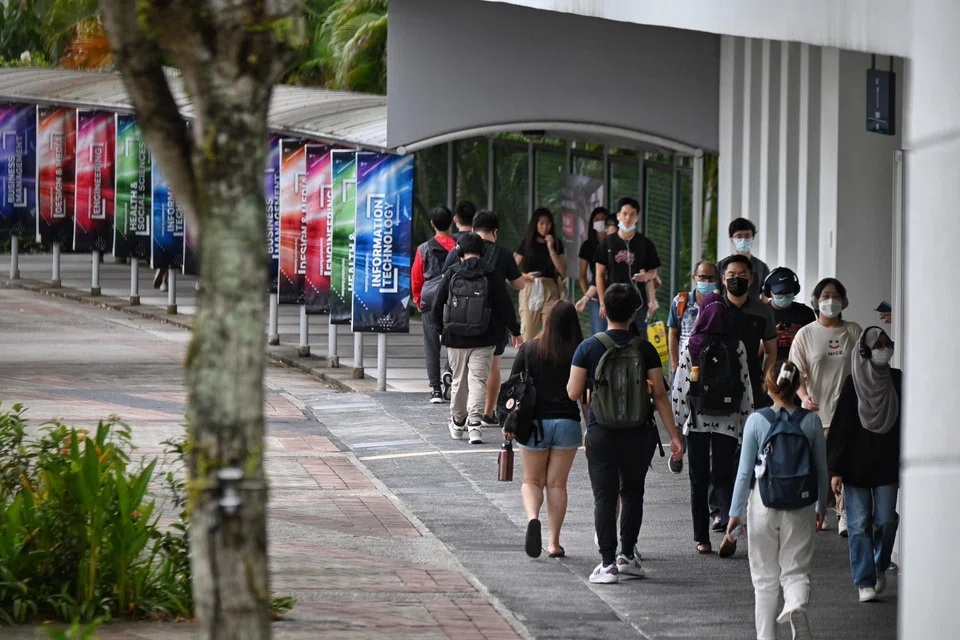
[SINGAPORE] The share of polytechnic graduates who secured jobs fell marginally in 2025, but the median salary for full-time permanent roles rose, the Graduate Employment Survey released on Thursday (Jan 15) showed.
The survey, jointly conducted by Singapore’s five polytechnics, noted that the proportion of polytechnic graduates – including fresh graduates and post-National Service (NS) graduates – who secured employment within six months of completing their final examinations or NS slipped to 90 per cent in 2025.
This marked a second consecutive year-on-year decline, from 90.4 per cent in 2024 and 95.8 per cent in 2023.
The survey defined employment as being currently employed, having accepted a job offer, or taking steps to start a business venture.
For fresh graduates, the rate was lower, at 88.5 per cent. This marked a year-on-year fall, from 88.7 per cent in 2024, and was also below 2023’s 95.3 per cent rate.
Citing Ministry of Manpower labour market data for the third quarter of 2025, the polytechnics said that the financial and insurance services and health and social services sectors led resident employment growth.
But there was subdued economic growth in outward-oriented sectors, such as information and communications, due to the uncertain global economic environment.
That said, the median monthly salary among graduates in full-time permanent roles increased to S$3,000, from S$2,900 in 2024. Humanities and social sciences polytechnic graduates brought home the highest pay, at S$3,200.
Findings showed that fresh graduates continue to be in demand, with entry-level vacancies increasing from 26,000 in September 2024 to 39,000 in September 2025.



About four in 10 vacancies were in growth sectors, including information and communications, financial and insurance services, and professional services.
The polytechnics noted that employment figures “generally continue to improve beyond the six-month mark, as more graduates subsequently secure jobs”.
For instance, the employment rate for the 2024 cohort was five percentage points lower than the 2023 cohort at the six-month mark. By the 12-month mark, the gap had narrowed to one percentage point. (*See amendment note)
The government launched the Graduate Industry Traineeships in October 2025 to provide fresh graduates with no prior working experience the opportunity to gain hands-on experience for a successful transition into full-time roles.
Lim Kok Kiang, principal and chief executive officer of Ngee Ann Polytechnic, said schools will continue to expand workplace immersion and career guidance that help students “build meaningful and sustainable careers”.
The poll, which surveyed 12,835 out of 18,430 graduates, was conducted from Oct 1 to Nov 30, 2025.
Fresh graduates from the 2025 cohort were polled about six months after their final examinations. Meanwhile, post-NS graduates, who were from the 2022 cohort, were polled between six months and 1.5 years after completing NS.
*Amendment note: An earlier version of this story said the 2024 cohort’s employment rate rose between the six-month and 12-month marks. The Ministry of Education has clarified that these data points cannot be compared directly due to different collection methods. The story has been revised to reflect this.
Decoding Asia newsletter: your guide to navigating Asia in a new global order. Sign up here to get Decoding Asia newsletter. Delivered to your inbox. Free.
Share with us your feedback on BT's products and services






