
COMMENTARY

Off the rails but still on the clock: MRT disruption underscores need for flexible work

Flexible work arrangements could have eased the strain for commuters during the six-day East-West Line disruption

Renald Yeo
Published Fri, Oct 4, 2024 · 05:00 AM
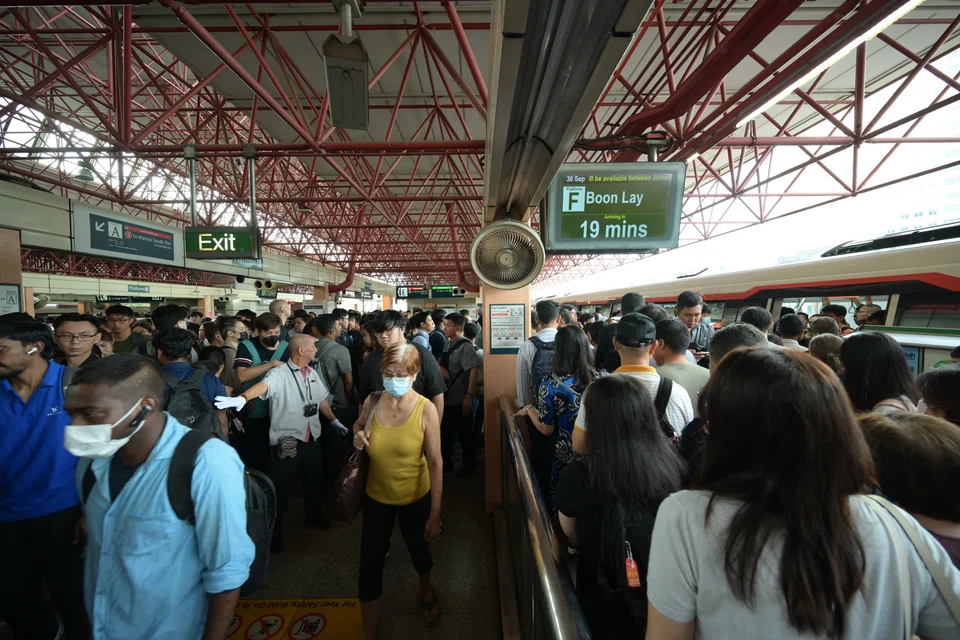
    • Many commuters were likely to have been employees travelling during peak hours.
    • Many commuters were likely to have been employees travelling during peak hours. PHOTO: NG SOR LUAN, ST

    FOR some commuters, the recent East-West Line train disruption served as a bumpy reminder that flexible work arrangements can sometimes be more of a necessity than a luxury.

    For six days – from the morning of Sep 25 until services resumed on Oct 1 – hundreds of thousands of commuters had to find alternative transportation.

    Many endured long queues, braved harsh weather and crammed into crowded bridging buses for journeys that took much longer than usual.


    Many of them were likely to have been employees commuting during peak hours. This raises the question: how many of these workers could have worked remotely or adjusted their hours to avoid the rush?

    For every aircraft mechanic or barista who must be physically present at work, there are workers who do not.

    Administrative assistants or bookkeepers, for instance, could have temporarily transitioned to remote work during the disruption, thereby easing the strain on the transport system.

    The disruption underscores why more companies should consider offering flexible work arrangements when needed – especially those that reverted to traditional setups post-pandemic.

    At a minimum, they should update their business continuity plans to address scenarios such as public transport disruptions, ensuring that both supervisors and employees are ready to respond appropriately.

    Flexible work readiness

    From December, all employers must establish a formal process for employees to request flexible work arrangements, in line with new tripartite guidelines.

    However, the effectiveness of this may be limited during unforeseen events such as the recent train disruption.

    In such scenarios, requesting and implementing flexible work schedules might take too long to help the situation.

    Moreover, many businesses may lack the infrastructure or readiness to pivot to remote work or staggered hours on short notice.

    It is therefore crucial to establish flexible work arrangements proactively, rather than scrambling to implement them when a situation arises. This would ensure smoother transitions and reduce disruptions for both employers and employees.

    We can draw lessons from the early days of the Covid-19 pandemic, when businesses were forced to scramble and rapidly digitalise their operations for remote work as movement restrictions took effect.

    Lessons learnt from that rapid shift to remote work should guide today’s implementation of ad hoc flexible work arrangements.

    Businesses that had the foresight to transition from desktop to laptop-based environments before the pandemic, for instance, avoided the chaotic scramble and maintained higher productivity.

    Of course, not all industries can easily accommodate remote work. Sectors such as healthcare, retail and manufacturing – where round-the-clock operations are necessary – naturally face more significant challenges in offering flexibility.

    For these sectors, staggered shifts or flexible working hours could be viable alternatives to remote work during similar disruptions.

    Employee well-being

    Having a framework for ad hoc flexible work arrangements is not just about convenience, but about supporting employee well-being.

    Indeed, if there was one word to describe the mood of affected commuters during the six-day disruption, it might be “frustration”.

    Media reports highlighted instances of tempers flaring, with unfortunate transport staff bearing the brunt of some commuters’ angst.

    Part of this frustration undoubtedly stemmed from missed meetings, disrupted schedules and the overall stress of extended commutes.

    Employees with flexible or remote working arrangements would have been spared such stress.

    The disruption should prompt a broader conversation among employers about the benefits of flexibility even in a post-Covid world.

    In the long run, fostering a flexible work culture may prove critical to ensuring that both employees and employers can weather any storm – be it a pandemic or a public transport breakdown.


