‘Reliability, stability and transparency’ key to Singapore’s response to geopolitical shocks: Edwin Tong
Law minister says Singapore, as a small country, feels global tremors more acutely than most
Jermaine Fok
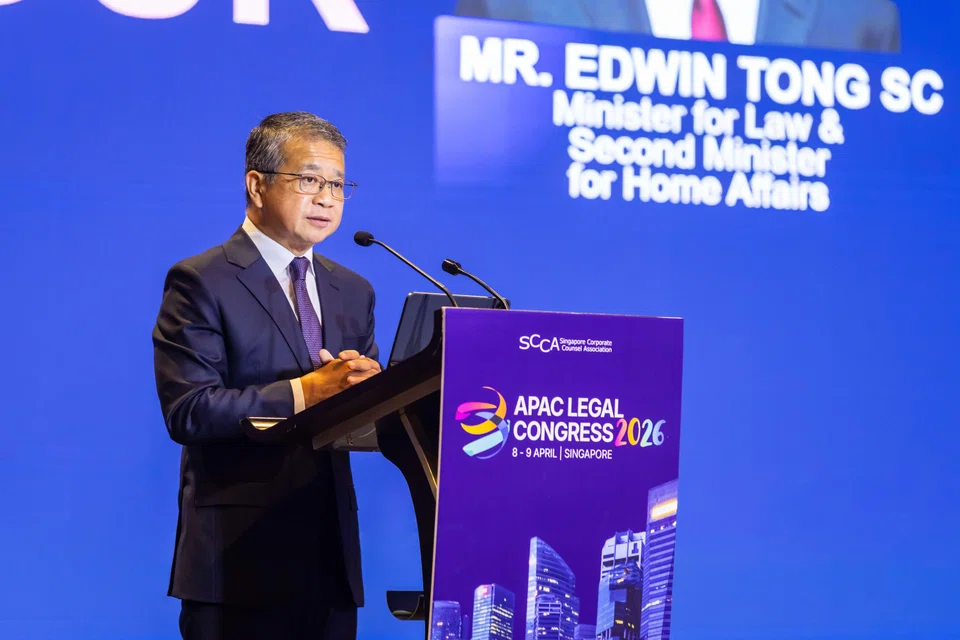
[SINGAPORE] Singapore’s position as a safe harbour for businesses navigating an increasingly unpredictable global landscape is anchored by three core principles – reliability, stability and transparency – said Law Minister Edwin Tong on Wednesday (Apr 8).
Speaking at the Singapore Corporate Counsel Association (SCCA) Asia-Pacific Legal Congress, he said these principles are “operating commitments” underpinning the Republic’s legal and business ecosystem.
“As a small, open economy, we feel the tremors more acutely than most,” he said. “Supply chain fragmentation affects our businesses. Trade tensions raise costs across our economy”.
Against this backdrop, he stressed the importance of the three principles in responding to geopolitical shocks.
On reliability, the minister pointed to the country’s strong intellectual property protections, clear regulatory regimes and dispute resolution ecosystem.
This, he said, “gives every business operating here the quiet confidence that: if something goes wrong, there is a fair, efficient and trusted path to resolution”.
He also underscored the importance of stability for long-term planning, noting that Singapore’s policy directions remain consistent despite global uncertainty.
“Our policy directions do not shift with geopolitical winds. Our commitment to open borders is not rhetorical,” he said.
“While others turned inward, we deepened our network of free trade agreements. While others retreated, we doubled down on our commitment to fair, open and inclusive commerce.”

Transparency and predictability
Tong also highlighted transparency and predictability as key pillars, noting that regulations are often “co-created” through direct engagement with businesses.
He added that these strengths have translated into tangible outcomes.
About half of global multinational corporations with Asia-Pacific regional headquarters are located in Singapore. Over 4,000 businesses with revenues exceeding S$100 million are also operating here, he said.
In addition, fixed asset investment has grown steadily, rising from S$11.5 billion in 2015 to S$14.2 billion in 2025, with capital increasingly flowing into sectors such as artificial intelligence, the green economy and precision medicine.
Singapore has also established itself as a hub for innovation, hosting over 4,000 technology startups and capturing more than two-thirds of the region’s venture capital funding.
In his remarks at the conference, SCCA president Daniel Choo underscored Singapore’s position as a regional business hub.
“Singapore sits at a crossroads of capital, trade, technology and regulation. What emerges here often does not remain local, it becomes regional,” he said.
The SCCA president added that in-house counsels today are expected not only to interpret rules, but to anticipate how shifting regulations, supply chains and societal expectations interact across borders.
Noting the diversity of legal systems, regulatory maturity, technological adoption and geopolitical contexts across Asia-Pacific, Choo said regional collaboration within the legal system is increasingly important.
The event also saw the signing of memorandums of understanding between the SCCA and the In-House Counsel Forum Korea, as well as the Legal Management Council of the Philippines.
These partnerships aim to deepen collaboration and foster a more connected in-house counsel community across jurisdictions. Last year, SCCA inked agreements with its regional counterparts in Indonesia, Japan and Thailand.
Now in its fourth year, this year’s congress saw some 2,500 participants – the largest attendance for a legal conference outside North America.
The event runs until Thursday and will discuss the theme of generative AI and its effects on in-house legal teams locally and regionally.
Decoding Asia newsletter: your guide to navigating Asia in a new global order. Sign up here to get Decoding Asia newsletter. Delivered to your inbox. Free.
Share with us your feedback on BT's products and services