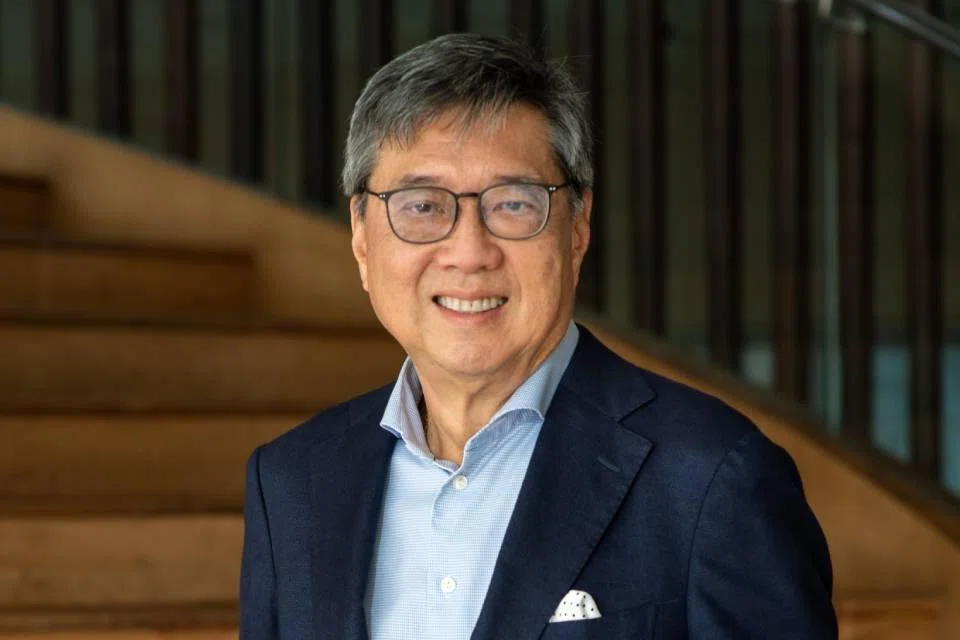
Richard Eu on how core values, customers keep Singapore’s TCM chain Eu Yan Sang relevant
New markets expansion, heightened focus on online e-commerce penetration and continuous new product development are on the cards
Inside Asia’s family empires: How they are transforming to seize the next stage of growth
[SINGAPORE] At wellness company Eu Yan Sang, mistakes are not only permitted, but also encouraged.
“Encouraging innovation also means allowing failure, so leaders must be prepared to accept that not every new idea will succeed,” explained group chairman Richard Eu.
“I believe it’s more important to try something new and be prepared to fail, rather than not try at all.”
That has been his guiding principle since he assumed leadership of the company, which was founded by his family nearly 150 years ago as a shop in Gopeng, Perak.
Eu Yan Sang is no longer majority-owned by the founding family after a Japanese consortium bought 86 per cent of the company in 2024. Eu retains close to a 10 per cent stake.
In his first extensive interview since the deal, the fourth-generation leader, who has been chairman of the traditional Chinese medicine company since 1989, noted that he has seen plenty of change over the years, such as how employees view their jobs.
In the past, staff tended to stay longer, especially if they were treated as part of “the family”, the 78-year-old said. But among younger workers, this mindset has “somewhat changed”.
“Now, they are looking more for instant gratification – to earn money more quickly. That would be a challenge that we face in the near future – talent retention. So it is important to temper their expectations as we are not like a tech company, for instance, that can pay huge bonuses. We are not that kind of company.”
Eu Yan Sang’s 147 year history can be traced back to its establishment by Eu’s great-grandfather, Eu Kong in Gopeng in 1879.
His grandfather, Eu Tong Sen, was a leading figure in the tin mining and rubber plantation industries. As he expanded his network of tin mines, he set up medical shops alongside.
But by the time, Eu joined the company in 1989, little of the business empire remained. As he put it, the customer base was “shrinking” when he joined.
“I had to reset to make ourselves relevant to the modern consumers and modern conditions.”
Construction firm Lum Chang acquired the company’s pharmaceutical arm in 1990. In 1993, Eu and three cousins staged a S$21 million buyout of the business – a move that gave them the “critical mass to create the company we know as Eu Yan Sang International today”.
In 1996, Eu Yan Sang’s business was consolidated by merging the Singapore and Malaysia units with its Hong Kong entity.
Following the merge, Eu envisioned a monolithic identity, in which both the shops and products share the same branding, similar to British skincare company The Body Shop from which he took inspiration. All of its products had the same branding as the store’s name, which was uncommon at the time.
“We had five medical halls in Malaysia and one in Singapore – and they were all focused on retail. So it was a natural development as we didn’t consider ourselves a manufacturing company.”
One of the earlier hurdles during his leadership was in 1997, during the Asian financial crisis when the company had to navigate the economic downturn.
“We were lucky that the (Asian financial) crisis was short-lived enough for us to tide through that period; and we partnered a company – probably referred to as a private equity firm today – that allowed us to still make some deals,” he added.
Plus, he said, the re-acquired entity did not have much debt, thanks to the cash flow from its business-to-consumer model.
Staying relevant to customers
The financial crisis also taught him that despite preparation, one can still be caught by surprise. “I think we have to remember what we are here for and what makes us relevant… You just keep asking these fundamental questions (for the business) to stay alive,” he said.
For Eu Yan Sang, the answer is “to be a health partner to our customers”. “People are always concerned about their families’ health, as well as their own,” the chairman added.
This notion is also in line with the brand name – “Yan Sang” which means “caring for mankind” in Cantonese. It also resonates with its customers, who are mostly above 35 years old.
Their support helped the company through difficult times such as Hong Kong’s Occupy Central protests and the Covid-19 pandemic when consumer sentiment took a beating.
“As a company, you try to survive by staying relevant. If you don’t have a customer base, you don’t have a business,” Eu said.
The group also saw the value of going digital early on, and had already transitioned the business before Covid hit.
“Thank goodness we started e-commerce before (the pandemic),” he said. “Personally, it is a challenge to navigate changing landscapes all the time. It keeps you on your toes, and you don’t know what happens next. Everything is cyclical – there are good times and bad times, but it is never a steady state at one or the other.”
He added: “To a large extent… if you don’t have the right vision, (your business) can fade into oblivion. I’m only responsible for setting a vision and a direction, but the execution is not me at all. It is everyone else.”
Therefore, it is important to explain the vision and mission to the staff – by being on the same page, “we can move accordingly and not have too much conflict internally… There is always going to be politics, but it is about how you navigate them”.
Guiding principles in alignment
Another guiding principle for Eu is a famous quote by the UK statesman Winston Churchill: “The farther backward you can look, the farther forward you are likely to see.”
“Things change, and the family is no longer the owner of the business. But I am still a shareholder, and I still care much for (the business). Even my relatives who are no longer shareholders (still) feel an attachment because it is family history,” he said.
“What we try to do on the family side is try and align our values with the company’s values, and we try to ensure the company continues on that trajectory.”
Giving back, for example, is important to the family. In 2024, it launched the Dr Richard K M Eu-SIM Social Entrepreneurship Centre, or Ressec, at the Singapore Institute of Management.
Ressec was the product of a two-year partnership between the institute and the family of the late Dr Richard Eu Keng Mun, SIM’s founding chairman and a former chairman of Eu Yan Sang. The centre offers postgraduate and professional development courses for budding social entrepreneurs and social service professionals.
The chairman said: “I think many business leaders feel that they should contribute back to society when they have achieved material success and have the means to do so.”
But they are more careful as it may involve their bottom line.
“Most times, this would be part of the CSR (corporate social responsibility) programme. For Eu Yan Sang, corporate giving is aligned with the mission of the company, which is ‘caring for mankind’,” he said.
“Perhaps more companies will do it if there was some recognition – for example, through corporate awards and making shareholders recognise that such giving is part of the company’s DNA.”
Eu Yan Sang International, the holding company, listed on the Singapore Exchange mainboard in 2000 after an initial public offering of 71.5 million shares at S$0.35 each.
Eu called it one of his “biggest achievements”, adding that the company was lucky to have been part of the early history of the bourse, which was formed in 1999 through the merger of Stock Exchange of Singapore and Singapore International Monetary Exchange.
Not an extension of a family office
Although there are now more regulations surrounding listed companies, he noted that the fundamentals have not changed. “You have to manage the business objectively, not as an extension of a family office… (as there are) many minority (shareholders) involved.”
The entity was delisted from the Singapore Exchange in 2016, following a privatisation bid by a consortium including the Eu family, Tower Capital Asia and Temasek. At the time, it was valued at US$196 million.
“We decided to privatise partly because one of my cousins wanted to sell his stake. The remaining family members and shareholders decided it was probably a (good opportunity) to find a way to bring in institutional shareholders,” Eu said.
“We knew it probably wasn’t going to be easy, but I felt for the future of the company, (it was necessary) that we bring in institutional investors. Then, we can take out (certain issues), as when a family business gets big, it gets more complicated (for) shareholders.”
More recently, in 2024, a Japanese consortium led by Mitsui and Rohto Pharmaceutical bought 86 per cent of Eu Yan Sang for a total cash consideration of about S$687 million. The move valued the company at around S$800 million.
“This partnership marks a new chapter for the company. They are more strategic than financial investors,” Eu noted.
With the move, new markets expansion, heightened focus on online e-commerce penetration and continuous new product development are on the cards.
At the end of the day, he said, the company must return to its purpose – which is treating people right. Nothing can ever be totally cast in stone, but core values such as that are crucial regardless of the situation, he added.
TRENDING NOW
Grab CEO’s wife Chloe Tong on life with Anthony Tan and finding her purpose
Brokers maintain ‘buy’ on CDL despite investor reservations over strategic review
Deal between tycoon friends sparks scrutiny of Philippine power sector
Hwa Seng Builder, two China companies win S$1.2 billion Tuas Road Viaduct phase two contracts