

RTS Link could cause S$290 million net increase in outflow annually for Singapore: study
The city-state’s central region is seen to gain from JB visitors in high-end retail, entertainment and dining

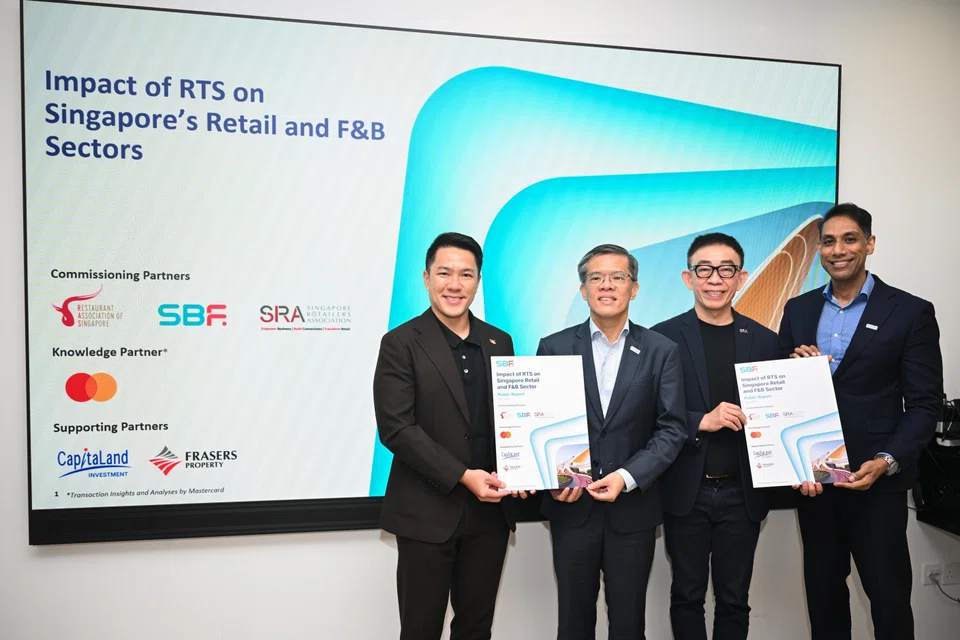
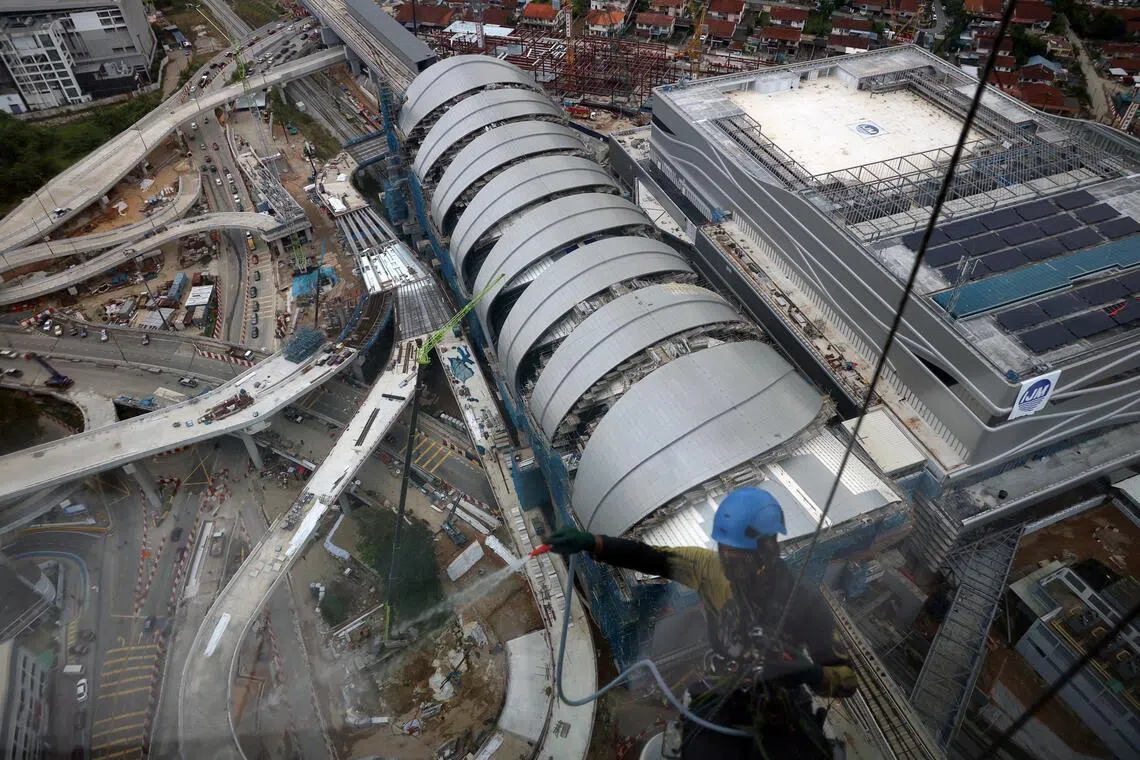
[SINGAPORE] The Republic is expected to record a S$290 million net increase in outbound annual spend in Johor Bahru after the Johor Bahru-Singapore Rapid Transit System (RTS) Link opens next year.
The figure represents 0.4 per cent of Singapore’s total retail and F&B sales in 2025.
This is according to a study on the impact of the RTS Link on these sectors that was released on Thursday (Jul 16).
Singapore consumers are projected to spend S$1.05 billion more in JB each year, with improved connectivity after RTS’ scheduled opening in January 2027.
Visitors from JB, conversely, are expected to contribute an additional S$756 million annually to the Republic’s retail and F&B businesses.
The study was jointly commissioned by the Singapore Business Federation (SBF), Restaurant Association of Singapore (RAS) and Singapore Retailers Association (SRA).
The RTS will accelerate a structural re-allocation of demand, and many Singapore businesses will see tighter margins, weaker footfall and a need to compete on factors beyond price, it said.
But opportunities could also arise from more JB visitors to Singapore, especially for premium retail, entertainment and major lifestyle events.
The study projects a 51 per cent increase in outbound trips by Singapore consumers, with the RTS Link adding 11.2 million Singapore-JB round trips, and 3.3 million such trips in the other direction annually. This is equivalent to an estimated daily ridership of 39,700 trips.
Some 34 per cent of JB respondents intend to visit Singapore for events after the launch of RTS, up from 24 per cent today.
Spending breakdown
SBF chief policy and operating officer Musa Fazal highlighted an “interesting distinction” between Singapore and JB consumers’ spending across the border.
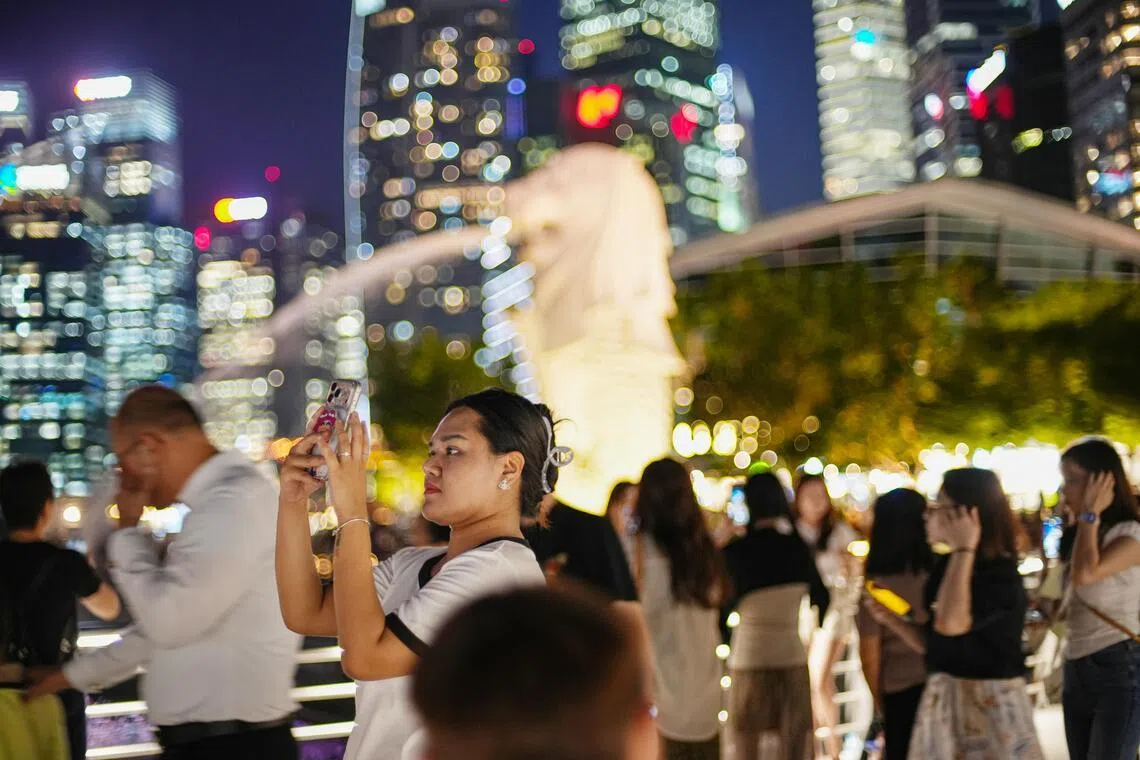
“Singaporeans in JB pretty much spend on everything, so we behave like the locals, whereas JB consumers in Singapore behave like tourists. And so they come to the city centre to shop. They go to our tourist attractions. So we see many of them are event goers.”
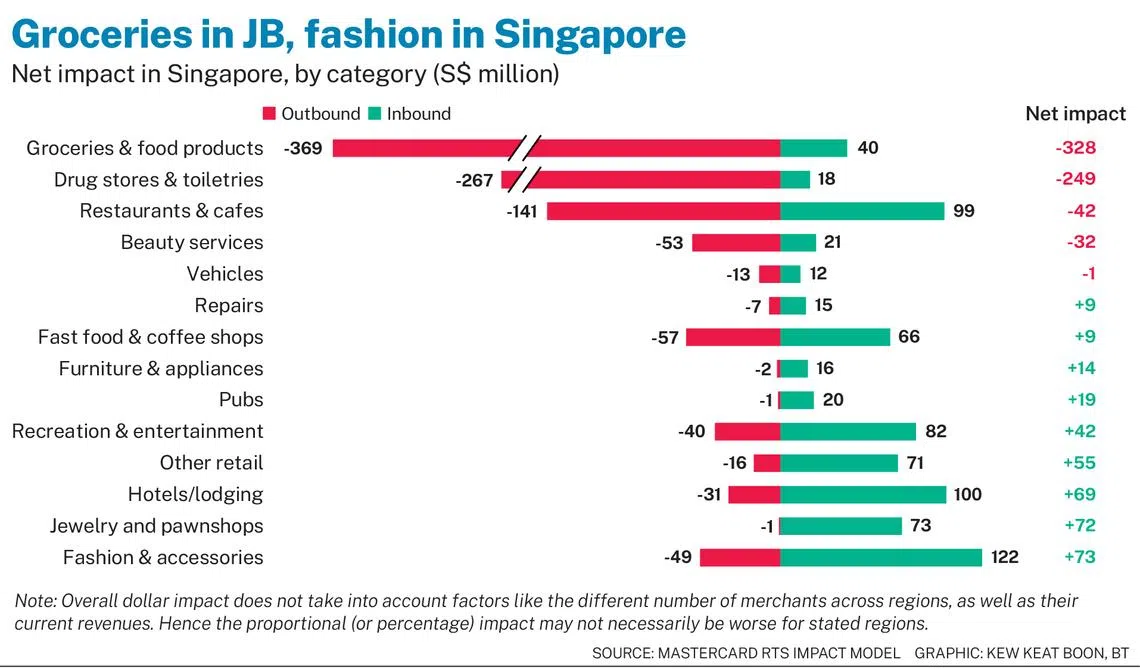
Groceries are expected to account for the largest share of Singaporeans’ spending in JB, followed by drug stores, dining and beauty.
In comparison, Singapore should see strong incremental inbound impact in higher-end retail shopping, entertainment, hotel and dining.
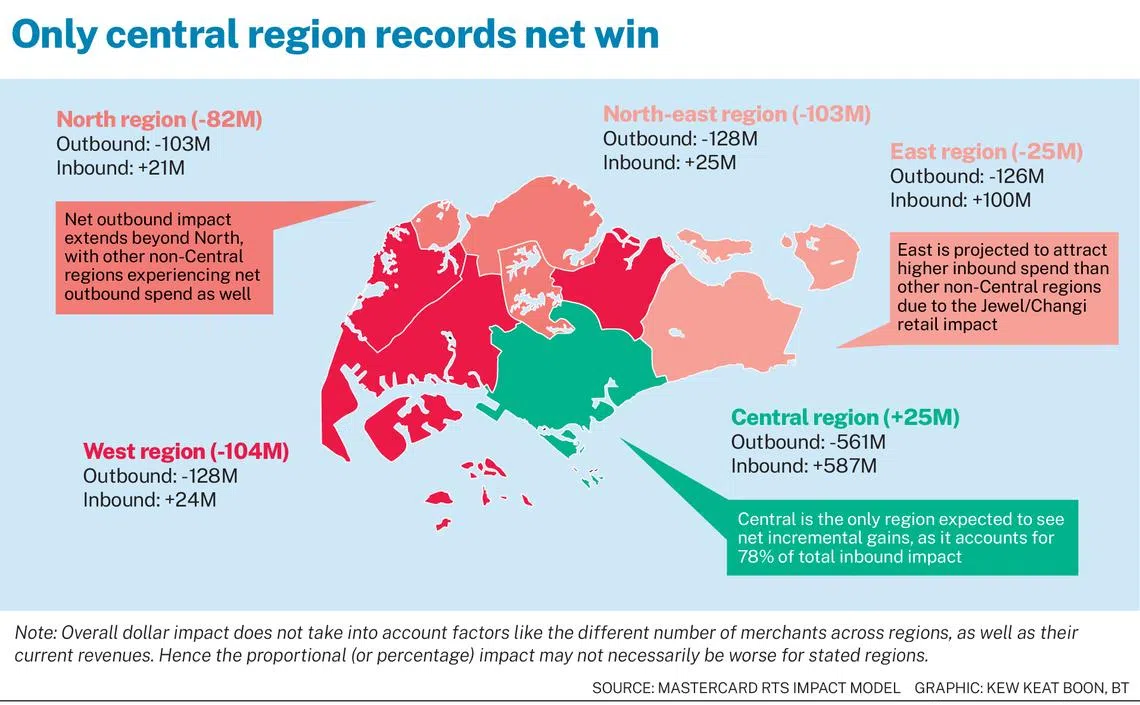
The city-state’s central region is expected to see a net incremental gain, as it accounts for 78 per cent of the total inbound impact, the study found.
Other regions are expected to see a net outbound impact, with the east being relatively cushioned due to retail at Jewel and Changi.
“Regions outside the north are expected to feel a greater net impact, as the north already sees higher outbound spend pre-RTS,” added SBF, RAS and SRA.
Competition and opportunity
Retail and F&B collectively contributed about S$16.6 billion to Singapore’s gross domestic product in 2025, accounted for about 17.5 per cent of the local workforce, and made up about 31 per cent of tourism receipts.
Hence, the RTS matters not just for the sectors, but also for the Singapore economy, said SBF CEO Kok Ping Soon.
The RTS Link will reshape travel, shopping and dining across Singapore and JB, he added. “This shift is structural, not incremental.”
Focus group discussions reinforced concerns that the RTS Link would accentuate competition from JB, especially in price-sensitive categories where lower cross-border prices are already influencing spending.
Businesses agreed that beyond competing on price, they would need to differentiate themselves through service quality, unique customer experiences and locally distinctive offerings.
But persistent manpower, compliance and cost pressures limit their ability to innovate and scale, they said.
Small and medium-sized enterprises, worried about not adapting as quickly as larger operators, called for more support to strengthen competitiveness and capture new opportunities from increased cross-border flows.
Industry, government support needed
Based on the findings, SBF, RAS and SRA identified three priority areas for action, and outlined 10 policy recommendations.
First, the industry and government should stimulate local spending through new and expanded voucher schemes and support for stronger offerings, especially in categories and locations most exposed to cross-border substitution.
Second, they should encourage longer stays and more spending in Singapore from RTS-enabled tourists, by strengthening the country’s appeal as a destination for experiences, events and higher-value consumption.
This can be done through leveraging mega events, decentralising event infrastructure, reinventing night-time offerings, enabling cross-border offerings and extending tax refunds.
SRA president Ernie Koh said that it is talking to landlords that have a presence in JB, and is partnering retailers’ associations there to discuss working together to provide complementary offerings, rather than competing.
Finally, they should address structural cost pressures and support new operating and business models for retail and F&B operators, to help them adapt and seize new opportunities in a more integrated Singapore-Johor corridor.
This includes supporting asset enhancements through targeted incentives, facilitating cross-border optimisation, easing short-term manpower constraints through reviews of foreign manpower policies, and encouraging sustainable and adaptive rental approaches.
The study also underscores the need for stronger collaboration among trade associations, landlords, tourism stakeholders and government agencies, to help businesses better respond to changing trends and increased connectivity, added SBF, RAS and SRA.
RAS president Benjamin Boh said that businesses must be empowered with manpower agility and operational flexibility, to capture both local and tourist spending.
SRA’s Koh said he looks forward to such government mitigation measures over the next three to five years, even as retailers pivot towards experiential concepts and malls “curate tenant remixes”.
The study, conducted in March, surveyed about 1,700 respondents in Singapore and 400 respondents in Johor. It excludes JB residents who work in the city-state, to capture the behaviour of leisure travellers only.
It draws on data sources including Mastercard historical transactions, consumer surveys, government statistics and industry consultations.
Decoding Asia newsletter: your guide to navigating Asia in a new global order. Sign up here to get Decoding Asia newsletter. Delivered to your inbox. Free.
Copyright SPH Media. All rights reserved.
TRENDING NOW
8 public officers referred to police over property buys near unannounced MRT stations: Chan Chun Sing

Grab CEO’s wife Chloe Tong on life with Anthony Tan and finding her purpose
Retrenched PMETs who return on lower pay see median 25% wage cut
Hao Mart owner resisting OG’s mortgage foreclosure on his Tanglin GCB

