

Shariot’s woes reflect rough road for car-sharing in Singapore: observers
High and fluctuating costs, small scale and operational difficulties may have been factors

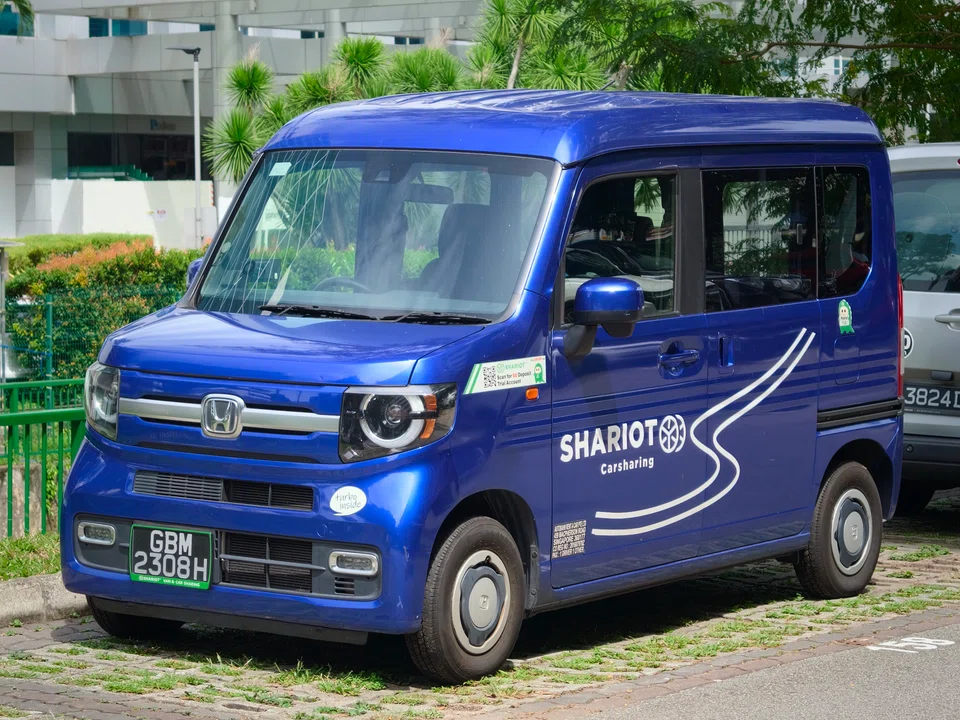
[SINGAPORE] With Shariot being the latest car-sharing venture to run into trouble, observers say that extremely high costs, difficulties in driving usage, and compelling alternatives mean car-sharing continues to be a tough business in Singapore.
On Wednesday (Nov 27), Shariot and eight related companies – including two other car rental services, Autobahn Rent A Car and Shinsei Rent A Car – were confirmed to be exploring restructuring options, with debts of around S$180 million.
Electric-vehicle car-sharing outfit BlueSG laid off staff and paused for an operational revamp in August, while Smove, which boasted the largest car-sharing fleet in 2018, went into liquidation in 2020.
“This is an industry that everyone has been saying will be the next big thing for the past 20 years – but nobody has found a sustainable business model yet,” said Walter Theseira, associate professor of economics at the Singapore University of Social Sciences.
Shariot is part of a group of nine related automotive companies named in a lawyer’s letter asking creditors to hold off on enforcement or recovery actions as the group considers restructuring options.
The companies are owned by Tan Boon Kee, also known as Roy Tan, the founder and managing director of Shariot. Tan did not respond to queries from The Business Times.
Paying the cost
Industry observers said that costs are a key difficulty for car-sharing services.
Nicholas Wong, chief executive of authorised Honda dealer Kah Motor, said: “The car business in Singapore is very competitive and highly capital-intensive. The capital investment for car purchases is very high, and cars are a depreciating asset, so (they) need to be very carefully managed.”
Kah Motor operated a car-sharing service called Honda Diracc, which ended in 2008 as it was unprofitable.
The high costs are compounded by how car-sharing requires a large number of cars and a wide network of locations to ensure enough users.
“You need volume and scale: The network must be strong, wide, and you need to have a lot of vehicles,” added Wong.
Shariot launched in 2020 with a fleet of 250 vehicles, providing short-term rentals. In 2023, it added 300. According to its website, it has more than 200,000 users and 300 locations in Singapore.
Its vehicles may have been owned by Autobahn Rent A Car, which accrued the majority of the S$180 million debt, and which has around 1,700 cars. It is understood that the nine companies have linked financial, operational and fleet-related arrangements.
Industry observers estimate that a fleet of that size would cost S$100 million to S$200 million.
Wong said that unless car-sharing vehicles are fully utilised, they lose more money compared with those that are leased, which generate monthly cash flow independent of usage.
Car value depreciation also puts extra pressure on car-sharing. Cars in Singapore depreciate at S$1,000 to S$2,000 a month, versus a few hundred dollars in other markets, noted Prof Theseira.
Maximum utility
Given the high capital outlay, car-sharing requires effective pricing strategies to profit or break even – even as it aims to attract users.
When Shariot launched, it advertised rental rates of as low as S$1 per hour. It now charges S$5.90 to S$13.90 an hour, depending on car model and time of rental.
“The issue seems to come back to who (your customer is, how much they pay and how profitable it is), given a context where car depreciation is massive compared to labour,” said Prof Theseira.
“With car-sharing, you have to attract users to come to you. But if you charge low prices, how do you overcome the depreciation? At the prices we frequently saw, it was not logical how they were going to overcome it.”
Automotive consultant Say Kwee Neng said: “Utilisation rate is the greatest challenge for any car-rental or sharing operation. The fleet size should track projected utilisation rates.”
Say, who previously operated Hertz car rental in Singapore, said Shariot may have focused on expansion without providing leeway for an unforeseen fall in utilisation.
It may also have failed to market itself adequately, he added. “It seems Shariot had a lower market awareness for its services.”
Another difficulty is balancing pricing and convenience against competing services such as taxis, ride-hailing and public transport.
Two Shariot users told BT that they found the service useful, but would not use it unless they specifically needed a vehicle for a few hours.
Timothy, 38, a public relations professional in the consumer goods industry, has rented a Honda N-Van from Shariot on occasion for transportation on weekends and to move bulky items.
He found the flexibility of hourly rental useful, and felt the price – around S$90 for 12 hours – was fair.
But he would not use it to replace daily modes of transport, such as driving the family car or taking the MRT.
“The alternatives are usually just too good, so the niche for car-sharing is terribly small,” said Prof Theseira. Public transport is cheaper and more convenient, while ride-hailing forgoes the need to find parking or to refuel.
Said Wong: “Singapore is the most expensive market in the world for cars, that’s the crux of it. It’s your cost of goods sold. If your cost is high and the market is not willing to pay a high premium for it, it’s not going to work.”
TRENDING NOW

Once staunchly pro-China, Malaysian Chinese businesses are now distancing themselves from Beijing

Stocks to watch: HPL, Aims Apac Reit, Zico, Advanced Systems Automation, ComfortDelGro

‘How many will survive?’: Bubble fears arise as China’s humanoid robotics face reality check

Smaller board lots can’t fix a market run by three banks

