

Singapore, Australia commit to keep LNG, diesel flowing; working on legally binding agreement
This pact on economic resilience and essential supplies will span energy and other critical sectors
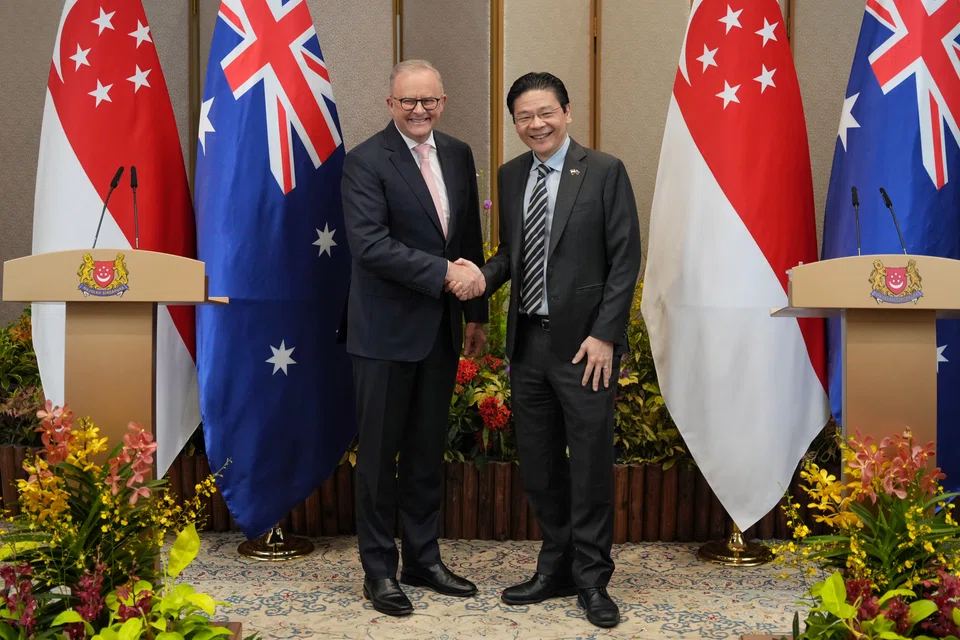
[SINGAPORE] Singapore and Australia have committed to keeping essential goods – including liquefied natural gas (LNG) and refined petroleum products – flowing between the countries.
Both countries are working quickly to turn this commitment into action through a legally binding agreement, said Prime Minister Lawrence Wong at a joint press conference with his Australian counterpart Anthony Albanese at the Istana on Friday (April 10).
This pact on economic resilience and essential supplies will span energy and other critical sectors, and is expected to add to the existing free trade agreement between the two countries.
“This is not just about managing today’s crisis. It is about building trusted supply lines for a more uncertain future,” said PM Wong.
His remarks build on a pledge by both countries in March to keep the flow of key goods unimpeded as the conflict in the Middle East continues to disrupt global energy supply chains and prices.
PM Wong said on April 10 that both leaders, who had a meeting before the press conference, agreed on a “simple but critical principle” of keeping trade flowing between the two countries.
'%3e%3cpath%20d='M12.1475%2025.5262C13.7713%2025.4295%2014.94%2023.913%2014.94%2021.8832C14.94%2019.5359%2013.474%2018.093%2011.5917%2018.093C11.3745%2018.093%2010.9582%2018.093%2010.8393%2018.1413V25.2086L11.8891%2025.5745C11.8891%2025.5745%2012.207%2025.5262%2012.1475%2025.5262ZM11.4934%2017.6281C13.2567%2017.6281%2014.3843%2016.4292%2014.3843%2014.4501C14.3843%2012.372%2013.275%2011.2973%2011.4339%2011.2973H10.8393V17.6305H11.4934V17.6281ZM6.66078%2025.6482L7.39265%2025.5492C8.02617%2025.4502%208.26403%2025.3053%208.26403%2025.1097V11.6149C8.26403%2011.4193%208.1451%2011.3709%207.23484%2011.249L6.68137%2011.173L6.6219%2010.7588H11.9508C15.7153%2010.7588%2017.0624%2012.0797%2017.0624%2014.1578C17.0624%2015.9666%2015.7748%2017.1909%2013.4969%2017.6305V17.7041C16.111%2017.948%2017.6571%2019.5382%2017.6571%2021.7636C17.6571%2024.3318%2015.8937%2026.0417%2012.1109%2026.0417H6.60132L6.66078%2025.6482Z'%20fill='%232B2B2B'/%3e%3cpath%20d='M20.6287%2025.6505L21.5596%2025.5515C22.1725%2025.4779%2022.4104%2025.3076%2022.4104%2025.112V11.249H21.9346C20.073%2011.3479%2018.982%2013.0095%2018.408%2014.6227L18.1907%2015.5018H17.6555L18.1701%2010.7588H29.3837L29.6421%2015.4787H29.1664L28.9491%2014.6227C28.3728%2012.8645%2027.3047%2011.2743%2025.5002%2011.249H24.9856V25.1856C24.9856%2025.3812%2025.1251%2025.4548%2025.9965%2025.5515L26.7695%2025.6505L26.829%2026.0417H20.5693L20.6287%2025.6505Z'%20fill='%232B2B2B'/%3e%3c/g%3e%3cdefs%3e%3cclipPath%20id='clip0_5242_21648'%3e%3crect%20width='24'%20height='16.8'%20fill='white'%20transform='translate(6%2010)'/%3e%3c/clipPath%3e%3c/defs%3e%3c/svg%3e)
LNG is one of the Republic’s key sources of power generation, and Australia supplies more than a third of Singapore’s needs.
PM Wong thanked Albanese, who is in Singapore for an official visit till April 11, for his assurance that Australia will continue supplying the Republic with LNG.
He also said that Singapore will continue supplying refined fuels to Australia.
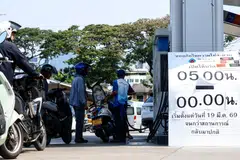
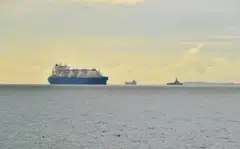
“As a global refining hub, we will keep these flows going as long as upstream supplies continue.”
Australian government statistics for 2025 showed that Singapore is Australia’s largest supplier of refined petroleum products, accounting for 26 per cent of refined fuel imports, 55 per cent of petrol imports, 22 per cent of aviation and turbine fuel imports, and 16 per cent of diesel imports.
Both countries will also stay in close contact to manage and respond quickly to any external disruptions that may affect Singapore or impact its supply chains, said PM Wong.
There will be both a ministerial dialogue on energy and a dialogue on economic resilience held soon to tackle common trade challenges and preserve the flow of essential supplies, he added.
“These are uncertain and unprecedented times, but it is precisely in such times that partnerships matter most,” he said.
PM Albanese said that in a time of global uncertainty, trust, friendship and cooperation with neighbours matter more than ever.
The relationship between Singapore and Australia helps deliver energy security to both countries, he said.
He noted that about 25 per cent of Australia’s fuel comes from Singapore’s refineries – which he visited on the morning of April 10 – and Australia supplies around 32 per cent of Singapore’s LNG.
PM Albanese had toured Jurong Island, where he met top executives from Singapore LNG Corporation and the Singapore Refining Company.
He also visited JTC Corporation’s Jurong Island Gallery, where he was briefed on the energy and chemicals hub’s capabilities, such as its shared services and utilities network that companies can plug into to start production quickly.
At the gallery, the Australian leader asked about the island’s history, and the Jurong Rock Caverns’ ability to withstand extreme weather and natural disasters.
At the press conference, he said the conflict in the Middle East is a long way from this region, but every nation here is being affected by it.
“By building regional cooperation on energy security and economic resilience, we strengthen our own fuel security and our own economy.”
He added that he and PM Wong had a “very wide-ranging” discussion, and “that is what friends can do, because you come to the relationship with that position of trust and mutual interest”.
The two prime ministers on April 10 signed a joint statement that said their countries would make “maximum efforts to meet each other’s energy security needs in the context of the acute energy crisis currently affecting global markets”.
Besides committing to support the flow of essential goods including petroleum oils, such as diesel, and LNG, they also agreed to cooperate on facilitating the timely movement of goods and essential supplies through enhanced coordination, efficient border and port processes, transparency, and early consultation.
“We reaffirmed our commitment to working together, particularly during crises, to support a resilient, rules-based multilateral trading system that underpins stability during periods of global disruption,” the statement added.
In his remarks, PM Wong said that as open and trade-dependent nations, Singapore and Australia feel the economic pressures resulting from the conflict in the Middle East directly.
“That is why in times like this, we must work closely, move faster, and stand together – not just to manage the risks, but to protect the well-being of our people.”
Both leaders had spoken over the phone two weeks ago and issued a joint statement on energy security cooperation.
“Today, we took that further – with concrete steps to reinforce our resilience and keep supply lines open.”
This is not the first time both countries have worked together to keep critical supply chains open.
During the Covid-19 pandemic, Singapore supplied 500,000 Pfizer-BioNTech vaccine doses to Australia in September 2021, and Australia returned the same quantity of Pfizer doses to Singapore in November 2021.
“In a more fractured and volatile world, we choose to stay open, to stay connected and to stand together,” said PM Wong on the discussions between the countries, which upgraded ties to a Comprehensive Strategic Partnership 2.0 in October 2025.
“Through the strength of our partnership, I am confident that Singapore and Australia will not just get through the crisis – but we will emerge stronger and more resilient.”
When asked by Australian media if Australia would be prioritised if Singapore were to start restricting exports, PM Wong said Singapore has no plans to restrict exports.
“We didn’t have to do so even in the darkest days of Covid and we will not do so during this energy crisis.”
The prime ministers were also asked if countries should negotiate to pass through the Strait of Hormuz, which Iran has blockaded since the early days of the war.
PM Wong was also asked if Singapore is looking to rely more heavily on alternative sources of fuel since it has ruled out these negotiations.
Both leaders said they believe the strait should be open.
PM Wong added that his Government’s position on the Strait of Hormuz is clear and consistent, and it is important to the Republic that countries uphold international law, including the right of passage through international waterways like the strait.
“As far as energy supplies are concerned, we believe it’s a global energy market,” he added.
Singapore’s companies source feedstock from all over the world, subject to prevailing laws and sanctions, and the Government expects them to uphold international agreements and obligations.
“As long as more oil enters the global energy market, it is good for the world. And our companies based here in Singapore are deeply connected to the different flows of energy supplies around the world.”
PM Albanese was hosted to lunch by PM Wong after the press conference. THE STRAITS TIMES
Decoding Asia newsletter: your guide to navigating Asia in a new global order. Sign up here to get Decoding Asia newsletter. Delivered to your inbox. Free.
Share with us your feedback on BT's products and services
TRENDING NOW

Once staunchly pro-China, Malaysian Chinese businesses are now distancing themselves from Beijing

Cliff Tan has 7 million followers and a 4-month waitlist. Why won’t he expand his business?

Grab CEO’s wife Chloe Tong on life with Anthony Tan and finding her purpose
Singapore F1 to proceed despite haze; no changes planned to outdoor entertainment

