Singapore, Australia commit to unrestricted flow of essential goods, defence supplies
Defence Minister Chan Chun Sing says trust is key for both countries to complement each other
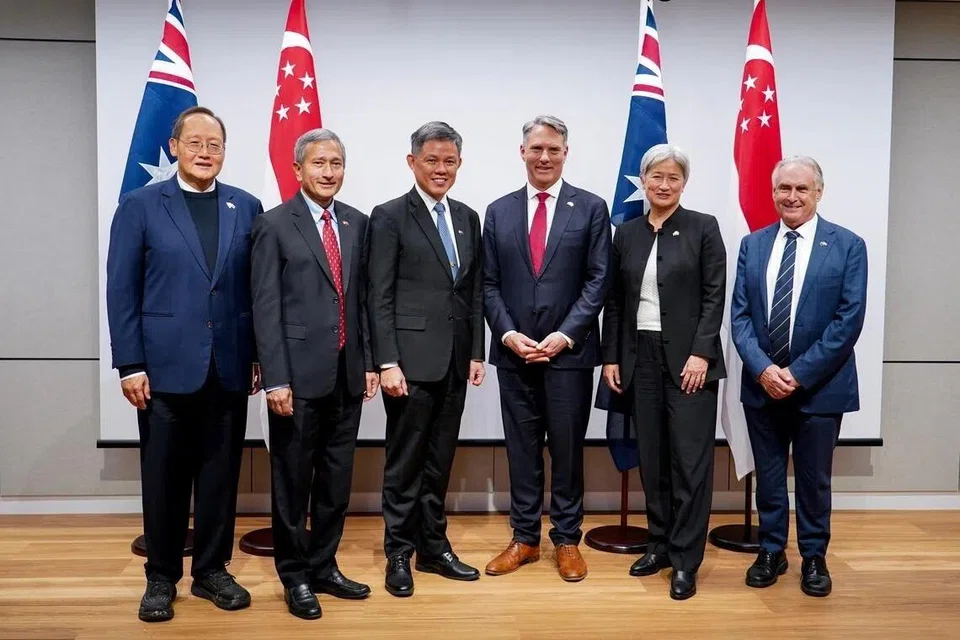
[SINGAPORE] Singapore and Australia signed two pacts on July 27 to ensure unrestricted flow of essential goods and defence supplies between the two countries.
This includes a legally-binding addition to Singapore and Australia’s free trade agreement for both sides to not adopt export restrictions on diesel and liquefied natural gas. Both sides had committed to this in April.
Both supply chain resilience deals were inked during the 15th Singapore-Australia Joint Ministerial Committee meeting held in Adelaide on Jul 27.
Speaking at a joint press conference at the Commonwealth Parliament Office, Defence Minister Chan Chun Sing said that trust is key for both countries to complement each other.
“That kind of the deep reservoir of trust that exists between Australia and Singapore at all levels, at a personal level, at institutional level – that is key to how we are able to do things together and constantly look for new opportunities to do better things and to do things better,” he said.
Foreign Minister Vivian Balakrishnan noted the various partnerships between Singapore and Australia over the years, including military arrangements and the Comprehensive Strategic Partnership 2.0 that was signed between the two countries in 2025.
The world today that both countries have to survive in is a more fractured, fractious and uncertain one where supply chain resilience cannot be taken for granted, he said.
“So it’s no accident that again you see we’ve entered into these agreements for economic resilience, supply chain resilience, and even the military dimension.
“The point I’m trying to make through this trek through history is that this special relationship, grounded on trust and alignment, has enabled us to deepen the engagement and to do so in a relevant and timely way to meet the challenges that have arisen,” said the minister.
The Singapore-Australia Joint Ministerial Committee is convened every 18 months involving the foreign affairs, defence and trade ministers.
This year marks the 30th anniversary of the dialogue that the two countries take turns to host. It was last held in Singapore in December 2024.
Australian Deputy Prime Minister and Minister for Defence Richard Marles said the energy partnership between the two countries has stood tall and firm amid one of the biggest energy shocks over the last three months.
It has been “profoundly important” in terms of maintaining fuel supplies in Australia, and speaks to the depth of trust between the two countries, he added.
At the joint ministerial committee meeting, Minister for Trade and Industry (Energy and Industry) Tan See Leng, and Australia Minister for Trade and Tourism Don Farrell signed the legally-binding agreement on economic resilience and essential supplies.
The agreement reflects both countries’ commitment to supply chain resilience and the priority they accord to each other in trading in essential supplies, the Ministry of Trade and Industry (MTI) said in a statement.
Under this protocol, Singapore and Australia commit to endeavour not to adopt or maintain export restrictions on agreed essential items, including petroleum oils such as diesel and liquefied natural gas.
It establishes a means for advance notification and consultation, as well as the review and withdrawal of measures.
It also establishes a dialogue to facilitate cooperation on economic resilience and trade in essential supplies, MTI said.
Tan said while both countries have been negotiating the agreement for several months, the outbreak of hostilities in the Middle East sped up the process.
“It has actually triggered an urgent momentum into making sure that both our countries continue to be able to function in as near normal as possible, and two of the most consequential supply lines that would be needed would be petroleum oils and natural gas,” he said.
Australia is one of the largest suppliers of liquefied natural gas to Singapore, noted Tan, while Singapore refines a significant amount of petroleum ores for Australia for use in industries like agriculture and manufacturing.
“As a result of that, this protocol... allows for a resilient, a reliable, open, transparent, and consultative process for both Australia and Singapore as close trusted partners to rely on one another in times of crisis,” he said.
Farrell said while fuel is the issue at the moment, it could be something else in the future and the agreement allows the two countries to add to the list of essential items as quickly as possible.
“We’ve got a mechanism, so that we don’t have to start the process all over again,” he said.
Singapore’s Permanent Secretary of Defence Development Melvyn Ong and Australia’s national armaments director Nadine Williams also signed the industrial base resiliency arrangement which ensures flow of defence supplies and military cooperation.
The new deal, which follows from an agreement signed by the Singapore’s and Australia’s defence ministers in October 2025, provides a framework for the two countries to strengthen defence industrial cooperation in support of the Singapore Armed Forces and the Australian Defence Force.
Singapore’s Ministry of Defence said the agreement allows both countries to engage in cross-sustainment of common defence platforms, examine priority delivery requests for defence orders, streamline equipment transfers, foster defence industry partnerships, and facilitate information exchanges to mitigate supply chain risk.
“By establishing clear channels for cooperation before disruptions occur, the (agreement) enables both countries to respond more swiftly and effectively when supply chains come under stress.”
Chan said that in today’s more complex military and security operations, it is not just a contest of the equipment, training or operational plans but also a contest of the defence ecosystems to see how one can be more resilient and outlast adversaries.
He said: “Today, the industrial base resilience arrangement is a step towards that direction, whereby we know that we can depend on one another, not just in times of peace, but also in the toughest of times.
“And we can watch out for one another and ensure that we can have the continuity in our operations, very much like what we have achieved over on the economic front.”
In a statement, the Ministry of Foreign Affairs said the ministers agreed that the two countries would deepen cooperation in emerging areas including subsea cables and artificial intelligence.
The ministers from both countries said in a joint communique that they welcomed ongoing bilateral collaboration to promote submarine cable resilience and protection in the region and encouraged the adoption of submarine cable best practices.
During the press conference, Tan was also asked about the recent announcement of more Singapore Airlines flights between the two countries.
In a statement on Jul 26, SIA said it will operate two more flights to Adelaide per week from Oct 25. This brings the total to 12 and adds 1,328 seats in and out of the city.
This will “support strong international travel demand, offering greater choice and capacity to the rest of the world through Singapore Changi Airport”.
Tan said more flights would also bring more investment into South Australia.
“It would also allow South Australian businesses to use Singapore as a platform to launch into Asean, into many of the industrial parks, the special economic zones that we have set up with our neighboring countries.” THE STRAITS TIMES
Decoding Asia newsletter: your guide to navigating Asia in a new global order. Sign up here to get Decoding Asia newsletter. Delivered to your inbox. Free.
Share with us your feedback on BT's products and services