Singapore braces for export slowdown as front-loading ‘payback effects’ bite
NODX contracts a surprising 11.3% in August, prompting one bank to slash its full-year forecast to -1 to 1%

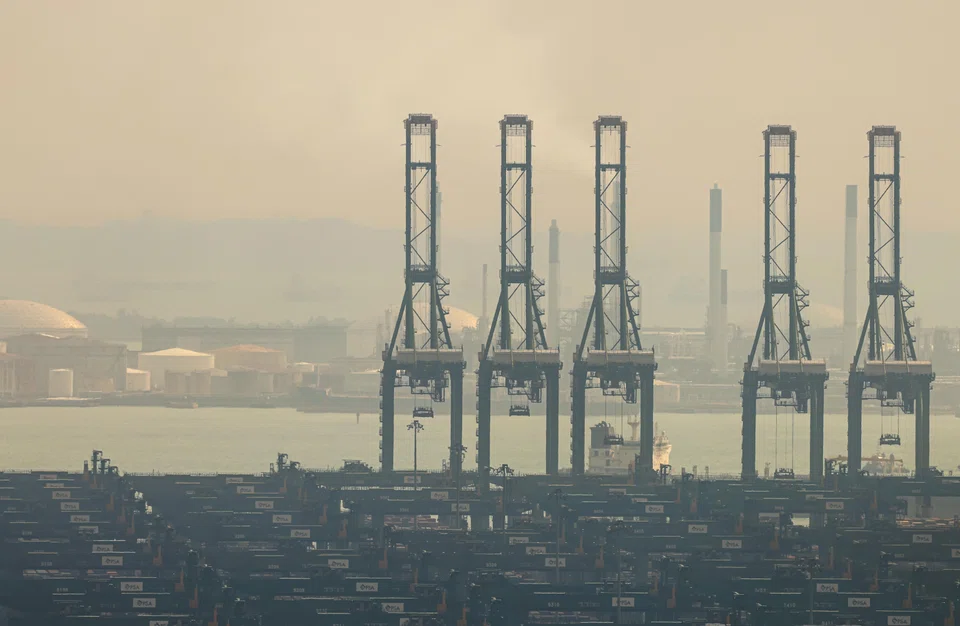
[SINGAPORE] The Republic’s export growth is expected to weaken further in 2025, with private-sector economists warning that “payback effects” from earlier front-loading activities will weigh on the city-state’s non-oil domestic exports (NODX) amid global trade headwinds.
OCBC chief economist Selena Ling said NODX is likely to come in at the lower end of Enterprise Singapore’s (EnterpriseSG) official 2025 forecast of 1 to 3 per cent, noting downside risks to the bank’s own 2 per cent projection.
“The bigger-than-expected bout of recent NODX weakness may imply some downside risk to the about 1 per cent year-on-year growth forecast, since the United States tariff and global growth slowdown story is still changing dynamically,” she said.
EnterpriseSG said on Wednesday (Sep 17) that it is “actively monitoring the evolving tariff situation and will adjust the 2025 NODX forecast as necessary” to reflect changing market conditions.
The expected moderation comes as Singapore faces “anticipated payback” following earlier front-loading that drove exports up 5.2 per cent in the first half of 2024, compared to a 4.9 per cent decline in the same period the previous year, noted Ling.
Going forward, NODX “may remain somewhat volatile amid the various external headwinds”, she warned, citing potential US sectoral tariffs on semiconductors and pharmaceuticals that “were earlier threatened but have not been implemented yet, so there could be more shockwaves ahead if they materialise”.
Surprise contraction
Singapore’s key exports contracted 11.3 per cent year on year in August, surprising private-sector economists who expected a 0.8 per cent expansion, data from EnterpriseSG showed on Wednesday.
The decline was driven by falls in electronics, specialised machinery, food preparation and petrochemicals, extending July’s revised 4.7 per cent drop.
Private-sector economists attributed the large contraction to high base effects from the previous year’s strong performance.
Exports to seven of Singapore’s top 10 markets declined, led by a 28.8 per cent drop to the US – an improvement from July’s 42.8 per cent plunge.
China recorded the second-largest decline at 21.5 per cent, which UOB associate economist Jester Koh said was “consistent with China’s August activity data where retail sales and fixed asset investments were downbeat”.
Forecast downgrade
The weaker performance prompted UOB to slash its 2025 NODX forecast to between -1 and 1 per cent, from 1 to 3 per cent previously. “Signs of a slowdown in monthly trade-related activity indicators are emerging in August… with scope for activity to weaken further due to payback effects from earlier front-loading,” said Koh.
RHB analysts Barnabas Gan and Laalitha Raveenthar maintained their 2 per cent full-year forecast, but noted risks tilted towards 1 per cent growth. They identified three key risks: escalating global tariff development, the rapid impact of front-loading trade, and Singapore’s structural reliance on semiconductor and pharmaceutical exports.
In contrast, Maybank struck a more upbeat tone, arguing that “despite exports losing some momentum, other indicators suggest that a sharp and extended trade downturn remains unlikely”.
The bank’s economists Chua Hak Bin and Brian Lee cited encouraging manufacturing data, including faster expansion in the electronics sub-gauge of the Purchasing Managers’ Index to 50.4 in August, with new electronics export orders hitting a five-month high.
Dr Chua and Lee expect electronics NODX to resume growth in September as base effects dissipate and artificial intelligence demand broadens. They also pointed to Singapore and Asean’s relative tariff advantage, falling interest rates, construction activity, and fiscal support as cushioning factors.
Bank of America economists Ang Kai Wen and Rahul Bajoria went further, upgrading Singapore’s full-year gross domestic product growth forecast to 2.9 per cent, from 2.3 per cent – above the official 1.5 to 2.5 per cent range. They cited resilient transhipment activities, with container throughput hitting record highs and both sea cargo and vessel arrivals growing in July and August.
Sectoral breakdown
Electronics exports shrank 6.5 per cent year on year, reversing July’s 2.7 per cent expansion due to declines in disk media products (-28.1 per cent), integrated circuits (-7.4 per cent) and PC parts (-36.9 per cent).
Non-electronics exports fell 13 per cent, extending the previous month’s 6.7 per cent decline, led by specialised machinery (-29.1 per cent), food preparations (-51.4 per cent) and petrochemicals (-23.2 per cent).
After China and the US, Indonesia posted the third-steepest decline at 39.6 per cent, while Hong Kong and Thailand contracted 20.9 per cent and 20 per cent, respectively.
In contrast, eurozone shipments expanded 28.9 per cent year on year, though slower than July’s 77.1 per cent surge. South Korea and Taiwan posted gains of 24.8 per cent and 9.1 per cent, respectively.
Overall, total trade grew 3 per cent year on year, down from August’s 8.2 per cent expansion. NODX growth stands at 1.6 per cent for the first eight months of 2025.