Singapore can bridge regional infrastructure’s bankability gap: Indranee
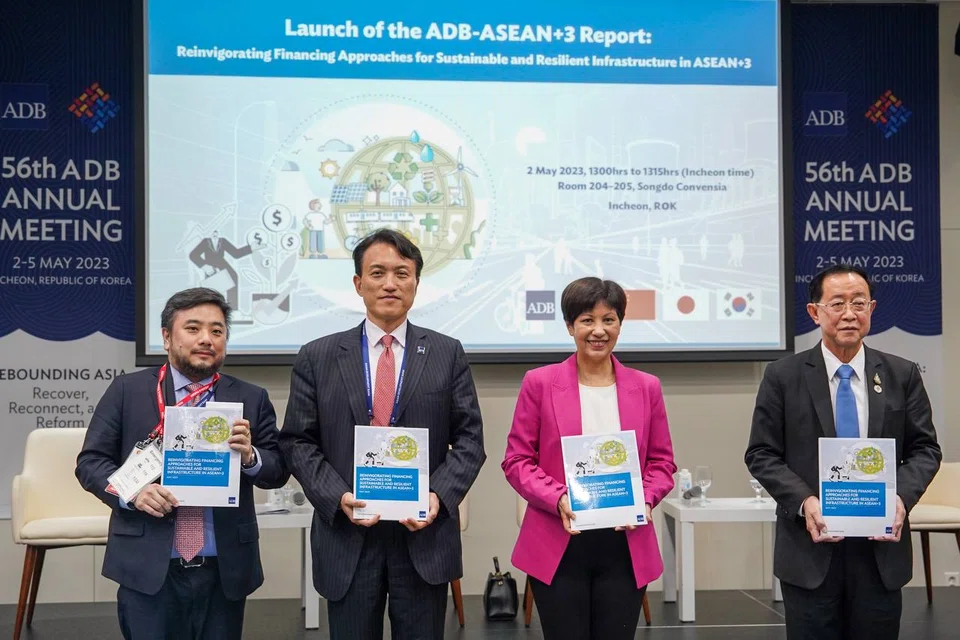
REGIONAL governments need to become more familiar with the concept of public-private partnerships for the next phase of their infrastructural developments, as private investors want to come in, said Second Minister for Finance Indranee Rajah on Friday (May 5).
She highlighted this as she sees a disconnect between supply and demand; public sector funds have all been deployed for Covid-19, so there is less available for infrastructure; but investors are looking for projects in this space, she said.
Speaking to The Business Times in Incheon, South Korea, as the 56th Asian Development Bank (ADB) Annual Meeting drew to a close, she identified the gap between this supply and demand as the projects’ bankability, and said Singapore wants to play a part.
Put simply, bankability is when investors are assured that there will be a return before they put their money in, she said, and that requires the project to address pertinent areas such as risks and timing. “You need to have the right kind of financing solutions. You need to have proper risk allocation. You need to have proper project structuring.”
“On the government side, it needs officials who understand the project, understand the investors, understand the market, and can design and structure (the project) accordingly,” she also said.
Building this capacity will require a range of expertise, and Singapore can meet the needs as it hosts a “very vibrant infrastructure ecosystem”, made of players who can connect investors with projects in a way that has acceptable risk allocation, she pointed out. The result is that projects may “get off the ground faster”.
She named two companies: Bayfront Infrastructure Management, which facilitates asset recycling – an innovative financing model that allows the initial investor to exit and new ones to come in – and Pentagreen Capital, which facilitates blended finance.
Bayfront is 70-30 owned by the Temasek-owned Clifford Capital Holdings and the Asian Infrastructure Investment Bank, while Pentagreen is backed by HSBC and Temasek.
Multilateral development banks (MDBs) are also present in Singapore, she noted. “We’ve got the World Bank hub here. ADB has set up its private sector operations here. And we work closely with other MDBs,” she said.
Plug-and-play solutions
Singapore’s ambition to fill the bankability gap and position itself as a centre for sustainable finance to help promote sustainable infrastructure extended to its involvement in the ADB-Asean+3 report earlier this week.
The report took stock of the latest innovative financing approaches deemed as key to private sector participation. Asean+3, or the Association of Southeast Asian Nations Plus Three, refers to the 10 Asean member states plus China, Japan and South Korea.
Indranee said that the report is significant as the region grapples with questions of how it may approach its energy transition. Most countries know where they would like to arrive, but questions remain as to how to get there, she remarked.
The first important step is the adoption of the Asean taxonomy for sustainable finance, a set of standards the region may get behind to measure if something is green or sustainable to avoid greenwashing. Version 2 of the Asean taxonomy was launched in March 2023. The next step – which Indranee said is what the report serves – is a set of financial products or solutions that can enable the transition from fossil fuels to clean or greener energy sources.
“Mix and match, plug and play, and use the ones that most fit the kind of project that you want to do – all with the overall objective of making that transition and ultimately landing up in a more environmentally friendly, sustainable infrastructure,” Indranee added.

Joining the fray
Clifford Capital chief executive officer Audra Low, participating in a panel discussion in Incheon on Friday, said that institutional investors could join the fray and participate in South-east Asian infrastructure projects, if the sector develops.
“Today, a lot of institutional investors are playing in much more developed markets – Australia in this part of the world. You hardly see them in South-east Asia, for example,” she noted. “What we can do to increase the participation of these investors is in providing not just equity but also debt financing because that’s what we really need in order to mobilise all these new green projects.”
Inspired by the idea of crowdfunding, an audience member asked if it is possible for such investments to be made available to retail investors.
According to Low, the idea is not as far-fetched as it is thought to be. As her company develops products, such as the collateralised loan obligation that institutional investors directly invest in, she said that it is “not unforeseeable” for retail tranches to be opened up.
However, a degree of investor education will be required. “(Investors) buy stocks in the stock market. (They) buy a bond. In the debt markets, (they) actually have quite a lot to overcome,” she explained.
For now, Clifford Capital is starting from a low base as, even among institutional professional investors, there isn’t a lot of awareness around what infrastructure is about, she highlighted.
“There’s a huge perception that it’s very, very high risk. And if we’re talking about emerging market infrastructure, there’s even a deeper perception that it’s so high risk, and nobody’s touching,” she felt. “I do think addressing this kind of perceptions is the first thing to do.”