Singapore, China exchange 27 agreements to boost cooperation, from financial connectivity to food trade
Deals are announced at bilateral meeting co-chaired by Singapore DPM Gan Kim Yong and Chinese Vice-Premier Ding Xuexiang
 Add BT as a preferred source
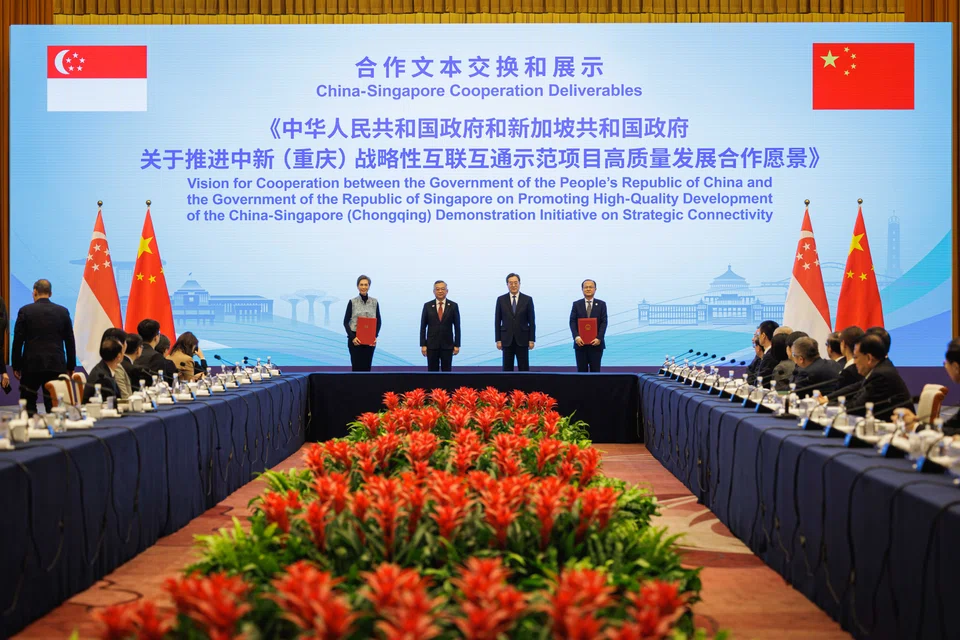
[SINGAPORE] Singapore and China exchanged 27 agreements at the 21st Joint Council for Bilateral Cooperation (JCBC) on Monday (Dec 15), to enhance cooperation in areas including the green and digital economies, education, financial connectivity and food trade.
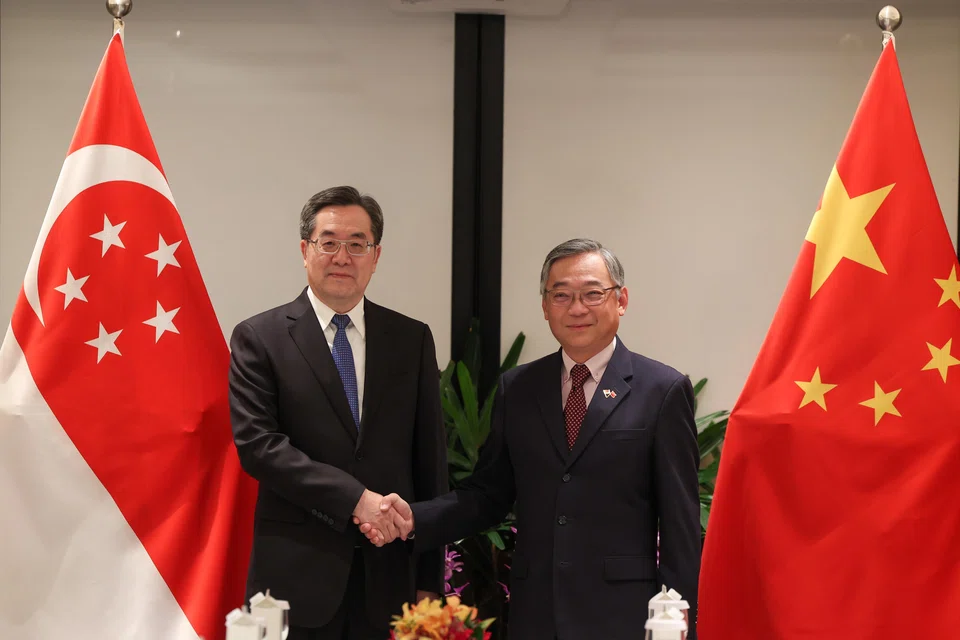
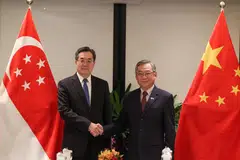
Singapore Deputy Prime Minister Gan Kim Yong and Chinese Vice-Premier Ding Xuexiang co-chaired the annual apex bilateral meeting, which is held alternately between the two countries.
This year’s JCBC holds special significance, as it marks not only the 35th anniversary of diplomatic relations between Singapore and China, but also the 10th anniversary of the Chongqing Connectivity Initiative (CCI), DPM Gan said at the opening of the meeting, which was held in Chongqing this year to commemorate this milestone.
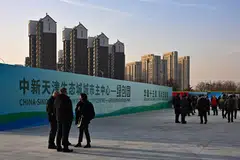
The CCI is the two countries’ third government-to-government project, following the Suzhou Industrial Park and Tianjin Eco-City. It aims to catalyse the economic growth of western China by enhancing connectivity within the region, between regions, and with the world.
Several agreements exchanged on Monday related to the CCI – setting out and committing to implementing Singapore and China’s long-term plans to promote “high-quality development” of the initiative.
The Ministry of Trade and Industry (MTI) said that in its next phase, the CCI will “build on its core strengths” to deepen connectivity and cooperation.
The collaborations will span the initiative’s four priority areas – financial services; aviation; transport and logistics; and information and communications technology – as well as the economic corridor between western China and South-east Asia. At the same time, it will be “broadening into newer areas such as education, technology and healthcare”.
These efforts will range from strengthening the development of Chongqing and Singapore as aviation hubs to the sharing of best practices in healthcare, MTI noted.
Deepening financial cooperation
New financial and capital-market initiatives will give bilateral financial cooperation a boost.
One move is the appointment of DBS as Singapore’s second renminbi (RMB) clearing bank, following the designation of the Singapore branch of the Industrial and Commercial Bank of China as the first RMB clearing bank in 2013.
This will “support further growth of the offshore RMB market in Singapore, and facilitate the use of RMB for trade, investment and other economic activities in line with regional needs”, the Monetary Authority of Singapore (MAS) said.
MAS and the China Securities Regulatory Commission will also support secondary listings of A-share companies on the Singapore Exchange (SGX), to provide access to international capital and additional funding channels for regional business expansion.
To facilitate this, MAS and SGX will be extending the secondary listing framework, including the streamlined prospectus requirements, for companies listed on the Shenzhen Stock Exchange and the Shanghai Stock Exchange.
Under the initiative (*see amendment note), Singapore and China will also commence their over-the-counter bond market arrangement through Bank of China and DBS, as well as launch a pilot for a Chinese yuan digital wallet for Singapore travellers.
Wide-ranging relationship
Economic cooperation remains key to the Singapore-China relationship. Singapore and Tianjin will support the development of key industry sectors and expand new areas of collaboration for enterprises.
The memorandum of understanding (MOU) between Singapore’s Ministry of National Development and the Tianjin Municipal People’s Government will also support joint initiatives to develop and promote pro-enterprise policies, and strengthen people-to-people exchanges in areas such as tourism, education and culture.
In education, Singapore and China announced on Monday progress on university collaborations, with agreements exchanged to facilitate cooperation in international technology translation and commercialisation; joint education programmes; applied sciences; digital transformation and sustainable living; and intelligent design.
The two countries also looked at food safety and food trade, signing documents on food safety and animal health requirements for exported meat from Singapore to China.
They also approved several meat products from Chongqing, Heilongjiang and Hunan provinces that can be exported to Singapore, and removed several pre-export testing requirements.
On health, Singapore and China agreed to promote cooperation in areas such as the prevention and control of communicable and non-communicable diseases, healthy ageing and aged care policy, and women’s and children’s health.
Meanwhile, Singapore’s law ministry and China’s council for international trade promotion committed to work together in areas including international commercial dispute resolution, intellectual property management, legal support for the growth of digital and green economy, and international trade policies and compliance.
Other tie-ups include sharing of information on digital and data policies, upgrading a customs twinning agreement, strengthening cooperation in science, technology and innovation, furthering cooperation in sports development and facilitating joint youth development.
The MOU exchange ceremony followed a morning of meetings for the JCBC and joint steering council meetings for the Suzhou Industrial Park, Tianjin Eco-City and CCI.
DPM Gan noted that this year’s JCBC takes place amid an uncertain geopolitical environment, rapid technological changes and global economic headwinds – which Singapore and China are each trying to navigate.
“It is, therefore, all the more important for Singapore and China to continue to find ways to cooperate, anticipating challenges and capitalising on new opportunities for our businesses and our peoples,” he said.
DPM Gan and Vice-Premier Ding also conducted a bilateral meeting earlier in the day, where they committed to “deepen cooperation to address challenges and opportunities posed by increasing geopolitical uncertainties and rapid technological advancements”.
They also agreed to promote inclusive development by enhancing trade links and economic connectivity, bilaterally and across the wider region, said a post-JCBC media statement.
“Singapore and China would continue to explore collaboration in the green and digital economies, including in low-carbon solutions, renewable energy technologies, and green finance, as well as to exchange best practices in digital regulations and deepen innovation partnerships,” said the statement.
It added that the leaders also discussed regional developments, with DPM Gan reaffirming that Singapore has consistently abided by its “One China” policy.
Ding hosted a lunch for Gan, who is also expected to attend a dinner hosted by Chongqing Party Secretary Yuan Jiajun.
Amendment note: An earlier version of this story said the over-the-counter bond market arrangement comes under an MOU. There is in fact no MOU for this initiative. The story has been amended to reflect this.
Decoding Asia newsletter: your guide to navigating Asia in a new global order. Sign up here to get Decoding Asia newsletter. Delivered to your inbox. Free.
Copyright SPH Media. All rights reserved.