
Singapore downgrades 2024 export forecasts again on weaker-than-expected recovery

Volatile segments such as pharmaceuticals and ships and boats could continue to weigh on Q4 2024 performance, says EnterpriseSG

Elysia Tan
Published Fri, Nov 22, 2024 · 08:00 AM — Updated Fri, Nov 22, 2024 · 07:37 PM
    • NODX to Singapore’s top markets expanded as a whole in the third quarter, led by Malaysia, China and the US.
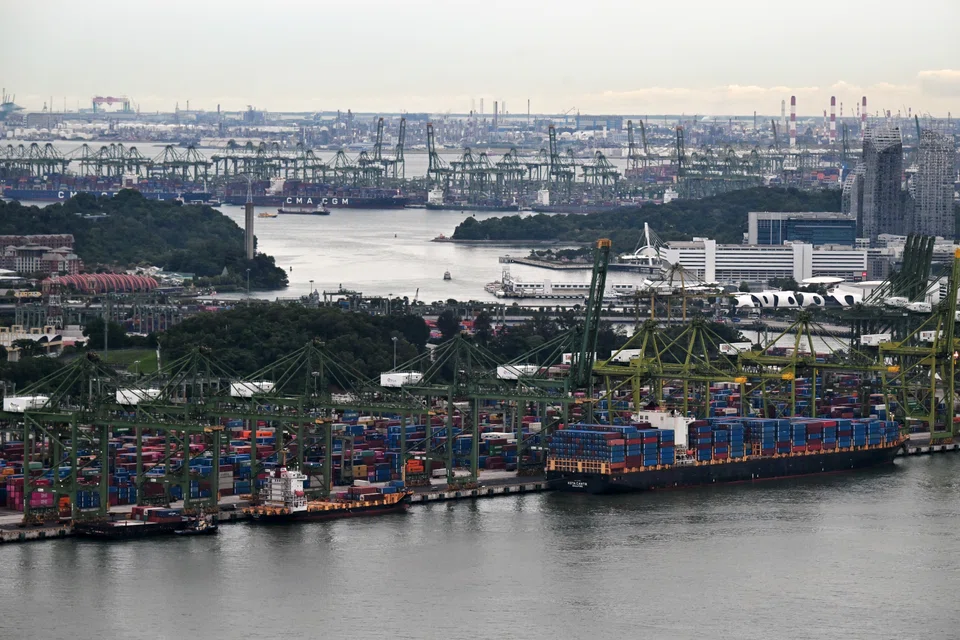
    • NODX to Singapore’s top markets expanded as a whole in the third quarter, led by Malaysia, China and the US. PHOTO: BT FILE

    SINGAPORE has narrowed its 2024 full-year growth forecast for non-oil domestic exports (NODX) to “around 1 per cent” year on year (yoy), from 4 to 5 per cent; and that for total merchandise trade to “around 5 per cent”, from 5 to 6 per cent previously.

    This is because of a worse-than-expected recovery at the start of the second half of the year, primarily due to volatile segments, Enterprise Singapore (EnterpriseSG) said in its quarterly review of trade performance on Friday (Nov 22). This comes after October’s NODX performance came in “weaker than expected” earlier this week.

    EnterpriseSG on Friday highlighted that it had flagged downside risks in its previous review, including a recovery that is softer than anticipated in H2 2024. These could result in full-year NODX growth that is below the forecast range, it added. “Since then, the weakness has materialised, as NODX performed weaker than expected, primarily due to the volatile segments such as pharmaceuticals and ships and boats, which could continue to weigh on Q4 2024 performance,” it noted.

    Both projections were also lowered in the August quarterly review, from a 4 to 6 per cent expansion.

    OCBC chief economist Selena Ling also said that she had previously expected NODX growth for November to December to average 6.2 per cent yoy, bringing full-year 2024 NODX growth to 1 per cent.

    For 2025, EnterpriseSG forecasts NODX to grow by 1 to 3 per cent, in line with the World Trade Organization’s projections of faster global merchandise trade growth. 

    But Ling believes that it could improve to 3 to 5 per cent, citing the low base and “assuming heightened uncertainties pertaining to (incoming US president Donald) Trump’s tariffs”. Namely, the tariffs’ timing and magnitude, and whether Singapore may be exempt from them due to its free trade agreement with the United States.

    Some improvement

    NODX gained 9.2 per cent yoy in the third quarter of 2024, compared with the previous quarter’s 6.5 per cent decline – a “decent rebound” after seven quarters of yoy declines, noted HSBC Asean economist Yun Liu.

    Electronics grew at a faster pace in Q3 2024, up 17 per cent on the year and marking the second consecutive quarter of growth. Integrated circuits, disk media products and PCs contributed most to the rise.

    The semiconductor contribution is consistent with industrial production data, where it has “finally started to catch up with peers like (South) Korea and Taiwan, riding on the tech upcycle”, explained Liu.

    Non-electronic NODX, meanwhile, rebounded after two quarters of declines, growing 7 per cent. This was led by specialised machinery, non-monetary gold and food preparations.

    NODX to Singapore’s top markets expanded as a whole in Q3, led by Malaysia, China and the US.

    On a seasonally adjusted, quarter-on-quarter basis, Q3 NODX grew by 7.9 per cent, in an about-turn from Q2’s 1.3 per cent contraction.

    Total merchandise trade grew 5.5 per cent on the year in Q3, slowing from the 10 per cent rise in the preceding quarter.

    Oil trade slipped by 4.9 per cent in Q3, reversing from the 16.9 per cent expansion in the second quarter. Non-oil trade rose by 8 per cent, a tad lower than the 8.4 per cent growth recorded in Q2.

    On a seasonally adjusted, quarter-on-quarter basis, total merchandise trade fell 2.5 per cent in Q3, after a 2 per cent rise in Q2.

    Total services trade expanded by 13.9 per cent yoy in Q3 to S$235.3 billion, following the 11.4 per cent rise in the previous quarter.

    The global trade environment may turn “even more challenging” next year, with Trump’s threats of punitive trade tariffs on China and potentially a universal 10 to 20 per cent tariff on the rest of the world, warned OCBC’s Ling. While Asean may remain resilient on the global electronics demand upswing, it is unlikely to be fully immune to any trade fallout, she added.

    The recent escalation in geopolitical hotspots and Trump’s push for onshoring manufacturing and strategic de-coupling from China also mean that the potential impacts on global supply chain recalibration and business capital expenditure are highly uncertain. 

    Said Liu: “Looking ahead, while there is a large degree of uncertainty from potential US tariffs, there is also potential room to grow from sustained tech recovery.”



