

Singapore to establish national space agency NSAS under MTI
The National Space Agency of Singapore will front the Republic’s ambitions to be a leader in space technologies

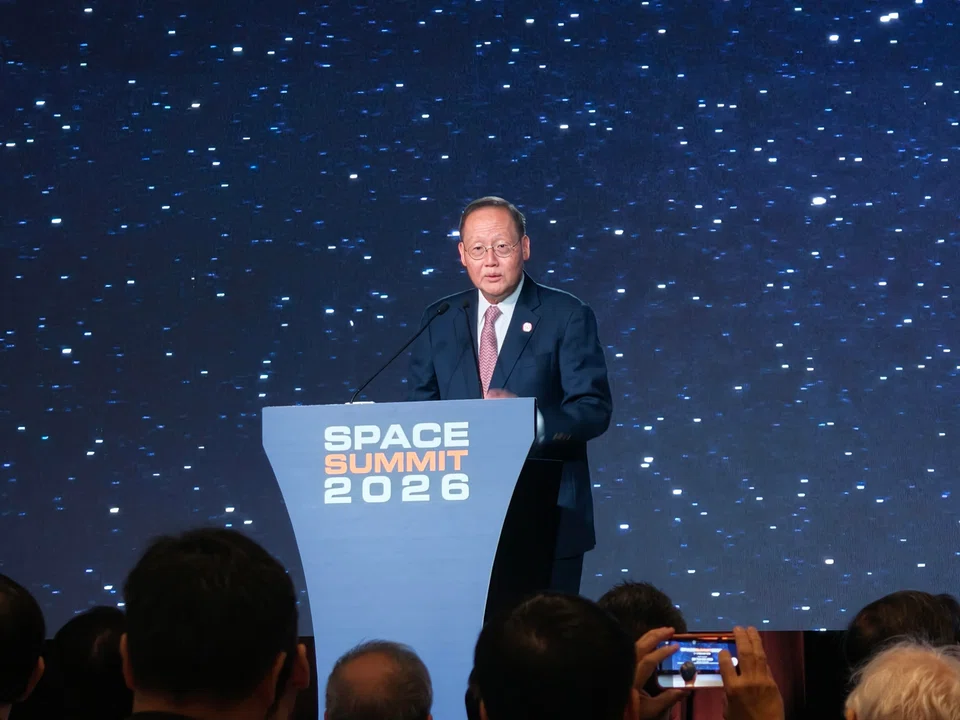
[SINGAPORE] The Republic will set up the National Space Agency of Singapore (NSAS) under the Ministry of Trade and Industry (MTI) from Apr 1.
The move was announced by Singapore’s Minister-in-charge of Energy and Science & Technology Tan See Leng at the inaugural Space Summit on Monday (Feb 2).
The agency will front national space ambitions to be a leader in space technologies and a credible contributor to the global space ecosystem.
It will be headed by Ngiam Le Na, who has been appointed as chief executive (designate) from Monday, and will become NSAS’ chief executive from Apr 1, 2026.
Ngiam has 25 years of experience in the public service. She is currently deputy chief executive officer at DSO National Laboratories, and was formerly deputy chief executive of the Defence Science and Technology Agency.
NSAS will provide “decisive leadership for Singapore to seize opportunities in the expanding space economy and the new possibilities posed by democratised access to outer space”, said Dr Tan, who is also minister for manpower.
It will take over from the current Office for Space Technology & Industry, Singapore (OSTIn) and build upon its functions.
NSAS will focus on five key areas: strengthening research and development (R&D), developing the space industry, advancing international partnerships, developing and operating national space capabilities, and creating legislation for space safety and sustainability.
More space
A multi-agency operation centre will be set up to support government agencies with satellite tasks and geospatial data analytics, which could help various areas such as port operations, urban planning and food security.
SEE ALSO



The Republic may also further develop its constellation of satellites for national purposes, as well as other applications across the equatorial belt.
Dr Tan said that Singapore will invest strategically in emerging areas, which include climate sustainability technologies such as satellite remote sensing for carbon monitoring, space sustainability technologies and microgravity research in space for advances in human health sciences.
Singapore’s space industry has around 70 space companies that employ 2,000 people. The government has dedicated S$200 million since 2022 for space R&D through the Space Technology Development Programme.
Space technologies and capabilities are a critical enabler for Singapore’s economy, said Dr Tan, as they underpin essential functions such as digital connectivity, navigation, maritime monitoring and climate resilience.
Singapore’s strengths in advanced manufacturing, aerospace, micro-electronics, precision engineering and artificial intelligence make it well-placed to capture new opportunities in the sector, he added.
Boldly go
OSTIn and other sector enxtities announced numerous partnerships at the Space Summit as well.
OSTIn signed letters of intent with Spain’s space agency on space situational awareness, industry collaboration and policy, as well as the Maldives Space Research Organisation to partner on projects in earth observation and data sharing.
Trade organisation the Association of Aerospace Industries (Singapore) also signed cooperation memorandums of understanding with industry associations from Japan, Australia and India on various topics, including information exchange, leadership initiatives and industry delegations.
Singapore Stock Exchange-listed palm oil company Golden Agri Resources signed a contract with nature technology startup Arkadiah Technology to use satellite data for carbon quantification, which will help the monitoring and protection of tropical forests.
Tokyo Stock Exchange-listed SKY Perfect JSAT entered a strategic capital and business partnership with Singapore startup SpeQtral to develop commercial, secure satellite communications through quantum cryptography.
According to Boston Consulting Group, the global space economy will grow to more than US$1 trillion by 2040 from US$400 billion today, thanks to a reduction in launch costs, the proliferation of satellites amid growing demand and the expected commercialisation of space launches by the private sector.
The Space Summit 2026 is held at Marina Bay Sands Singapore from Feb 2 to 3, and is a leadership forum that sees policymakers, space agencies and industry figures discussing infrastructure, sustainability and investments.
Arranged by Experia Events – which also organises the Singapore Airshow – the summit is endorsed by Singapore’s space agency, the Office for Space Technology & Industry, which is part of the Singapore Economic Development Board.
Decoding Asia newsletter: your guide to navigating Asia in a new global order. Sign up here to get Decoding Asia newsletter. Delivered to your inbox. Free.
Copyright SPH Media. All rights reserved.
TRENDING NOW

Once staunchly pro-China, Malaysian Chinese businesses are now distancing themselves from Beijing

Britain’s mansion tax shows the difficulty of targeting wealth
Three hats, one goal: How Ng Kian Swan runs sustainability at NUHS

COE review: The gap between luxury and mass-market cars isn’t the only one worth bridging

