Singapore factory output slumps 7.8% in August, reversing July’s growth
Most clusters post year-on-year contractions in production, with the exception of chemicals and transport engineering

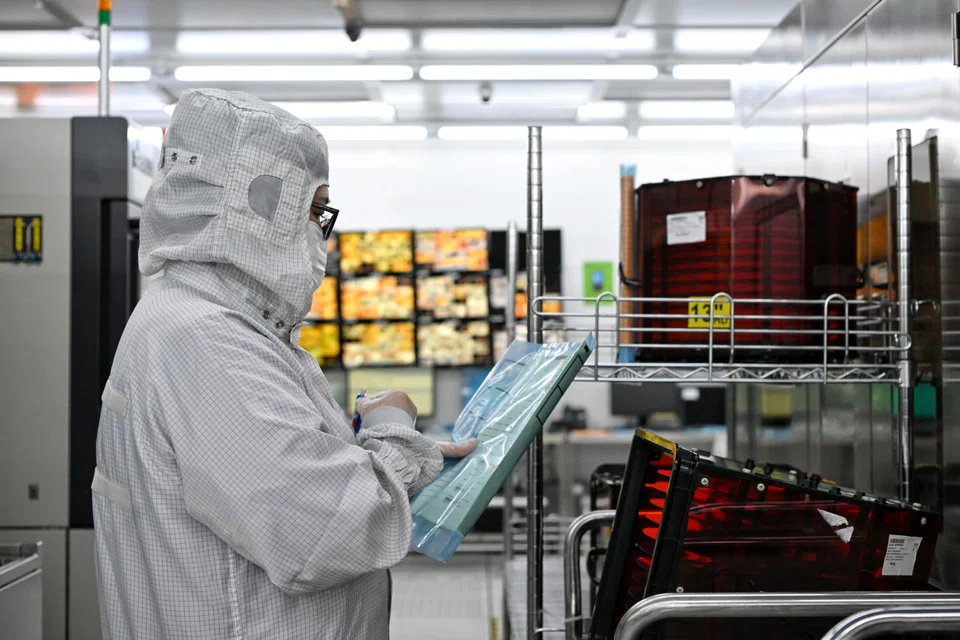
[SINGAPORE] Factory output plunged 7.8 per cent year on year in August, far steeper than economists’ forecast of a 1.9 per cent fall, and marking a reversal from July’s upward-revised 7.7 per cent growth figure.
The latest statistic, released by the Economic Development Board on Friday (Sep 26), ended a 13-month streak of expansion.
DBS senior economist Chua Han Teng said the drop – the sharpest since March last year – was due partly to adverse base effects, as factory output had surged 22.8 per cent in August 2024, its fastest pace that year.
Economists expect Singapore’s factory performance to be poor for the rest of 2025. RHB’s group chief economist Barnabas Gan said trade developments are “likely to keep weighing on external demand, as tariffs take effect and front-loading fades”.
Excluding the volatile biomedical manufacturing cluster, output shrank 2.9 per cent year on year, reversing from July’s revised growth of 10.1 per cent.
On a seasonally adjusted monthly basis, output contracted 9.7 per cent in August, reversing from July’s upward-revised figure of 8.8 per cent growth. Excluding biomedical manufacturing, output fell 3.5 per cent, in contrast to 7.8 per cent growth in the previous month.
Most clusters posted year-on-year contractions, with the exception of chemicals and transport engineering.
Economists warned that the new US tariff of 100 per cent on branded pharmaceutical imports, which kicks in on Oct 1, poses a risk for Singapore’s trade-reliant economy.
Noting that pharmaceuticals are the city-state’s key export to the US, worth about 1.5 per cent of nominal gross domestic product, Moody’s Analytics economist Denise Cheok said the sector could be “hard hit” if exemptions are not secured.
However, Chua said the impact may be cushioned by exemptions for companies with US facilities. Of the nine global pharmaceutical giants based here, several already have operations in the US or are expanding there.
Performance by cluster
The linchpin electronics cluster’s output declined 4.8 per cent in August, reversing July’s 14.7 per cent gain. Within this cluster, the sole growth was in infocomms and consumer electronics, at 42.4 per cent.
This was offset by contractions in computer peripherals and data storage (-16.8 per cent), electronic modules and components (-13.1 per cent), and semiconductors (-8.8 per cent).
The transport engineering cluster had the greatest year-on-year rise in August, at 18.9 per cent.
This was led by the aerospace (36 per cent) and marine and offshore engineering (1.7 per cent) segments, with aerospace recording higher production of aircraft parts as well as sustained maintenance, repair and overhaul jobs from commercial airlines.
This expansion made up for a 24.5 per cent decline in the land segment.
The chemicals cluster grew 3.5 per cent, led by the petroleum segment, which rose 12.4 per cent from a low base last year due to plant maintenance shutdowns.
Growth was also recorded in specialities, which expanded 7.2 per cent due to greater production of biofuels as well as electronic chemicals, materials and laminates; and the “other chemicals” segment (10.9 per cent).
The sole segment that declined was petrochemicals (-18 per cent) due to plant maintenance shutdowns.
The biomedical manufacturing cluster’s output contracted 37.3 cent, with the largest fall of 59.3 per cent in pharmaceuticals, due to a different mix of pharmaceutical ingredients being produced.
This more than outweighed the 5.3 per cent gain in medical technology output, with sustained export demand for medical devices.
Output for the general manufacturing cluster contracted 13.9 per cent, with declines across all segments.
Food, beverages and tobacco shrank 15.9 per cent, led by lower production of beverages, dairy and bakery products.
Miscellaneous industries contracted 12.7 per cent due to lower output of structural metal products, batteries, as well as paper and paperboard containers and boxes. The printing segment shrank 0.4 per cent.
Of all clusters, the precision engineering cluster had the smallest contraction, at 1.7 per cent.
Within this cluster, the precision modules and components segment expanded 2.1 per cent, supported by higher output of electronic connectors, electric power cables and wires. In contrast, machinery and systems fell 3.2 per cent, largely because of lower production of front-end semiconductor equipment.