

Singapore hiring outlook worsens sharply to 4-year low: ManpowerGroup survey
Local employment outlook is well below the global average; finance sector bucks trend with most improved net employment outlook

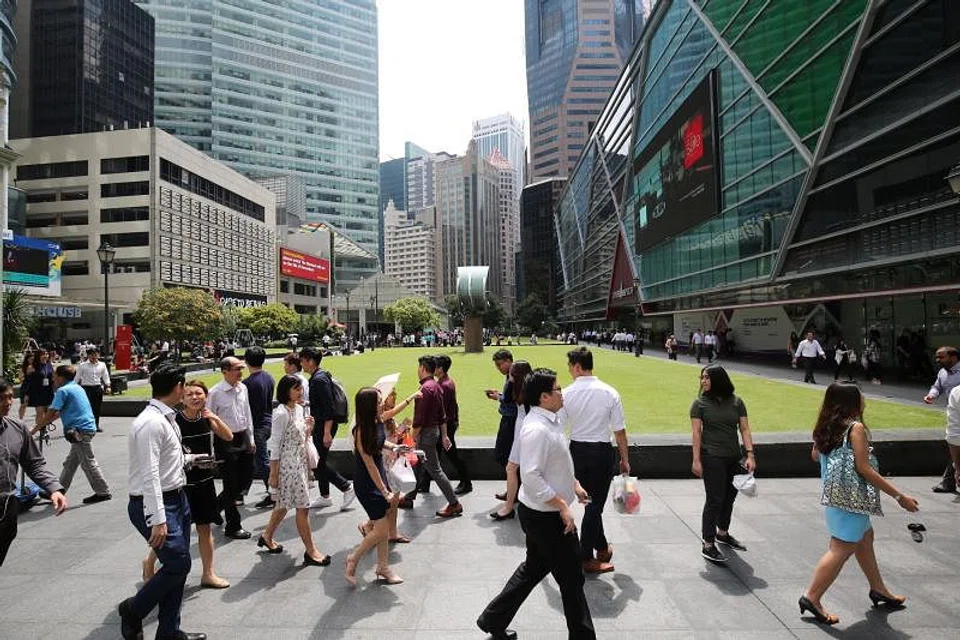
[SINGAPORE] Hiring sentiment in Singapore is set to slow significantly in the first quarter of 2026, dropping to its lowest level since 2022 as economic uncertainty reshapes workforce strategy.
According to the latest ManpowerGroup Employment Outlook Survey released on Tuesday (Dec 9), Singapore’s net employment outlook for Q1 2026 stands at 15 per cent.
This figure – calculated by subtracting the percentage of employers who anticipate reductions to staffing levels from those who plan to hire – represents a decline of five percentage points from the previous quarter and a sharp 11-point drop compared with the same period last year. It marks the lowest net employment outlook since Q1 2022, when it also stood at 15 per cent.
The data indicates that while hiring sentiment remains positive, it is notably subdued, placing the Republic well below the global average net employment outlook of 24 per cent.
Employers opt for stability over expansion
The survey of 504 employers reveals a distinct shift towards maintaining the status quo. In Q1 2026,
- 46 per cent of employers plan to keep staffing levels unchanged, up from 34 per cent in Q1 2025
- 32 per cent plan to increase headcount, down from 45 per cent a year ago
- 18 per cent anticipate a decrease in staffing, down from 20 per cent a year ago
- 4 per cent are unsure of their plans, up from 1 per cent a year ago
Linda Teo, country manager of ManpowerGroup Singapore, described the outlook as a “period of recalibration”.
She added: “More employers are focused on maintaining staffing levels or holding off on making staffing decisions while waiting to see how economic conditions evolve, while those hiring are doing so strategically, driven by organisational growth, diversity initiatives and maintaining a competitive advantage.”
Among organisations maintaining headcount, nearly a quarter (23 per cent) are waiting to see how the economy evolves before making hiring decisions.
Outlook drivers
Economic caution is the primary driver reshaping workforce strategies – 43 per cent of those unsure of their plans cite this as the reason for their hesitation.


Among companies planning to reduce staff, 30 per cent cited economic challenges as the main reason, while 31 per cent pointed to market shifts lowering job demand. Operational efficiency initiatives also played a role, with 30 per cent of employers citing role consolidation as a factor. Company restructuring (30 per cent) and rightsizing (26 per cent) were also main drivers.
As for the 32 per cent of employers planning to hire, the top drivers include organisational growth (39 per cent), diversity initiatives (34 per cent) and a desire to increase their competitive advantage (31 per cent).
Wanting to branch out to new business areas (26 per cent), backfilling recent (26 per cent) and long-standing vacancies (23 per cent) were also some of the high-priority factors cited.
Sector spotlight: finance surges, manufacturing slumps
Despite the overall cooling, specific sectors show robust demand.
The finance and insurance sector reported the strongest outlook at 33 per cent, a significant 23-point jump from the previous quarter.
Conversely, the manufacturing sector reported an outlook of 10 per cent, which is a 13-point decline.
Global and regional comparison
The global net employment outlook average stands at 24 per cent.
Singapore’s cautious stance contrasts with more bullish markets across the region.
The Asia-Pacific region is led by India, which boasts a robust net employment outlook of 52 per cent, ranking second globally after Brazil at 54 per cent.
Hong Kong (1 per cent) remains the most cautious in the region, while China (24 per cent) saw the largest quarter-on-quarter decline, down by nine points.
Decoding Asia newsletter: your guide to navigating Asia in a new global order. Sign up here to get Decoding Asia newsletter. Delivered to your inbox. Free.
Copyright SPH Media. All rights reserved.
TRENDING NOW

S$8 billion wiped off OCBC value as shares slide 5.8% in heavy trade

Grab CEO’s wife Chloe Tong on life with Anthony Tan and finding her purpose

Brookfield denies accusation it cut Soilbuild out of Mapletree deal
8 public officers referred to police over property buys near unannounced MRT stations: Chan Chun Sing

