

Singapore hotel rates race higher for F1 weekend despite softer early demand
Room occupancy pace is slower than last year’s level but picking up, say observers

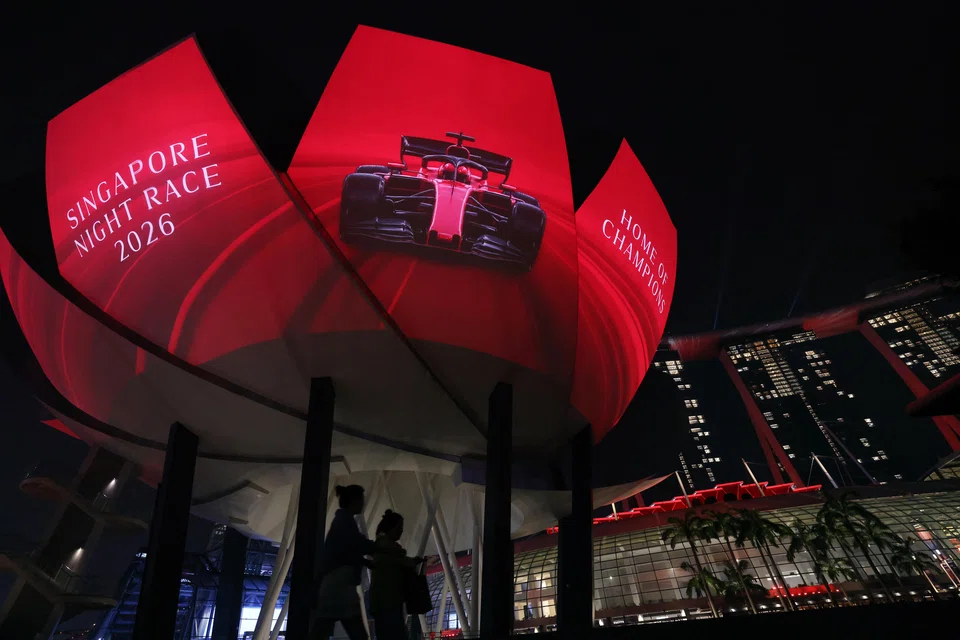
[SINGAPORE] While hotel room rates for the Formula 1 (F1) Singapore Grand Prix 2026 weekend have raced higher, occupancies possibly lag the 2025 record. Still, hotels may yet pull ahead.
The race weekend, from Friday (Oct 9) to Sunday, will feature music acts including South Korean boy group Cortis and American pop icon Lana Del Rey.
The recent weeks leading up to the race have also seen Singapore play host to more than 40 business events – including crypto and Web3 conference Token2049 Singapore, the Milken Institute Asia Summit and the Forbes Global CEO Conference – as well as companies’ regional or global meetings, which have created spillover benefits.
But the stacked calendar may have been slower to drum up hotel guest volumes that match last year’s levels.
DBS Group Research analyst Derek Tan noted that while channel checks with hoteliers indicate that booking take-up for the 2026 F1 weekend is broadly comparable to that in 2025, some operators reported slightly softer demand.
Jesper Palmqvist, regional vice-president for the Asia-Pacific at hospitality research firm STR, said that occupancy on the books for both the race week and the main weekend has been behind 2025’s figure.
Wyndham Singapore Hotel reported that F1 weekend occupancy was tracking in the mid-80 per cent range as at Tuesday. This was about five percentage points lower year on year – though Jacqueline Ho, general manager of the hotel, added that the average room rate has increased.
STR data from five weeks before the race weekend found that the 2025 F1 weekend occupancy was more than 10 percentage points ahead of this year’s. However, the 2026 figures are on a par with 2023’s pace “almost exactly”, and slightly ahead of 2024.
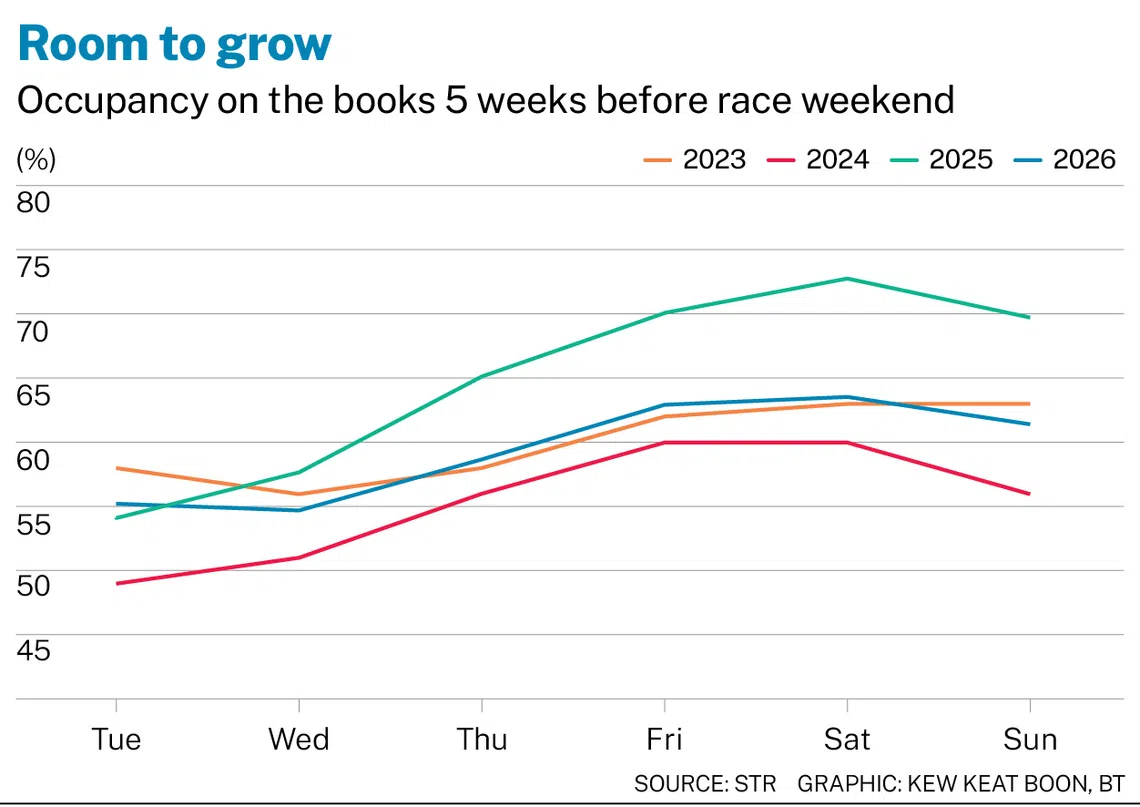
“Set in that context, we are to some degree pacing as expected,” said Palmqvist, adding that the gap is smaller for hotels in the Marina Bay sub-market, which has more annual booking stability.



Hard to beat
Palmqvist noted that “2025 had a record-breaking pace from very early on, well ahead of any year we’ve seen”, adding that occupancy has strengthened consistently across Singapore over the F1 weekends from 2023 to 2025.
The race overlapped with China’s Golden Week holiday last year. That it did not do so this year potentially reduced the overlap in travel demand, said Tan, though he added the caveat that there are currently insufficient data points to quantify the impact.
Wyndham’s Ho has observed a significant shift in the nationalities of the hotel guests. International visitors from Western markets account for about 30 per cent of its guest mix for the 2026 F1 period, compared with around 15 per cent in 2025.
Palmqvist also pointed to a stronger-than-usual entertainment line-up last year, as well as earlier booking activity.
“In contrast, 2023 and 2024 to some degree had final stages of new air-capacity normalisation.”
He added that, by 2025, most sub-markets were operating at around 90 to 96 per cent occupancy, indicating a highly occupied market with limited room for further occupancy growth.
Still gaining traction
Notably, booking velocity has accelerated as the race weekend has got closer.
Less than two weeks out, week-of-event occupancy had “picked up strongly”, said Palmqvist, with the Marina Bay region levels averaging over 82 per cent then.
Based on Wyndham’s current booking pace and demand trends, Ho projects that final occupancy will be in the high-80 per cent to 90 per cent range across the F1 weekend.
Sebastien Kaeuffer, vice-president of commercial operations for Apac at Hilton, similarly said: “Bookings at all of our Singapore properties are tracking well heading into race weekend, with expected occupancy during the race period increasing daily to near full capacity.”
DoubleTree by Hilton Singapore Robertson Quay, which opened on Oct 1, observed a “particular spike in demand” for the F1 weekend when it opened for reservations in August, he added.
Regardless of guest volumes, prices certainly seem to be climbing.
Wyndham’s average daily rates across the three-day race weekend are in the range of S$1,000 to S$1,200 for lead-in rooms, Ho said. The premium Marina Bay Suites overlooking the F1 circuit are priced at around S$2,160 per night.
Of course, the F1 weekend commands higher prices than non-race dates.
Tan said that hoteliers generally raise room rates by 50 to 60 per cent, with some properties commanding up to double their usual rates, though not all incremental revenue flows through to the bottom line, given the government-imposed F1 levies.
Benjamin Cassim, senior lecturer at Temasek Polytechnic’s School of Business, has seen premiums of about 250 to 350 per cent in some cases.
For Wyndham, the F1 weekend rates are more than three times those of a typical October weekend, Ho said.
But more interesting are the year-on-year increases.
Cassim said that compared with 2025, rates for some room categories have more than doubled.
For Hilton, both its rates and occupancy are higher than in the year-ago period.
William J Haandrikman, managing director of Fairmont Singapore and Swissotel The Stamford, said that the average daily rate at these hotels during race week is up 20 per cent on the year.
“This could be one of the best F1s Singapore has ever seen for hotel bookings,” he said, noting an appetite for F1 also reflected in its Monaco property.
“A big part of it is our hospitality suites... This year we have a record number (being booked).”
With occupancy passing 87 per cent across both hotels, total hotel revenue has increased more than 20 per cent year on year, Haandrikman added.
Bookings are still coming in, as the inventory is managed very deliberately over the F1 period.
“Rather than selling everything too far in advance, we retain some availability so that our loyal Accor guests continue to have access to rooms closer to the race weekend,” he said.
Wyndham’s Ho estimated that on a yearly basis, rates grew 25 to 30 per cent. She observed stronger demand for higher room categories compared with the previous year, particularly its track-facing Premier Marina Bay View rooms, Club rooms and suites.
“This stronger demand, coupled with the limited availability of these categories, has contributed to the increase in average rates,” she said.
The hotel is now actively managing its room inventory to optimise availability and revenue, she added.
Middle East impact
One key difference between last year and now is the outbreak of conflict in the Middle East, which has introduced global uncertainty, including around travel. Due to these developments, the Bahrain Grand Prix was relocated to Sepang in Malaysia this year.
“Changes to the race calendar can affect travel decisions, particularly for those who had intended to attend races in the affected region,” said Cassim, adding that fans may instead consider other races on the calendar, including the one in Singapore.
But it would be challenging to attribute any increase in Singapore attendance directly to this without booking or attendance data, he said.
“What works in Singapore’s favour is that it is an established F1 destination with a broader proposition encompassing the race, entertainment, hospitality, dining and other visitor experiences.”
The haze situation in Singapore may also put a damper on the festivities. This is not an entirely new consideration, with races previously going forward in spite of it, watchers said.
Cassim said that from a spending perspective, the impact would likely depend on the severity and duration of the haze.
“Visitors who have already committed to flights, accommodation and race tickets may be less likely to cancel, although they may adjust how much time they spend outdoors or the types of activities they participate in.”
Decoding Asia newsletter: your guide to navigating Asia in a new global order. Sign up here to get Decoding Asia newsletter. Delivered to your inbox. Free.
Copyright SPH Media. All rights reserved.
TRENDING NOW
Prima to move out of historic Keppel Road flour mill building in 2028

Grab CEO’s wife Chloe Tong on life with Anthony Tan and finding her purpose

OCBC sheds S$8 billion in value as shares close nearly 6% down; analysts cautious on banks
As Asia’s food delivery giants rejig the pie, who will win the market?

