Singapore key exports to extend slump on broad-based weakness, slow China reopening: economists

Elysia Tan
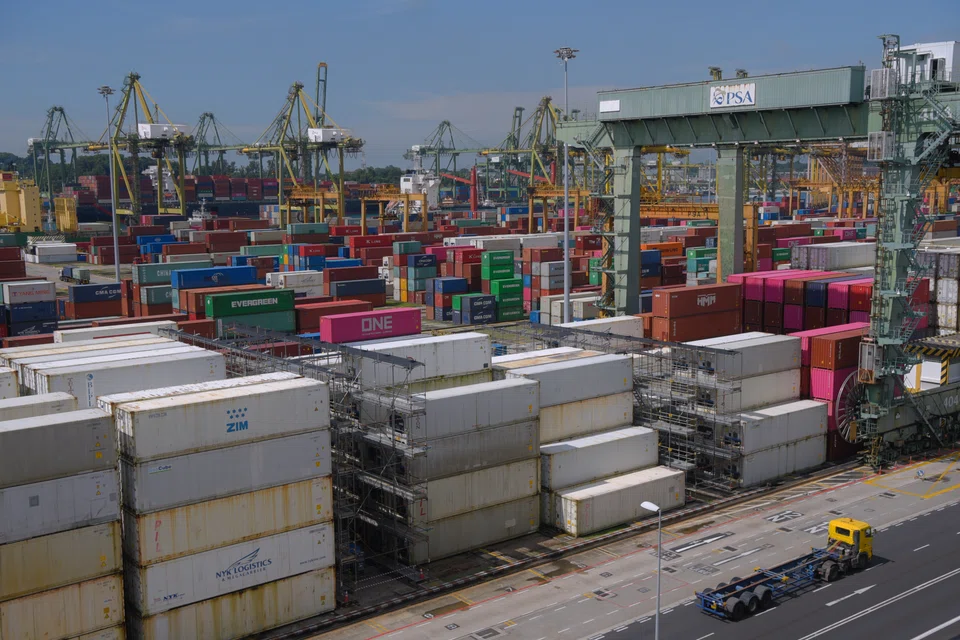
THE weakness in Singapore’s non-oil domestic exports (NODX) is expected to persist as external demand conditions remain lacklustre, weighing on both electronic and non-electronic exports, economists said on Wednesday (May 17) after the release of April’s trade prints. Many noted that NODX to China in particular has continued to underperform.
In April, NODX fell 9.8 per cent year on year (yoy), shrinking for the seventh straight month and deepening from March’s 8.3 per cent contraction. The month’s fall was marginally larger than private-sector economists’ median forecast of a 9.7 per cent drop in a Bloomberg poll. Both electronics and non-electronics continued to decline.
On a seasonally adjusted monthly basis, NODX edged up 2.7 per cent last month, extending March’s 18.4 per cent growth. Sequentially, both electronic and non-electronic shipments expanded.
But this growth was supported by a continued rise in the usually-volatile shipment of pharmaceuticals, flagged Barclays senior regional economist Brian Tan. April’s NODX data illustrated a “pickup without a fix for weak spots”, he said.
On year, shipments of electronics dropped 23.3 per cent, led by integrated circuits (-21.1 per cent), PCs (-50.3 per cent) and disk media products (-41.6 per cent).
“Global electronics demand conditions may still be searching for a trough and the anticipated H2 2023 recovery for the global electronics industry looks elusive,” said OCBC chief economist Selena Ling.
Pharmaceuticals were at the highest level on record, noted Maybank economists Chua Hak Bin and Lee Ju Ye. Still, non-electronics NODX fell 5.8 per cent yoy in April, worsening from March as the pharmaceuticals surge was offset by double-digit contractions in petrochemicals (-32.8 per cent), primary chemicals (-57.7 per cent) and food preparations (-27 per cent).
On shipments to Singapore’s top 10 markets, NODX to China was the main driver of the overall decline, falling by 20.9 per cent on year and deepening from 14.1 per cent yoy in March. It was followed by Malaysia and Taiwan.
“NODX to China continued to disappoint as the reopening failed to lift exports of neither electronics nor non-electronics,” said the Maybank team, noting that the decline was led by petrochemicals, pharma and integrated circuits. “The boost from China’s reopening remains elusive as its recovery has largely been driven by domestic services, while manufacturing remains subdued.”
Ling noted that the deeper NODX contraction “reinforced the weaker pace of China’s recovery post-reopening, as illustrated by the set of disappointing Chinese economic data prints”.
UOB senior economist Alvin Liew noted that, overtaking China at S$2.1 billion, the US (S$3.2 billion) and European Union (S$2.3 billion) were Singapore’s biggest NODX destinations in April in nominal value terms.
The US, EU and South Korea were the exceptions to the declining NODX trend observed among the top 10 markets.
But citing weak expectations data for both the eurozone and Germany in the latest survey by economic research institute ZEW, Ling added that it remains to be seen if NODX demand from this market will be sustained.
Liew noted: “While NODX to US and EU may have outperformed in April, it may have been driven by non-electronics (especially pharmaceuticals) and this might not be sustainable,” he added. He continues to expect economic slowdown in developed markets, due to the tighter monetary environment. This is possibly worsened by ongoing weakness in the financial system, further restraining credit growth and dampening confidence.
Ling agreed: “Even assuming that NODX demand from the US continues to hold up near term (notwithstanding recent recession concerns from the market and still hawkish Fed rhetoric), the global demand engine prognosis still looks vulnerable, especially if China’s reopening pace remains tepid.”
“The risk remains that the global electronics industry demand turnaround may be pushed out from H2 2023 to end-2023 or even early 2024,” she added. She maintained her NODX growth forecast at -3 per cent yoy.
UOB similarly maintained its NODX forecast at -5.5 per cent for the full year. Liew noted that a few more months of yoy declines are expected before some improvement in the second half of the year.
The Maybank team, on the other hand, downgraded their projection to -9 per cent to -6 per cent, from -7 per cent to -4 per cent previously, “given the worse-than-expected performance in the first four months of the year” and China’s lacking recovery boost.
They expect first-quarter final gross domestic product (GDP) to remain unchanged from the advanced estimate at +0.1 per cent, weighed down by manufacturing and external-oriented service declines.
“Singapore may slip into a technical recession if the boost from China’s reopening fails to materialise in the second quarter,” Chua and Lee warned. “(The) probability of recession in Singapore in the next 12 months, as predicted by the US Treasury spread, rose to 36.7 per cent in April from 30.2 per cent in March.”
For the full year, they maintained their GDP growth forecast at +0.8 per cent. However, they expect the Ministry of Trade and Industry to cut its 2023 GDP growth forecast range to -0.5 per cent to +1.5 per cent (from +0.5 per cent to +2.5 per cent), and Enterprise Singapore to slash its NODX forecast from the current -2 per cent to zero per cent range.