Singapore key exports shrink an unexpected 11.3% in August; US and Indonesian markets lead slide
Economists previously forecast an 0.8% expansion; only three out of Singapore’s top 10 markets post increase in exports

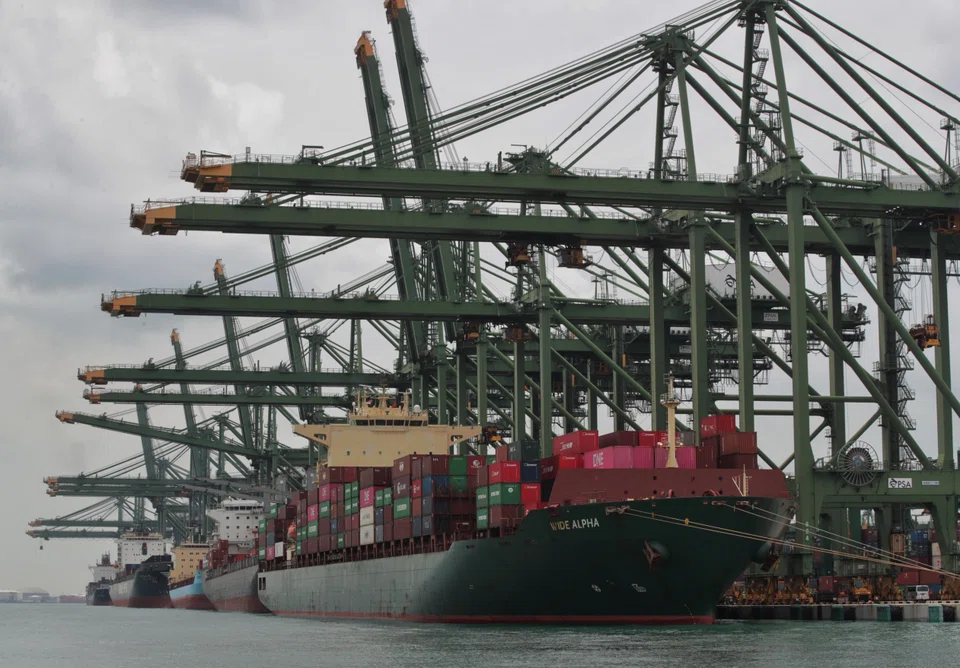
[SINGAPORE] The Republic’s key exports contracted by 11.3 per cent year on year in August, surprising private-sector economists who were expecting a slight expansion, data from Enterprise Singapore (EnterpriseSG) showed on Wednesday (Sep 17).
Private-sector economists had expected a slight 0.8 per cent year-on-year expansion, a Bloomberg poll indicated.
The contraction was driven by declines in electronics, as well as specialised machinery, food preparation and petrochemicals, said EnterpriseSG. August’s contraction extends July’s decline, which was revised up 0.1 percentage point to 4.7 per cent year on year.
Singapore’s exports profile has weakened in the first two months of the second half-year compared with the first half, and will continue to face challenges and volatility amid an uncertain global trade landscape, said DBS senior economist Chua Han Teng.
External demand faces headwinds from high US tariffs, with reciprocal tariffs already raised since August, he added. The city-state’s electronics and biomedical exports remain vulnerable to the United States’ threatened steep sectoral tariffs on semiconductors and pharmaceuticals, though exemptions or delayed implementation could reduce the impact.
Both electronics and non-electronics exports declined in August. This brings the non-oil domestic exports (NODX) growth to 1.6 per cent year on year, for the first eight months of 2025.
EnterpriseSG said that it is actively monitoring the evolving tariff situation, and will adjust its 2025 full-year NODX forecast “as necessary” to reflect changing market conditions.
Despite the worse-than-expected export performance, Bank of America (BOA) economists Ang Kai Wei and Rahul Bajoria have upgraded their full-year growth forecast for Singapore to 2.9 per cent, from 2.3 per cent, putting their projection above the official forecast range of 1.5 to 2.5 per cent growth in 2025.
The analysts’ optimism stems from resilient economic indicators elsewhere. They pointed to sustained momentum in transhipment activities, with container throughput volumes hitting new all-time highs and both sea cargo and vessel arrivals showing growth in July and August.
BOA also expects sequential expansion in manufacturing, accommodation and food services, which are being supported by encouraging tourism trends and the disbursement of SG60 Vouchers.
NODX performance
Shipments of electronics products shrank 6.5 per cent year on year, reversing from the 2.7 per cent expansion in July. This was due to high base effects, said EnterpriseSG, as well as declines in exports of disk media products (-28.1 per cent), integrated circuits (-7.4 per cent), and parts of PCs (-36.9 per cent).
Non-electronics exports were down 13 per cent on the year, extending the previous month’s 6.7 per cent decline. In particular, shipments of specialised machinery (-29.1 per cent), food preparations (-51.4 per cent) and petrochemicals (-23.2 per cent) led the decline.
In August, only three out of Singapore’s top 10 markets experienced an increase in exports.
NODX to Indonesia contracted 39.6 per cent, following a 32.3 per cent decline in the previous month.
This was followed by the United States at 28.8 per cent contraction, China at 21.5 per cent and Hong Kong at 20.9 per cent. Thailand followed closely with a 20 per cent contraction.
Shipments to the eurozone had the biggest expansion at 28.9 per cent on the year, though this was at a slower rate than July’s 77.1 per cent increase.
This was followed by exports to South Korea and Taiwan, which expanded 24.8 per cent and 9.1 per cent, respectively.
Overall, total trade grew 3 per cent year on year, extending the previous month’s 8.2 per cent growth.