Singapore manufacturing growth to moderate in 2026 but AI boom, tariff exemptions are bright spots
The lynchpin electronics sector should still lead growth

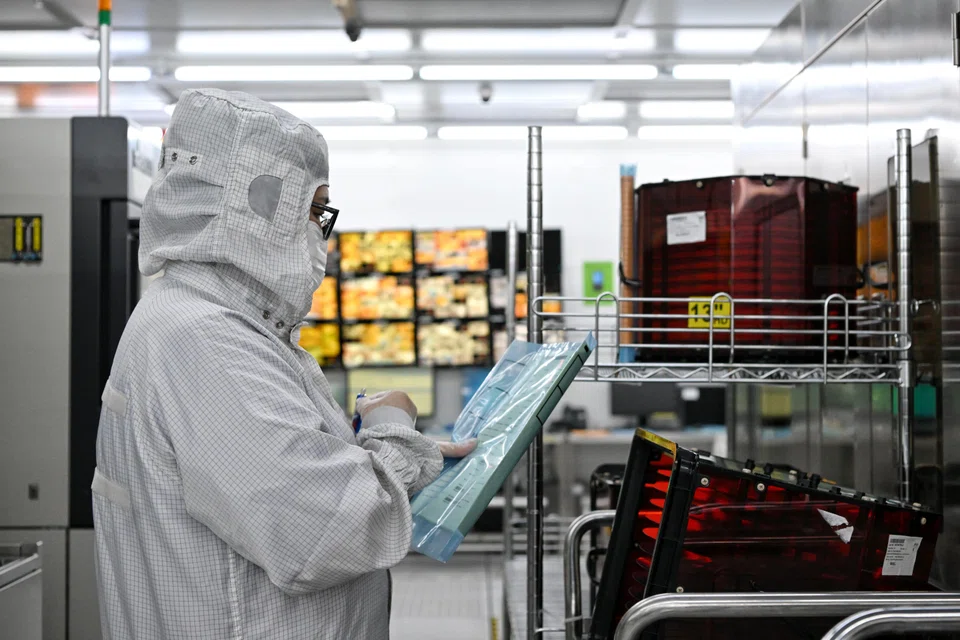
[SINGAPORE] Given the continued artificial intelligence (AI)-led electronics demand and exemptions from US President Donald Trump’s sectoral tariffs, Singapore’s manufacturing sector is still expected to chart growth this year, albeit at a more moderate pace.
The manufacturing sector performed beyond expectations in 2025, in spite of – or perhaps due to – global tariff disruptions.
There was a lot of uncertainty with the introduction of last April’s “Liberation Day” tariffs and the subsequent 90-day truce, said Singapore Manufacturing Federation (SMF) president Lennon Tan, noting the front-loading activity that followed.
Singapore’s industrial production growth averaged 8.2 per cent in the first 11 months of 2025.
This was partly due to diversification, said HSBC Asean economist Yun Liu, noting strong growth in volatile pharmaceutical production and outperformance in precision and transport engineering.
Electronics remained the standout performer.
Sustained elevated AI-driven demand lifted trade growth in tech-exposed economies, including Singapore, Liu said.
RHB group chief economist Barnabas Gan highlighted strong demand for AI-related semiconductors, servers and advanced components. Last year’s manufacturing growth was underpinned by the global semiconductor upcycle and steady industrial investment, he said.
In 2026, high base effects will come into play, and front-loading will also need to be paid back. The uncertainty that lingers from the start-stop nature of US-led trade disruptions are also expected to carry into the new year, observers said.
Said HSBC’s Liu: “In 2026, we expect a gradual deceleration in industrial production but not a sudden downturn.”
Maybank predicts that the manufacturing sector’s growth will “remain healthy” this year, easing to a “relatively resilient” 3.1 per cent, said analyst Brian Lee. In the flash fourth-quarter estimate, 2025 manufacturing growth was 7.6 per cent.
SMF’s Tan foresees growth momentum in Singapore remaining strong into the first quarter, before more muted growth for the rest of the year, with manufacturers looking at how to move forward and reconstruct supply chains “now that the dust has settled” more.
Anticipation for AI
Still, manufacturers are cautiously optimistic, heading into 2026. One key reason is the sustained electronics demand, driven by the AI boom, observers said.
Tan said the possibility of an AI bubble is more capital markets-focused, but the high “real demand” for its use, such as for general office productivity, will demand more powerful equipment.
Singapore Semiconductor Industry Association executive director Ang Wee Seng said: “The growth trajectory will be shaped primarily by AI compute, cloud infrastructure, industrial digitalisation and electrification trends.”
He added: “These structural drivers remain strong even if some consumer segments stay soft.”
Maybank’s Lee said that Singapore’s tech supply chain stands to benefit as America’s six largest hyper-scalers – Meta, Amazon, Google, Microsoft, Oracle and Apple – are planning to increase capital expenditure by 36 per cent in 2026.
Singapore’s role in the AI supply chain is also set to deepen this year, he added, with Micron’s new US$7 billion high-bandwidth memory (HBM) advanced packaging facility starting operations in 2026.
“Nearly all (98 per cent) of Micron’s Nand flash memory chips are already produced in the city-state,” he added.
But despite the resilient demand so far, Moody’s Analytics economist Denise Cheok warned: “Production of high-end chips out of South Korea and Taiwan indicates that (the boom in AI) is fading from its peak, so this might not sustain the sector throughout the rest of (2026).”
Escaping tariffs
The US’ sectoral tariffs will be another key factor in deciding Singapore’s manufacturing performance in 2026.
Liu cautioned that “the final verdicts” of sectoral tariffs on semiconductors and pharmaceuticals have not been addressed. These products made up a large 36 per cent share of Singapore’s exports to the US in 2024, added Lee.
US officials have reportedly said that long-threatened semiconductor tariffs may be delayed.
As for pharmaceuticals, Trump last September announced a 100 per cent tariff on any branded or patented pharmaceutical product from Oct 1, unless its manufacturer “is building their pharmaceutical manufacturing plant in America” – though he has yet to sign an executive order to impose this.
Regardless, watchers noted that Singapore’s manufacturers may be shielded from the worst of the tariff hits.
Trump has promised significant exemptions for pharmaceutical and semiconductor companies that invest in the US.
Many major firms operating out of Singapore already have a US presence and will likely qualify for sectoral tariff exemptions, said Moody’s Cheok, adding: “This should keep the effective tariff rate, which takes into account exemptions, below the base 10 per cent rate.”
Furthermore, threatened measures lack concrete timelines, said Lee, adding that Trump has also said firms “committing to build” in the US will be eligible for exemptions.
“Most MNC (multinational corporation) producers in Singapore, which account for the dominant share of output, are investing in manufacturing capacity in the US,” he said.
SMF’s Tan’s take is that, as long as companies commit to invest in some production in the US, it is “business as usual”.
Cheok noted that pharmaceutical manufacturing has “done surprisingly well” in recent months, “despite (or perhaps because of)” the sectoral tariff announcement.
This possibly reflects the front-loading effect seen in electronics, replicated in the pharma space, she said. “The huge surge in orders imply that the resulting payback will likely be strong as well.”
But with the lack of clarity, some companies are taking things into their own hands to manage the disruption.
Pharmaceutical players are having closed-door discussions with the US trade office, SMF’s Tan confirmed, adding that he believes that the US “are not coming down so hard on the drug companies”.
Higher drug tariffs could mean making life-saving medications unaffordable, he said. “ I don’t think the Trump administration wants that on their hands.”
Last month, nine of the largest US and Europe-based drugmakers inked deals with Trump to lower their US drug prices, in exchange for a three-year exemption from his planned sectoral tariffs, as long as they further invest in US manufacturing.
Singapore’s manufacturers are also continuing to set themselves apart.
Gan said: “(They) are responding (to risks) by diversifying operations and leveraging Singapore’s strengths as a high-value hub for R&D (research and development), testing and regional coordination.”
While routine production shifts to lower-cost Asean countries, Singapore continues to attract high-value activities, supported by strong governance, intellectual property protection and world-class infrastructure.
“These factors position Singapore as a regional centre of excellence in semiconductors, pharmaceuticals and precision engineering, reinforcing economic resilience and long-term industrial competitiveness despite external headwinds,” he said.
Other sectors
As for the remaining sectors within manufacturing, performances are expected to remain uneven.
General manufacturing has posted multiple months of year-on-year declines, noted Gan.
Meanwhile, OCBC chief economist Selena Ling noted that the transport engineering industry is benefiting from the maintenance, repair and overhaul pipeline in the aerospace segment. Transport engineering’s marine and offshore engineering segment also continues to make a strong showing.
Tan noted that furniture companies face significant tariffs, with products from some Singaporean brands that are “quite popular in the US” mainly made in China.
In these cases, SMF is working to advise them, link them with tax advisers, and introduce them to grants so that they can optimise costs, he said.
Tariff hikes on “certain upholstered wooden products” were set to rise at the beginning of this year, though this has since been postponed.
He also noted increased competition for local suppliers. The US market used to make up about 25 per cent of total Chinese exports, he said. This has fallen to about 12 to 13 per cent today, with much of the excess coming to Asia.
Beyond AI and tariffs, Tan will be keeping an eye on any escalation in geopolitical conflicts, such as between China and Japan or China and Taiwan. Heightened tensions have direct implications for manufacturing, he said.
Severely worsened relations could affect supply chains, for example, complicating matters if a Japanese company chooses not to buy any product with Chinese components and vice versa, he said.
Ling noted that, for Singapore, policy support may be in the wings, “to help overcome the trade fragmentation and tariff challenges”.
She believes this could come in the government’s Economic Strategy Review recommendations – due in the first half of 2026 – as well as Budget 2026 in February.
Decoding Asia newsletter: your guide to navigating Asia in a new global order. Sign up here to get Decoding Asia newsletter. Delivered to your inbox. Free.
Copyright SPH Media. All rights reserved.