Singapore manufacturing PMI at a 10-month high in January, driven by AI boom

The overall purchasing managers’ index is up 0.2 point at 50.5, marking the sixth straight month of expansion

Summarise
Tessa Oh
Published Mon, Feb 2, 2026 · 09:00 PM
    • January's PMI reading marked the sixth straight month of expansion.
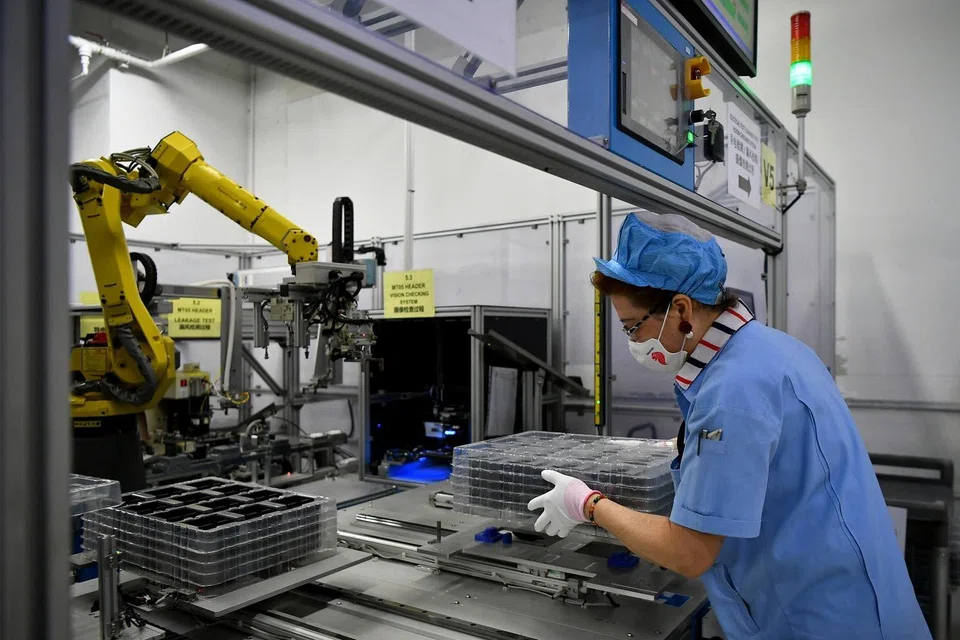
    • January's PMI reading marked the sixth straight month of expansion. PHOTO: BT FILE

    [SINGAPORE] Overall factory activity in Singapore rose to 50.5 in January, its highest reading in 10 months, as manufacturers across the region benefited from sustained demand for artificial intelligence (AI)-related products.

    The purchasing managers’ index (PMI) rose 0.2 point to 50.5 in January from 50.3 in December, data from the Singapore Institute of Purchasing and Materials Management (SIPMM) showed on Monday (Feb 2).

    This marks the sixth straight month of expansion. A reading above 50 indicates expansion, while one below 50 indicates decline.

    The electronics sector PMI increased by 0.2 point to 51.1 from 50.9 the month prior, signalling a stronger pace of expansion and marking the eighth consecutive month of growth.

    The industry’s performance was supported by faster expansion in new orders, new exports, factory output, input purchases and employment, with the employment index recording its fifth consecutive month of expansion.

    The supplier deliveries index recorded its third consecutive month of contraction, indicating longer delivery lead times.

    DBS senior economist Chua Han Teng said: “Singapore’s electronics players continued to benefit from global AI tailwinds, underpinned by demand for AI-related server products and memory chips, with this support possibly sustained in the near term.”

    Bullish expectations

    OCBC chief economist Selena Ling noted that the bullish manufacturing and electronics PMI readings were validated by the recent business expectations survey for manufacturing, which found a net weighted 11 per cent of businesses upbeat for the first half of 2026.

    This was led by the electronics cluster, with a net weighted 33 per cent citing a positive business outlook for the next six months on the back of sustained AI-related demand. The semiconductors segment was the most bullish, at a net weighted 41 per cent.

    Only the chemicals cluster was pessimistic, with a net weighted 17 per cent of firms tipping a weaker business outlook, weighed down by the petroleum segment due to macroeconomic uncertainties dampening refining product demand and margins.

    The biggest challenges cited by manufacturing firms were price competition from overseas competitors and political or economic conditions abroad, including geopolitical tensions and tariff uncertainties.

    SIPMM executive director Stephen Poh noted that the latest PMI readings pointed to a continued positive outlook for the manufacturing sector, underpinned by strong demand for AI-related chips and memory products.

    Yet, manufacturers continue to face capacity and supply-chain constraints, he added. Ongoing avoidance of the Red Sea and Suez Canal routes has resulted in longer transit times and slower turnaround schedules.

    AI-driven demand

    "A lot of the business optimism may be underpinned by the AI-related global demand narrative, as illustrated by the electronics PMI hitting above the 51 handle," Ling said.

    Other regional PMIs have also benefited from the AI boom. Taiwan, South Korea and Malaysia all recorded expansions in factory activity.

    Manufacturing PMIs also improved for Indonesia, Myanmar and the Philippines. Vietnam's PMI eased to 52.5, but remained in expansionary mode, with just a slight dip from the previous month's 53 reading.

    Bucking the trend was China, where the official manufacturing PMI contracted by an unexpected 0.8 point to 49.3 in January, from 50.1 in December. The decline was driven by a significant drop in new orders and a continued fall in the employment index.

    The weaker-than-expected reading suggests recently announced front-loading measures may still be insufficient or may need more time to stabilise sentiment and growth, noted Barclays analysts Zhou Yingke, Zhang Ying and Chang Jian.

    High-frequency indicators of domestic demand showed no signs of a turnaround, with property sales continuing to decline and box-office revenue falling.

    China's exports likely remained strong, however, with port cargo throughput growth edging higher to 7.7 per cent year on year in January, from 7.2 per cent in December, the analysts said.

    Although Singapore's headline manufacturing PMI expanded at a faster pace in January, Chua said he remains cautious about the outlook for non-electronics manufacturing, given the lagged impact of higher US tariffs globally.

    The contraction in the supplier deliveries sub-index in January and constrained readings in the fourth quarter of 2025 pointed to some supply-chain challenges, he noted.

    While the order backlog sub-index reverted to slight expansion in January after two months of contraction, it requires monitoring to determine whether this rebound of higher unfulfilled orders was one-off and temporary, he added.