

Singapore PMI inches up in June but remains in contraction for 3rd straight month

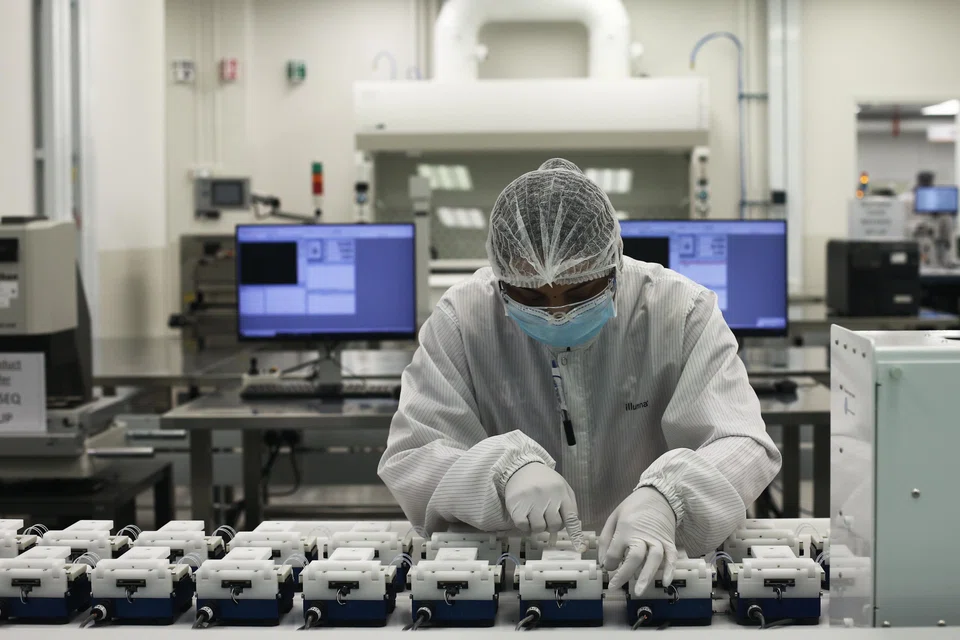
SINGAPORE’S overall factory activity improved slightly in June, but remained in contraction territory for the third straight month, as weak global demand continues to hit manufacturing sentiment in the region.
The Purchasing Managers’ Index (PMI) inched up 0.2 point to 49.7 last month, contracting at a slower rate than in May, data from the Singapore Institute of Purchasing and Materials Management (SIPMM) showed on Monday (Jul 3).
A reading below 50 indicates that the manufacturing sector is declining, while a reading above 50 means growth.
In contrast, the lynchpin electronics sector slipped 0.1 point from the previous month to post a faster contraction at 49. This is the 11th consecutive contraction since August 2022, after two years of continuous expansion.
“Local manufacturers are bracing for a dour outlook going into the second half of the year, amid increased uncertainties in the global economic environment,” said SIPMM executive director Stephen Poh.
Disruptions in semiconductor supply chains, as a result of the US chip restrictions, have also affected the electronics markets, he noted, with industry insiders flagging the longest drag in semiconductor market sales, which have fallen for five consecutive quarters.
OCBC chief economist Selena Ling noted that the small uptick in June was mainly due to marginally better new orders, new exports, output, as well as the order backlog index which reverted to the 50 handle. But the dip in supplier deliveries, imports and employment “suggests the June overall manufacturing PMI print is a stabilisation rather than a broad-based rebound”, she added.
DBS economist Chua Han Teng said the coming months’ data will be key to determining if the manufacturing sector has “reached a bottom” and if better days are ahead in the second half.
Both economists said the electronics segment is crucial to the manufacturing sector’s turnaround.
“Without (an improvement in the electronics segment), the activity pickup in the other manufacturing industries, like transport engineering and the biomedical cluster, may not be sufficient to lift the overall industrial production from its current slump,” said Ling.
“The near-term electronics outlook remains uncertain, as the segment still has to contend with demand headwinds in advanced economies from high interest rates, destocking of high inventories, even though we see medium-term potential and optimism for artificial intelligence-related chips,” Chua added.
The glum manufacturing sentiment is in line with other regional economies, which also saw manufacturing activity soften in April.
China’s official manufacturing PMI edged up slightly to 49 in June, from 48.8 in the previous month, but remained in contraction territory for the third consecutive month. The Caixin PMI, derived from smaller private manufacturers, shed 0.4 point to 50.5 in June.
Caixin Insight Group senior economist Wang Zhe said recent economic data from China suggested that the country’s recovery has yet to find a stable footing, as prominent issues including a lack of internal growth drivers, weak demand and dimming prospects remain.
In Taiwan, the S&P Global Manufacturing PMI edged up 0.5 point to 44.8 in June, though it still remained in contraction territory. Meanwhile, the S&P Global Korea Manufacturing PMI tumbled to 47.8 in June, from 48.4.
Closer to home, the S&P Global Malaysia Manufacturing PMI fell 0.1 point to 47.7, from 47.8. The S&P Global Vietnam Manufacturing PMI also remained in contraction territory, though it went up to 46.2 in June.
Although Thailand’s and the Philippines’ manufacturing PMIs were in expansionary territory, both pulled back in June from the previous month. The S&P Global Thailand Manufacturing PMI tumbled to 53.2, down from 58.2, while the S&P Global Philippines Manufacturing PMI dropped to 50.9, from 52.2 previously.
TRENDING NOW

Ex-Nvidia CEO Jensen Huang carried a secret for more than a year. It led to his downfall

South-east Asia has lost Nvidia’s best salesman

Demand, tech capabilities position Apac and AI as Skyscanner’s next growth frontiers: CEO Bryan Batista

Jensen Huang discusses comeback as Nvidia CEO with allies: report

