

Singapore port achieves record-high performance in 2025
It overtakes Hong Kong after hundreds of vessels reflag from Chinese city to Singapore in September and October

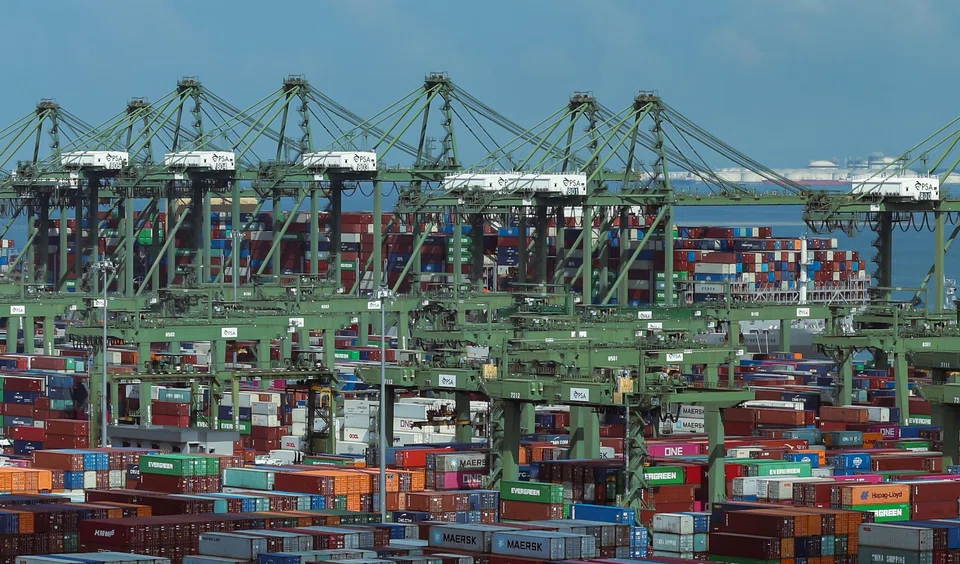
[SINGAPORE] The Port of Singapore had a banner year in 2025, achieving all-time highs for annual vessel arrival tonnage, container throughput, marine fuel sales, sales of alternative bunker fuels, and total tonnage of ships under the country’s flag.
Gross tonnage of vessel arrivals rose by 3.5 per cent year on year to around 3.2 billion, while box throughput improved by 8.6 per cent to about 44.7 million 20-foot equivalent units (TEUs), based on Maritime and Port Authority of Singapore (MPA) data. TEU is a measure of cargo capacity.
Tan Hua Joo, an analyst at container shipping intelligence provider Linerlytica, told The Business Times that all the main South-east Asia hub ports reported record-high volumes in 2025 due to strong Chinese exports outside of the US.
He noted that Singapore’s 8.6 per cent improvement was below Malaysia’s Tanjung Pelepas’ 14.5 per cent, but better than Port Klang’s 3.4 per cent.
The box throughput handled should place Singapore as the world’s second-busiest container port in 2025, behind Chinese port Shanghai’s 55.1 billion TEUs, but ahead of Ningbo-Zhoushan’s over 43 million TEUs. This was also how the three ports were positioned in 2024, as ranked by the World Shipping Council.
Notably, the Chinese ports also broke their 2024 container throughput records.
However, Singapore handled 1.4 per cent less general and bulk cargo at 614.3 million tonnes in 2025, compared with 622.9 million tonnes in 2024.
Meanwhile, Singapore’s marine fuel sales were up 3.4 per cent at about 56.8 million tonnes in 2025, which included two million tonnes of alternative marine fuels (up from 1.4 million tonnes).
The Singapore Registry of Ships climbed one position higher to be the fourth-largest ship registry in the world for the first time with 137.5 million gross tonnage, up 27 per cent from 2024. Ship registries are ranked by gross tonnage.
SEE ALSO

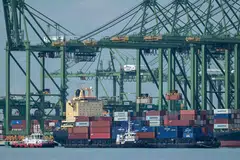

Singapore overtook Hong Kong after hundreds of vessels reflagged from the Chinese city to the Republic in September and October, amid US imposition of port fees on Chinese-linked ships. The levy was, however, suspended in early November.
The effect of the pause showed up in November and December, as there was a smaller increase in the number of vessels and gross tonnage added at Singapore’s ship registry.
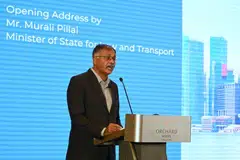
Murali Pillai, senior minister of state for law and transport, noted the Port of Singapore’s achievement in 2025 was an exceptional success despite global uncertainties.
He made the comments and also provided an update on the industry’s 2025 developments in his opening remarks at the annual Singapore Maritime Foundation’s New Year Conversations event at Parkroyal Collection Marina Bay on Tuesday (Jan 13).
He pointed out that 35 maritime companies opened or expanded their operations in Singapore in 2025, bringing the total to more than 200 international shipping groups. These groups contribute an estimated annual total business spending of around S$5 billion to Singapore’s economy.
Digital bunkering, efficient ops
In its bid to raise its competitiveness, Singapore will streamline regulatory processes to make it easier for businesses to operate efficiently and reduce costs.
MPA will launch an integrated portal for maritime-sector incentive schemes to shorten processing times. This follows a streamlined and digitalised declaration regime for withholding tax exemptions, simplifying the process for interest and related payments.
In 2025, MPA also implemented digital bunkering, and introduced the electronic bunker delivery notes inquiry facility for bunker buyers.
All bunker suppliers in Singapore have implemented digital bunkering as at August 2025. This has improved productivity and enhanced transparency in bunkering operations, saving up to 40,000 man-days annually in business process efforts.
MPA to raise readiness for a multi-fuel bunkering hub
On Wednesday, MPA will open applications for new liquefied natural gas (LNG) bunker supply licences.
This comes as the authority in November awarded three licences to supply methanol as marine fuel in the Port of Singapore from January this year.
It will also launch the standards for port limit LNG bunker vessels to cover the equipment, operational performance and efficiency of such vessels operating in Singapore to enhance safety.
The port authority and Enterprise Singapore – through the Singapore Standards Council – will also be upgrading the existing technical reference for LNG bunkering (TR56) to a Singapore standard in the second quarter, to enhance requirements for safe, transparent and quality-assured LNG bunkering.
They will also publish Singapore’s first technical reference for refuelling ships with ammonia in Q2, to guide safe and reliable operations, and support trials and early adoption.
The projects it intends to develop for the green and digital shipping corridors initiative in 2026 include common emissions-reporting protocols, enhancing digital exchanges, and conducting fuel trials along participating routes.
The Singapore Registry of Ships is expected to flag its first ammonia dual-fuelled vessel within the next two years, having flagged five methanol-fuelled vessels since 2020. It awarded 34 green ship certificates under the green ship programme in 2025.
Maritime outlook
The external environment remains challenging in 2026, Murali said, with continued uncertainty from geopolitical tensions, changing tariffs, and threats of supply chain disruption.
Nonetheless, Singapore’s maritime industry is expected to remain resilient this year, as global seaborne trade is projected to rise, especially for commodity trades where diversification and re-routing are driving up shipping demand.
The MPA celebrates its 30th anniversary while the ship registry marks its 60th year of inception this year.
Decoding Asia newsletter: your guide to navigating Asia in a new global order. Sign up here to get Decoding Asia newsletter. Delivered to your inbox. Free.
Copyright SPH Media. All rights reserved.
TRENDING NOW

LTA proposes combining car COE categories, adding rebate-surcharge system
StarHub to acquire MyRepublic’s mobile business amid ongoing telco consolidation

DBS, OCBC, UOB rout lops billions off STI as inflation, rate concerns spook investors

Grab CEO’s wife Chloe Tong on life with Anthony Tan and finding her purpose

