

Singapore retail sales up 0.6% in August, driven by vehicle takings
Of the 14 industries, nine report year-on-year falls

SINGAPORE’S retail sales grew 0.6 per cent on year in August, less than the 1 per cent growth recorded in July, based on Department of Statistics (Singstat) data released on Friday (Oct 4).
Still, the reading was higher than the median forecast of 0.2 per cent growth in a Bloomberg poll of private-sector economists.
On a month-on-month, seasonally adjusted basis, retail sales rose 0.7 per cent, slowing significantly from the 3.1 per cent expansion in July.
August’s estimated total retail sales value was S$4.1 billion, with online sales accounting for 12.1 per cent.
Excluding motor vehicles, retail sales slipped 1.5 per cent from the year-ago period, but climbed sequentially – up 2 per cent on a seasonally adjusted basis.
Year on year, nine retail sales categories marked declines in August, with the others category posting the largest fall.
DBS economist Chua Han Teng said: “A still-strong Singapore dollar likely incentivised locals to divert their spending and purchase (portable goods such as apparel and footwear and recreational goods) when they travel abroad.”
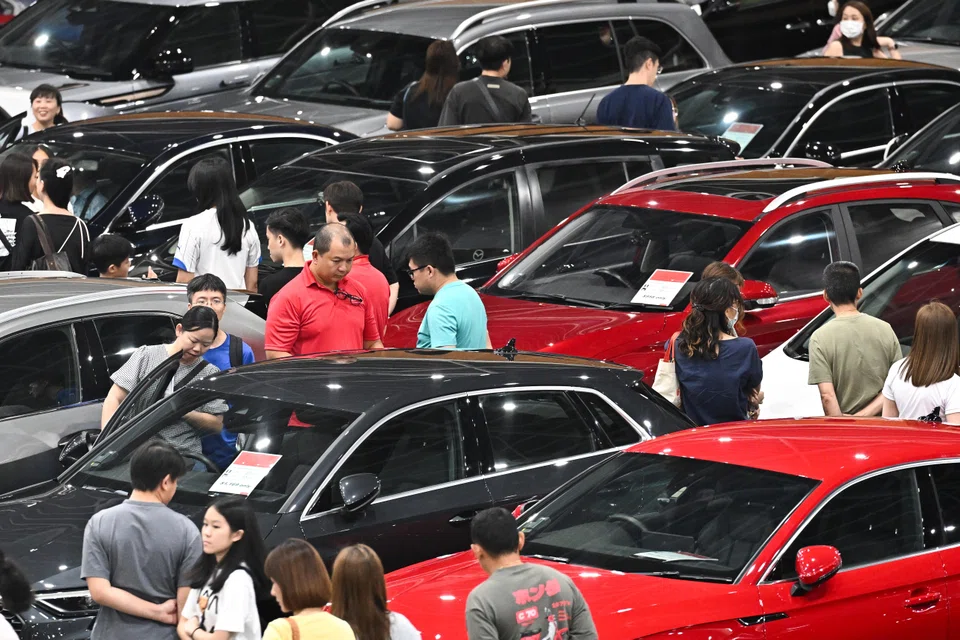
Of the five categories that picked up on year, motor vehicles jumped by the most.
The increased sales in motor vehicles corresponded to a higher Certificate of Entitlement (COE) quota, Singstat noted.
The on-year retail sales growth in July and August were slightly better in the second quarter, Chua added. “We hold hopes for improved momentum in the remainder of 2024.”
UOB associate economist Jester Koh noted a potential boost from Chinese tourists in October during the Golden Week holiday, though whether the impact is tempered by lower per capita tourism receipts remains to be seen, as this depends on whether the recent barrage of stimulus measures can boost consumer confidence.
Economists also expect the Singapore Grand Prix, concerts, meetings, incentives, conferences and exhibitions, as well as government support measures such as the Assurance Package, to provide some uplift in the months ahead.
OCBC chief economist Selena Ling pointed out that given the relatively low base in September to December 2023, “it should not be difficult to see retail sales expand by 2.5 to 3.8 per cent year on year” in the last four months of this year. She identified the health of the domestic labour market, the COE premium trends, as well as the escalation in geopolitical tensions in the Middle East – which contributed to a recent uptick in crude oil prices – as key factors to watch.
On a month-on-month, seasonally adjusted basis, sales growth was recorded in the majority – nine out of 14 – of the categories.
Meanwhile, in a separate index, sales of food and beverage (F&B) services jumped 4.3 per cent on year in August, accelerating from the 0.2 per cent increase posted in the preceding month. It was up 3.5 per cent on a monthly, seasonally adjusted basis.
On the year, growth was recorded across all F&B segments:
- Restaurants (2 per cent);
- Fast-food outlets (0.1 per cent);
- Food caterers (24.3 per cent);
- Cafes, food courts and other eating places (3.3 per cent).
All four categories were also up on a seasonally adjusted, month-on-month basis.
F&B services receipts amounted to S$1 billion, with online sales accounting for 24.2 per cent.
TRENDING NOW
Prima to move out of historic Keppel Road flour mill building in 2028

Grab CEO’s wife Chloe Tong on life with Anthony Tan and finding her purpose

OCBC sheds S$8 billion in value as shares close nearly 6% down; analysts cautious on banks
As Asia’s food delivery giants rejig the pie, who will win the market?

