Singapore tourist arrivals rise again to 957,605 in February; Chinese reopening more impactful in H2

Elysia Tan
Elysia Tan

Published Fri, Mar 10, 2023 · 11:59 AM
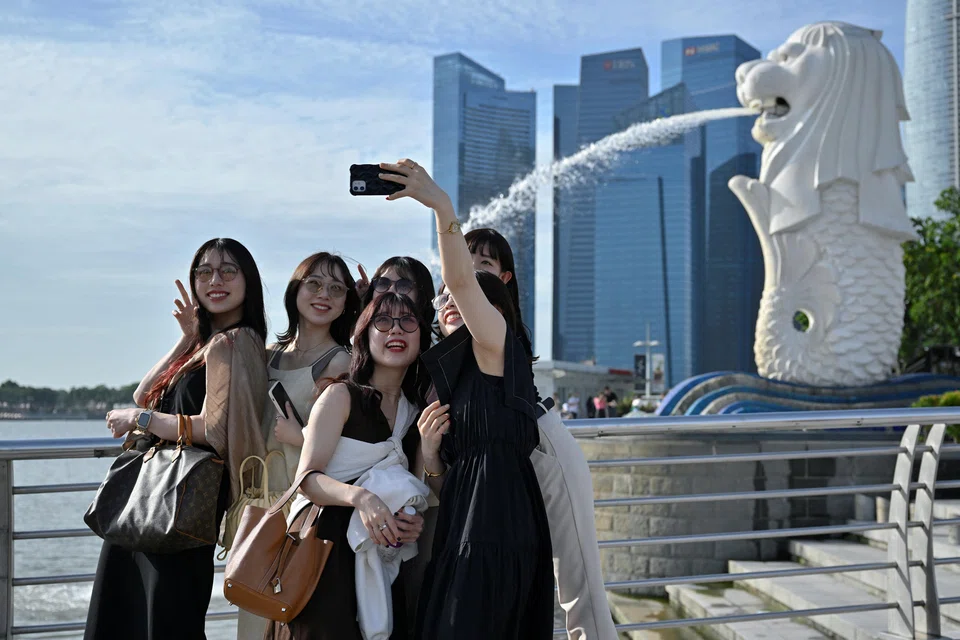
    • Indonesia has come in as the top source of visitors to Singapore in February, followed by Malaysia, Australia and South Korea.
    • Indonesia has come in as the top source of visitors to Singapore in February, followed by Malaysia, Australia and South Korea. PHOTO: REUTERS

    SINGAPORE’S international visitor arrivals grew to 957,605 in February, setting a new record since the pandemic began, latest figures from the Singapore Tourism Board (STB) showed on Friday (Mar 10).

    February’s arrival numbers rose from 931,652 in the preceding month, but remained below the 1.7 million visitors recorded in January 2020, before the Covid-19 pandemic.

    The month’s increase “highlights an expectation of a sustainable recovery pattern”, said Govinda Singh, Colliers’ executive director of hotels and leisure in Asia.


    Indonesia was the top source of tourists for the 11th straight month, with 156,444 visitors arriving from the country in February – though this was down from 168,956 in the previous month.

    The next-largest source country was Malaysia, overtaking Australia with 88,031 tourist arrivals. This was an increase from the 72,751 visitors in January.

    Some 72,360 visitors hailed from Australia last month, falling from 102,882 in the month before and putting it in third place.

    Coming in fourth was South Korea, where 64,868 visitors arrived from, up from 60,454 in the previous month.

    Just 35,300 visitors were registered from China in February, Singapore’s largest in-bound market in pre-Covid 2017 to 2019. But this marked an increase from the 28,363 visitors recorded in January and the 3,823 visitors in the corresponding month a year before, when its Covid-19 restrictions were stricter.

    “It was always first going to be domestic broad recovery (which we are seeing) as people physically recover from illness and try to plan their travel,” said Jesper Palmqvist, senior director for the Asia-Pacific at hotel industry research firm STR. “We are still missing a lot of wide body planes and flights to and from multiple Chinese markets,” he added.

    Govinda also noted China’s still-limited airlift capacity, “with some 56 weekly flights seen currently compared to 400 in 2019”.

    In the year to date, Singapore has reported some 1.9 million international visitor arrivals, against STB’s expectation of 12 million to 14 million visitors for the full year announced in January.

    The city-state will likely meet that target, though Chinese-led recovery will be more evident in the latter half of the year, industry watchers agreed.

    “While it is a bit early to establish, early indicators are exhibiting that we are on target,” added Govinda. “With the expectation that China will start to meaningfully contribute to the number from the second half of 2023, it bodes well for the target.” 

    Palmqvist agreed that the estimate is plausible, though “we still have some opaque factors” such as flight seat capacity growth and global economic conditions. H2 will bring “a more broad flow of travellers, both business and leisure, and both FIT (free independent travellers) and group”, he explained.

    Still, nearer-term recovery is also expected. This will be prompted by a “significant ramp-up” of flights to China and airlift capacity added to destinations, alongside staffing increases, said Govinda.

    Palmqvist said: “I don’t see a linear growth.” It may remain “patchy” in the second quarter, despite “good search volumes” at Chinese online travel agencies, he added. But even so, improvements will come with higher capacity, “if flight prices can be held at decent levels”, particularly during the next big holiday in May.