

Singapore updates national AI strategy, partners Google and OpenAI
Government will help 10,000 enterprises over the next three years to use AI meaningfully
Ranamita Chakraborty &
Meera Pathmanathan
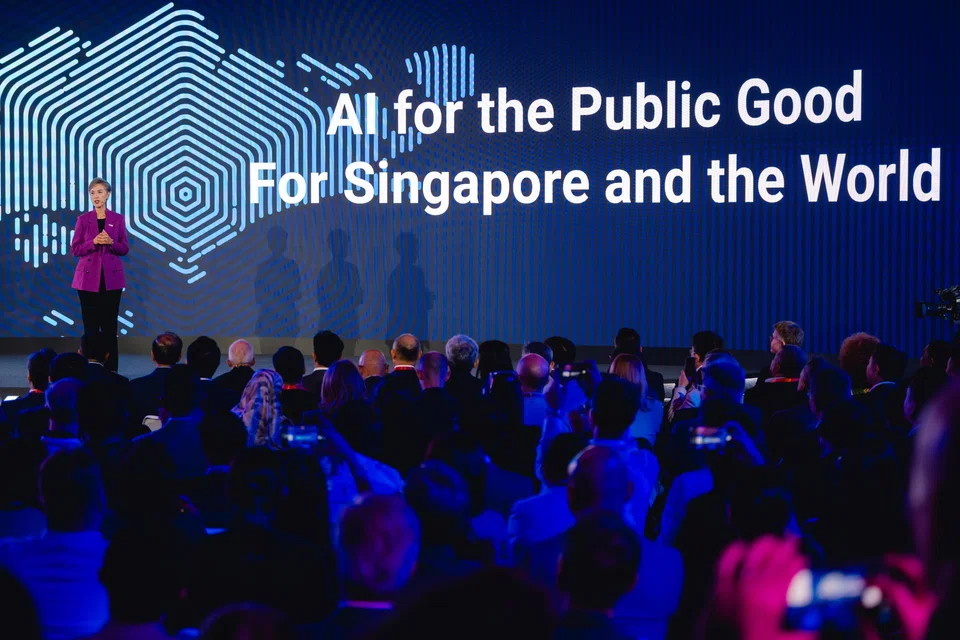
[SINGAPORE] The government is seeking to broaden adoption of artificial intelligence among Singapore-based small and medium-sized enterprises by supporting 10,000 firms over the next three years to move from experimentation to operational integration.
“We will help 10,000 enterprises use AI meaningfully,” said Minister for Digital Development and Information Josephine Teo at the ATxSummit on Wednesday (May 20), referring to the National AI Impact Programme that aims to broaden the base of enterprise users.
This will be part of 10 refreshed priorities under the newly updated Singapore’s National AI Strategy (NAIS) to harness AI for the public good.
Hosted by the Infocomm Media Development Authority at Capella Singapore, ATxSummit covers a range of topics such as agentic and embodied AI, AI safety and governance, space satellites and communications, and quantum compute through a series of plenary sessions. Teo was delivering the opening keynote at the event.
In her address, the minister covered Singapore’s AI priorities and ambitions, including how the Republic will deepen adoption across key sectors, partner industry to solve real-world problems and strengthen its position as a trusted AI hub.
The update provided by Teo builds on NAIS 2.0, which was launched in December 2023 by then deputy prime minister Lawrence Wong. It refreshes the government’s priorities across the 10 NAIS Enablers.
These enablers have been updated to incorporate insights from implementing NAIS 2.0, and to better support the National AI Council’s elevated ambitions. They are not meant to operate as separate workstreams.
Each enabler helps to advance AI development in Singapore and works in concert with other enablers to create greater impact.
Other refreshed priorities include nurturing AI bilingual talent, while continuing to attract top-tier AI talent and cultivate practitioners of the tech, as well as building capabilities across the spectrum of AI research to enable greater impact. “We are updating our strategies and priorities (and) this refresh builds on our experiences and insights implementing NAIS 2.0,” said Teo.


Global acceleration
The move comes amid acceleration of global deployments in AI, Teo noted.
In Singapore, 70 AI Centres of Excellence have been established, and open-source models such as Sea-Lion and Meralion have been developed to reflect the regional context.
Sea-Lion stands for Southeast Asian Languages in One Network, while Meralion is short for Multimodal Empathetic Reasoning and Learning in One Network.
At the same time, Singapore’s AI for Science programme is tackling pressing challenges such as vaccine development.
Teo also highlighted the establishment of the National AI Council earlier this year, chaired by PM Wong.
She said the council will focus on advancing national AI missions to expand adoption across Singapore’s economy, deepen AI capabilities, and strengthen the country’s position as a leading hub for AI innovation.
These missions, she noted, provide “strong reason” for leading AI firms to anchor themselves here to develop, test and scale AI solutions that are trusted and globally relevant. “In areas like healthcare and education, we are harnessing AI for the public good and to improve the well-being of our citizens,” she added.
She said the missions will be driven by problem statements worth solving not only for Singapore, but for the world. The goal is to establish “beachheads” for deep, transformative AI adoption across key sectors, and work has already begun.
She pointed to aviation as an example.
Changi Airport is currently the world’s fourth-busiest international airport and the upcoming Terminal 5 expansion is expected to double annual passenger handling capacity from 70 million to 140 million over the next decade.
Teo highlighted the need for a next-generation air traffic management system as one of many areas where AI can play a transformative role.
She also cited Tuas Port as another example, saying that its “rich data sets of complex operations (are) useful for developing exciting new AI solutions”. “Our connectivity challenges clearly demonstrate where Singapore can be a living lab for the world,” she added.
Meanwhile, four sectors have been identified as priorities for an AI push – connectivity, advanced manufacturing, healthcare and finance.
Teo noted that Singapore already holds global standing in each of these industries, which together account for more than 40 per cent of the country’s gross domestic product.
They are also areas where government enablers, such as data access and regulatory sandboxes, can catalyse AI breakthroughs.
Developments in physical and modern AI have great relevance to our manufacturing companies, Teo said, adding that industrial robot density in Singapore is about five times the global average, and consistently one of the highest in the world.
Deploying physical AI
In her keynote, Teo also announced that the Infocomm Media Development Authority (IMDA), JTC Corporation and the Singapore Institute of Technology are embarking on new collaborations with eight industry leaders at the Punggol Digital District to bring physical AI to the real world.
“We will create an integrated data platform, design real-world test scenarios, and rules that enable robots to safely operate across the district,” she said.
This test bed will be launched later in 2026 to research, test and deploy physical AI. It will be Singapore’s first testbed to enable multi use-case and multi-operator deployments at-scale, in a mixed-use public area.
Teo noted that robots can help workers enhance service delivery to areas that are currently underserved. Certis, DHL, Grab and QuikBot will be among the first companies to co-design, deploy and test commercially viable robotics services in public spaces.
This will include food and parcel delivery, as well as cleaning and security patrolling, to complement existing human operations.
The test bed is facilitated in collaboration with the Land Transport Authority, through a precinct-level exemption framework under the Active Mobility Act.
The ATxSummit also announced the launch of an AI research lab by Nvidia, which seeks to sharpen Singapore’s manufacturing advantage. The lab will be focused on advancing embodied and efficient AI in collaboration with university researchers, industry partners and government agencies. The lab is Nvidia’s Singapore hub and second research presence in Asia-Pacific.
It will focus on two strategic domains that have numerous potential applications in manufacturing.
These partnerships are one of two critical enablers to activate our national AI missions, noted Teo.
Partnerships to advance Singapore’s national AI strategy
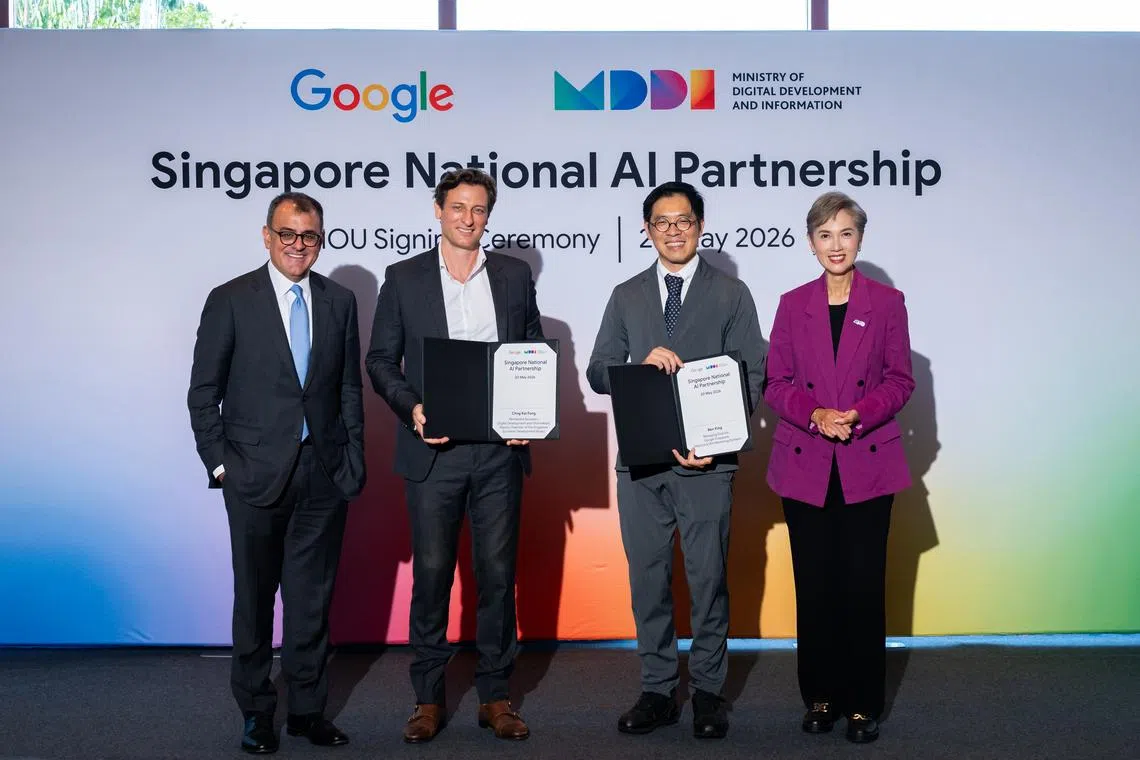
At the summit, the Ministry of Digital Development and Information (MDDI) and Alphabet’s Google also announced a new national AI partnership to deepen collaboration in support of Singapore’s national AI strategy.
The partnership will focus on using frontier AI to address societal challenges, build an AI-ready workforce, strengthen enterprise innovation and support the development of a secure AI ecosystem.
This is an extension of the programme within Google’s “Majulah AI” initiative, which seeks to equip Singaporeans with practical AI skills.
These include the Skills Ignition SG programme with IMDA for jobseekers, the Google for Startups Accelerator: AI First and AI Cloud Takeoff initiatives for startups and developers, as well as the Gemini Academy for Singaporeans.
Google Cloud will also expand its team of forward-deployed engineers following the launch of its Singapore Engineering Centre, to help local enterprises accelerate the adoption of agentic AI and scale enterprise transformation efforts.
At the same event, MDDI and OpenAI signed a memorandum of understanding for a new “OpenAI for Singapore” initiative aimed at strengthening the Republic’s position as a leading hub for applied AI innovation.
The partnership – first between the Singapore government and OpenAI – will focus on advancing applied AI innovation, developing AI talent, and making it accessible to citizens, enterprises and the public sector.
OpenAI has committed more than S$300 million to strengthen Singapore’s AI ecosystem.
Decoding Asia newsletter: your guide to navigating Asia in a new global order. Sign up here to get Decoding Asia newsletter. Delivered to your inbox. Free.
Copyright SPH Media. All rights reserved.
TRENDING NOW

DBS, OCBC, UOB rout lops billions off STI as inflation, rate concerns spook investors

Grab CEO’s wife Chloe Tong on life with Anthony Tan and finding her purpose

OCBC sheds S$8 billion in value as shares close nearly 6% down; analysts cautious on banks

Deal between tycoon friends sparks scrutiny of Philippine power sector

