

Singapore watching developments, could introduce support measures as Trump’s 15% tariff threat raises uncertainty: DPM Gan
Opportunities for Singapore to do business with US still exist even if tariffs are applied
[SINGAPORE] The Singapore government is closely monitoring fresh tariff developments and engaging its US counterparts, and stands ready to render more support measures if needed, as US President Donald Trump’s new 15 per cent tariff threat heightens uncertainty.
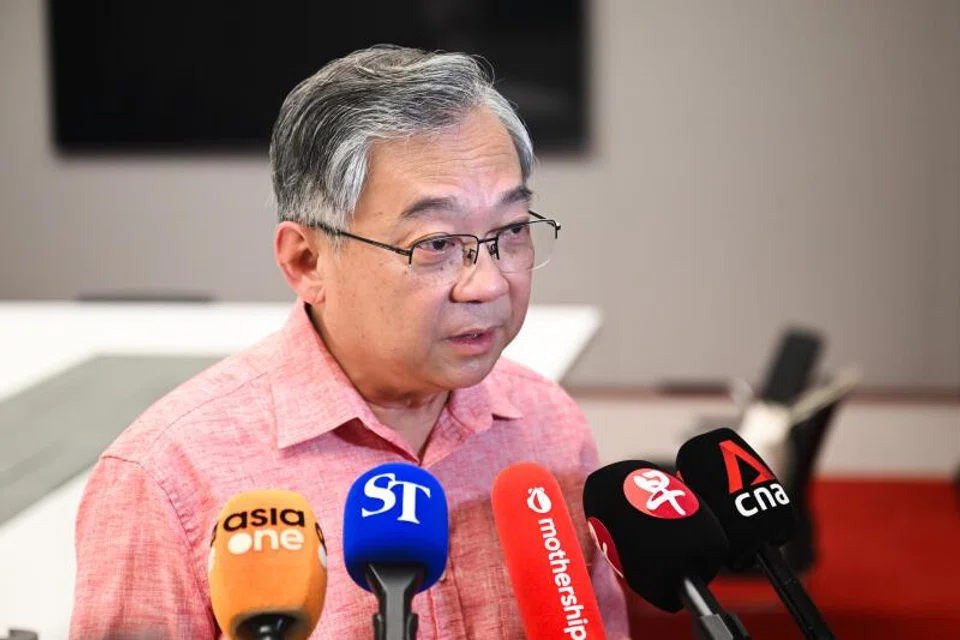
Speaking at a media doorstop on Sunday (Feb 22), Deputy Prime Minister Gan Kim Yong said: “(The latest development) is a stark reminder to all of us that we are now facing a very unpredictable and uncertain operating environment.”
While implementation details remain unclear, he said Singapore’s relative export competitiveness would not be affected even if tariffs were applied across the board.
“We will still have opportunities for Singapore to continue doing business with the US,” he said, though higher costs could dampen trade and investment flows.
The government is monitoring the situation closely and will engage its US counterparts to seek clarity on the implementation of the new Section 122 tariffs and the processes for tariff refunds, said a spokesperson from the Ministry of Trade and Industry (MTI).
Singapore has not revised its growth forecast, said DPM Gan in response to a question.
Trump on Saturday raised the global duty on US imports to 15 per cent from 10 per cent. The move comes after the US Supreme Court ruled that the president lacks authority under the International Emergency Economic Powers Act (IEEPA) to unilaterally impose tariffs. Shortly after the ruling, Trump imposed a new 10 per cent global levy under another trade law provision.
Under the earlier IEEPA framework, a baseline 10 per cent tariff had been imposed on Singapore goods in April 2025, despite the city-state being a US free trade partner since 2004.
The 15 per cent tariff is being imposed under Section 122 of the Trade Act of 1974, which allows tariffs of up to 15 per cent for 150 days without congressional approval.
Given the time limit, Gan said there remains “significant uncertainty” and changes can be expected.
To that end, the government will continue working with the Singapore Economic Resilience Taskforce and engage businesses and workers to assess the impact on jobs and operations, he added.
Asked whether Singapore could be exempted in the coming months – given it neither runs a large trade surplus with the US nor engages in unfair trade practices – Gan discouraged such speculation.
US Census Bureau data indicated that the US ran a goods trade surplus of US$3.6 billion with Singapore in 2025, higher than the surplus of US$1.9 billion in 2024.
“The world is very uncertain; and what’s going to happen in five months time is still very far away, very difficult to predict,” he added, noting that the US administration has shown it can create new avenues to sustain its tariff regime.
Still, Nydia Ngiow, managing director for global trade and economics at BowerGroupAsia, reckoned that despite the uncertainty, the immediate impact on Singapore is likely to be contained rather than disruptive.
This is because Singapore’s two largest export categories – semiconductors and pharmaceuticals – are governed under another trade act, and are not newly exposed by this measure.
“This distinction is critical, and the practical effect of the new tariff on Singapore’s export base is considerably more limited and nuanced than headline numbers suggest,” she said.
About 75 per cent of Singapore’s semiconductor exports enter the US duty free or at reduced rates due to exemptions tied to US data centres, research and development, consumer applications and supply chain buildout.
Singapore-based pharmaceutical firms face a 100 per cent tariff on branded or patented products unless they are building manufacturing facilities in the US, though implementation has been delayed.
The MTI spokesperson said certain goods, including pharmaceuticals, pharmaceutical ingredients and some electronics, are exempt from the Section 122 tariffs.
“Semiconductors and pharmaceuticals are not subject to the Section 122 tariffs, as they may be the subject of Section 232 tariffs that have not yet been imposed,” said the spokesperson.
Impact on supply chains
Beyond direct exports, Singapore is most exposed to indirect trade impacts – particularly through supply chain disruptions, market watchers told The Business Times.
For example, Singapore-based companies that supply inputs to regional production networks serving the US could see their operations affected, while multinational companies might delay investment or reconfigure production locations, said Ngiow.
“Singapore’s position as a regional hub amplifies its vulnerability to indirect global trade stress relative to economies with larger domestic demand buffers,” she added.
For the semiconductor industry, tariffs on downstream products, such as industrial equipment, can still impact demand, investment decisions and supply chain configurations, said Ang Wee Seng, executive director of Singapore Semiconductor Industry Association.
The core challenge for the semicon players is more about the predictability and consistency of policy environments, he added.
“Long-term investments in semicon manufacturing involve significant capital commitments and multi-year development timelines, and require stable operating conditions.”
Companies may increasingly focus on strengthening supply chain resilience, diversifying market exposure, and optimising their production networks, he noted.
Still, with exports focused on high-value, specialised goods, Singapore is unlikely to face a structural competitiveness disadvantage from a uniform tariff rate of 15 per cent, said Ngiow.
“The more meaningful risks that Singapore would have to deal with are slower global demand and second-order effects, rather than an overnight loss of market share.”
RHB group chief economist and head of market research Barnabas Gan said Singapore retains an edge through its technological sophistication in high-tech sectors and its reputation as a reliable trading partner supported by an extensive network of free trade agreements. These factors should help mitigate price-competitiveness pressures.
Even if tariff differentials disappear, as countries that previously faced higher reciprocal tariffs are now subject to the same 15 per cent duty, Singapore’s competitiveness is unlikely to be significantly affected, said Frank Debets, Asia-Pacific customs and trade leader, PwC Singapore.
For one thing, companies generally require a significant tariff gap to justify restructuring supply chains, and the difference between Singapore’s 10 per cent and higher rates elsewhere has often been too small to trigger major changes.
Additionally, Singapore’s broader economic and legal strengths – including skilled manpower and adoption of artificial intelligence – continue to make it an attractive hub.
While widespread fears that the tariffs would trigger a sharp slowdown last year did not materialise, Finance Minister and Prime Minister Lawrence Wong had noted in his Budget 2026 speech that “growth will be harder in this changed world... We must aim higher, move faster and be prepared to take calculated risks.”
He had said that Singapore must stay open, but connect in smarter, more diversified and more resilient ways. New connections have been formed, such as the Future of Investment and Trade Partnership, and agreements have been inked including the EU-Singapore Digital Trade Agreement.
OCBC chief economist Selena Ling said: “It is likely still early days yet as there are other tools that the US administration could use for tariffs, albeit the Supreme Court ruling is a big setback.”
She added: “The key lesson from 2025 was to wait and see, rather than react immediately as the situation is still fluid. So there’s no point overreacting to adjust growth forecasts as the tariff situation could rapidly change again with the US administration.”
TRENDING NOW

Once staunchly pro-China, Malaysian Chinese businesses are now distancing themselves from Beijing

Looking beyond looming CEO succession, should UOB potentially pursue a transformative merger?

Could stablecoins be the future of money?

Grab CEO’s wife Chloe Tong on life with Anthony Tan and finding her purpose

