Singapore’s adoption of electric heavy vehicles up 10 times on incentives; diesel spikes fuel further interest

But range and cost of charging infrastructure remain barriers, industry observers say

Summarise
Derryn Wong
Published Fri, Apr 10, 2026 · 07:00 AM
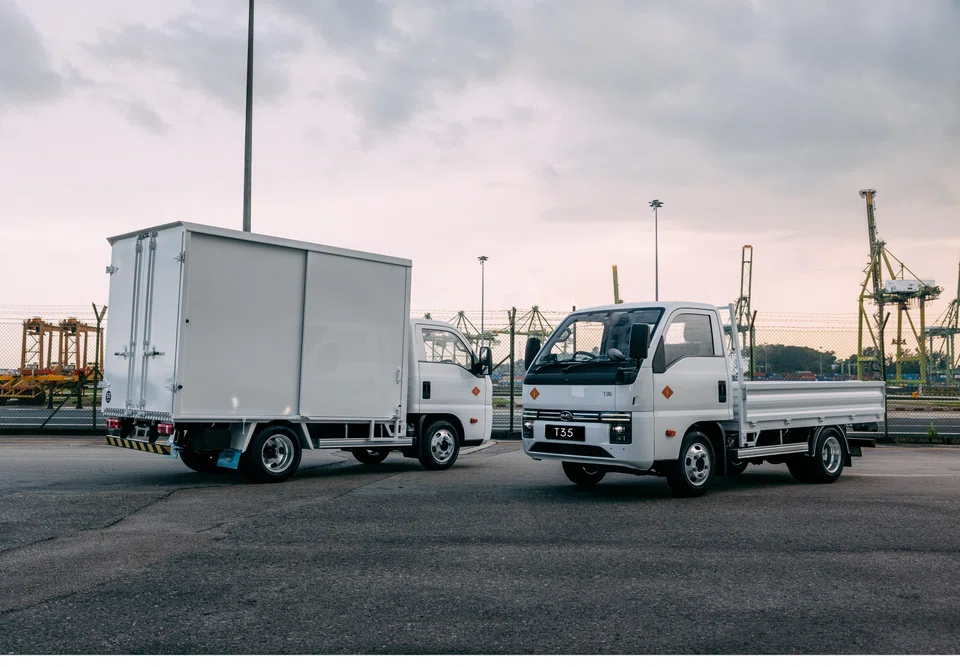
    • The BYD T35 was launched in Singapore on Mar 26. A fully electric truck, it is classified as a heavy goods vehicle and is eligible for S$40,000 of incentives.
    • The BYD T35 was launched in Singapore on Mar 26. A fully electric truck, it is classified as a heavy goods vehicle and is eligible for S$40,000 of incentives. PHOTO: BYD SINGAPORE

    [SINGAPORE] Registrations of fully electric heavy goods vehicles, also known as EHVs, in Singapore have jumped 10 times – thanks largely to incentives rolled out at the start of the year.

    EHVs are also receiving more attention as the Middle East conflict drives diesel prices up. But industry observers say that significant barriers to adoption remain, including operational and charging challenges.

    EHVs are electric versions of heavy goods vehicles (HGVs), which have a maximum laden weight of 3,501 kg to 16,000 kg, and very heavy goods vehicles (VHGVs), which have a maximum laden weight of more than 16,000 kg.

    Data from the Land Transport Authority showed that in the first two months of 2026, the number of EHVs registrations was 119, compared with 11 in the year-ago period. EHVs accounted for 14.2 per cent of registrations, up from 1.5 per cent across the same time period.

    “There was already growing interest in EHVs, but the incentives have helped boost take-up,” said Ryan Woon, CEO of EcoSwift, the agent for Sany commercial vehicles. “We have seen more orders in these three months than in the last three years combined.”

    For January and February this year, the number of brands with EHV registrations increased to 10 from three in the year-ago period. Such marques include BYD, Farizon, Foton, JAC, Mercedes-Benz and Qingling.

    Incentives levelling the field

    Singapore’s EHV incentives began this year, with a total of S$40,000 per vehicle and co-funding up to S$30,000 per accompanying charger.

    Eligible vehicles must be commercial EVs with a maximum laden weight of more than 3,500 kg, including goods vehicles, goods-cum-passenger vehicles and buses.

    These incentives have been the prime mover for the increased EHV registrations, as they have helped reduce the cost of such vehicles relative to diesel-powered equivalents.

    James Ng, the managing director of BYD Singapore, said there has been “very strong demand” for the brand’s T35 model since its launch on Mar 26. The electric light truck is priced at around S$140,000 with a Certificate of Entitlement (COE) and rebates, while an equivalent diesel model costs around S$120,000 with COE.

    “The strong product of BYD and S$40,000 push from the government has motivated users to replace their fleets,” said Ng.

    BYD had one of the highest single-model registrations for EHVs, with 18 T35 trucks registered in February.

    Edward Tan, executive director of Hong Seh Group, which is the distributor for multiple Chinese commercial vehicles, including Farizon, said: “With rebates, EHVs are within ‘striking distance’. The Farizon H9 is within S$10,000 of an equivalent diesel model in price.”

    This has translated into demand for EHVs.

    “In fact, we’ve encountered stocking issues because we underestimated demand,” said EcoSwift’s Woon. In the first two months of 2026, 17 Sany EHVs were registered.

    However, most of the EHVs registered are HGVs. Adoption in the VHGV segment is slower as these require larger batteries, making them more expensive than electric HGVs.

    Alvin Ea, CEO of container haulage platform Haulio, said: “A major factor is that the current purchase price of some heavier EHVs is easily 1.5 to two times that of the diesel trucks, which doesn’t make commercial sense, hence the slow adoption.

    “These additional costs don’t translate to increased revenues as customers are not willing to pay the premium.”

    Heavy fuel

    Because of the lower energy costs and less servicing required, EHVs claim a lower total cost of ownership than diesel equivalents; rising fuel prices are making that contrast more stark.

    Diesel prices have spiked because of the Middle East conflict. Diesel pump prices at SPC increased more than 40 per cent to S$3.92 on Apr 2, from Feb 23. While diesel-related costs have increased by as much as 80 per cent for some businesses, EV charging rates have remained stable.

    “The enquiries into electric commercial vehicles we have been receiving have doubled, and those asking have said it is the increase in oil and diesel prices that drives them to seek alternatives,” said BYD’s Ng.

    Neo Beng Lin, managing director of RichLand Logistics Singapore, said the diesel price situation has given EHVs an extra boost.

    “We had a client who was undecided about running an EHV fleet for logistics, but since the Middle East crisis and rising fuel prices, they decided to go ahead with the EHV proposal,” he said.

    Beyond savings, sustainability is also driving decision-making on EHVs.

    “Some of our clients, especially MNCs (multinational corporations), are keen to reduce their emissions, and EHVs are a step towards that,” said RichLand’s Neo. “We worked with companies like 3M and Schneider Electric on using EHVs for some of their logistics requirements.”

    In January, RichLand was contracted by 3M to use two Sany electric prime movers for transport containers between plants in Singapore.

    The Sany EV490 is a fully electric prime mover that can be charged conventionally or use battery swopping. PHOTO: ECOSWIFT

    Some resistance

    While the adoption of EHVs is increasing at this early stage, there are still barriers to adoption, such as range and the cost of charging infrastructure.

    Alson Ea, executive director of HUB Logistics Group, said that while EHVs have tangible benefits, being able to deliver good range is the most important factor for logistics.

    “A diesel vehicle can usually complete about six jobs around the island, but with EHVs, most of them have a real-life range of about 200 to 250 km, and they can only complete three to four jobs a day,” he said.

    “Anything less than six jobs and we’ll lose money.”

    HUB Logistics Group has a fleet of 10 EHVs, out of a total of more than 150 vehicles, which are mostly diesel-powered vehicles.

    Another problem is the cost of installing chargers. Because EHVs have larger batteries, a fast charger is important to reduce downtime.

    The incentives also cover half the cost of an EHV fast charger, capped at S$30,000. This cap may be raised for additions, including wiring and electrical equipment.

    This helps reduce the cost, but the total expense may still be out of reach for some.

    “To set up your own charging facilities to support a growing EHV fleet, you may also need to install high-tension trunking or even add capacity to local transformer stations, which can be very expensive,” said RichLand’s Neo.

    “For smaller logistics players, who usually lease their premises for three to five years, this is not long enough to recoup the investment on chargers. Landlords may also not allow these changes,” he said, adding that RichLand is currently acquiring its own premises to allow it to operate charging infrastructure.