OUTLOOK 2023

Singapore’s consumer sector cautiously optimistic about 2023

Both tourist and domestic spending are recovering, but labour remains a major constraint

Summarise
Venga Subramaniam
Published Wed, Dec 21, 2022 · 05:50 AM
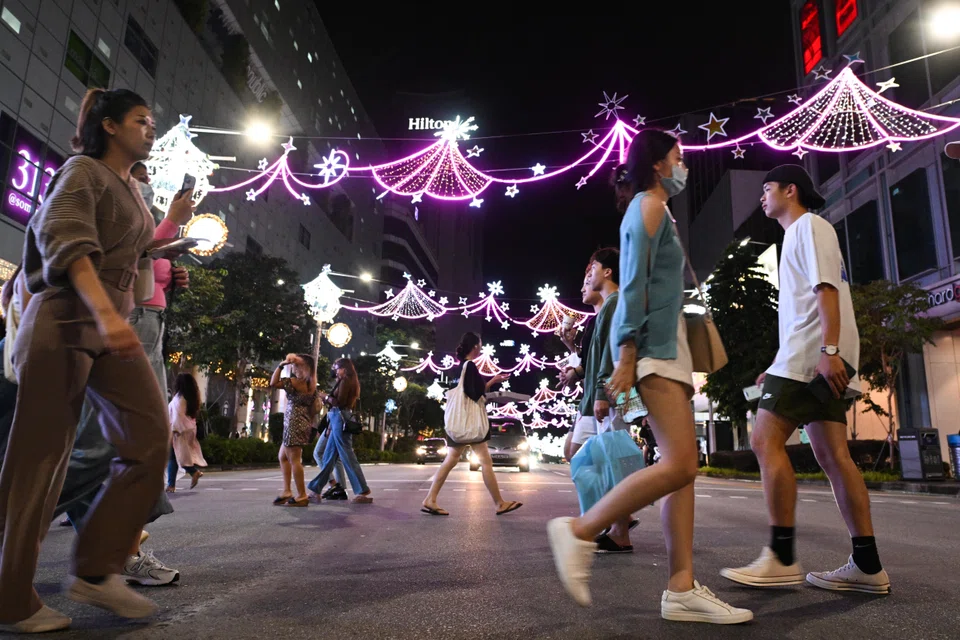
    • Though border relaxations have increased inflows of tourists, they also mean more locals heading overseas.
    • Though border relaxations have increased inflows of tourists, they also mean more locals heading overseas. PHOTO: LIM YAOHUI, ST

    AS MUCH of the world emerges from the shadow of Covid-19, consumer spending in Singapore – by both locals and tourists – is rising. Industry players expect this trend to continue into 2023. The optimism is tempered with caution, however, as inflationary pressures and labour market tightness continue.

    Since March, Singapore’s retail sales have grown year on year for eight months straight. Growth has largely been driven by the effect of a low base in 2021. But month-on-month growth has also trended upwards, apart from dips in June and August.

    Retail activities have improved as borders reopen and locals are more willing to spend in the absence of Covid curbs, said Singapore Retailers Association (SRA) president Ernie Koh. “Some in the retail sector are seeing steady growth, and many are back to pre-pandemic levels or close to it.”


    With domestic expenditure rising as pandemic curbs were relaxed, clothing retailer Uniqlo opened six new stores in Singapore this year.

    “With the workforce gradually returning to the office, and borders opening up for travel, we observed that the demand has shifted from loungewear and home goods to smart-casual wear and travel essential items,” said a Uniqlo spokesperson.

    In the first three quarters of 2022, real estate group CapitaLand welcomed over 230 new stores in its Singapore malls. Its overall portfolio occupancy stood at 96.8 per cent.

    In the third quarter of 2022, its malls recorded year-on-year growth of 21.3 per cent for retail sales and 21.9 per cent for shopper traffic. Overall tenant sales have already surpassed pre-pandemic 2019 levels.

    Consumer spending has also exceeded pre-Covid levels at City Square Mall and Palais Renaissance, managed by City Developments (CDL) . Both tourist and domestic spending are up, said Callie Yah, executive vice-president and head of global asset management: “The robust performance can be attributed to pent-up demand and a resurgence of tourists visiting the revitalised Orchard Road belt.”

    “With the gradual opening of markets and borders this year, consumer confidence has steadily and gradually returned – marking a clear increase in spending compared to a lower base last year when safe management measures were still in place,” she added.

    In 2023, SRA’s Koh expects “revenge travel” to continue for foreign tourists heading here, especially as China opens up. Yet, border reopenings also mean more locals heading overseas.

    Some retailers, such as those of furniture and household products, “are seeing a levelling-off of demand as consumers are spending in other areas such as travel and restaurants”, said Koh.

    More broadly, retail growth could be dampened as more locals go abroad, with the strong Singapore dollar making overseas shopping cheaper, he added.

    On the hospitality front, the Singapore Hospitality Association’s (SHA) outlook for 2023 is one of “cautious optimism” for a sustained recovery, “supported by a healthy pipeline of Mice (meetings, incentives, conferences, exhibitions) events and elevated tourism offerings”, said president Kwee Wei-Lin.

    Singapore is likely to achieve the higher end of the Singapore Tourism Board’s (STB) projection of four to six million visitors by end-2022, said Kwee.

    STB statistics also show that room rates hit a 14-year high of S$283.47 in September, falling only slightly in October to S$281.89, with an average occupancy rate of 84.8 per cent.

    Redesigning post-pandemic

    The pandemic forced businesses to adapt to ever-shifting norms and restrictions – and some of these changes have endured.

    One Farrer Hotel, for instance, made permanent changes to its guest rooms and common areas. It has replaced carpets with custom vinyl flooring, and installed antiviral-coated wall coverings, antimicrobial blind fabrics, and moveable furniture to facilitate thorough cleaning and disinfecting.

    In upgrading works and future projects, the hotel will continue to invest in materials that are antiviral, antibacterial and antimicrobial, said director of sales and marketing Elaine Kum.

    During the pandemic, the hotel also converted its 20th floor – originally housing guest rooms – into a private dining facility to boost its food and beverage (F&B) offerings. This is now set to become a permanent fixture due to its popularity, added Kum.

    Last year, Ascott’s Citadines Raffles Place Singapore began deploying a service robot for tasks such as concierge services, leading guests to rooms or facilities, delivering clean laundry and packages, as well as refilling room supplies. Even as the pandemic’s impact wanes, the robot is here to stay.

    In retail, many see the pandemic as a once-a-generation event, and aim to return to pre-pandemic activity, said SRA’s Koh: “Some pivoted to other business models to survive, but they have to pivot back to their usual business models to thrive in the long run.”

    “The question is to what extent companies go to prepare for the next pandemic,” he added, noting that many retailers face day-to-day challenges and may lack the resources to do so.

    Even for listed companies, the bottom line is most important, he said: “If you tell shareholders you will spend big on a pandemic that may only happen 20 years down the road, there will be a lot of resistance. It may not be a viable idea for many companies.”

    What might endure, however, is the shift online. Retailers that moved towards digitalisation and e-commerce during the pandemic may continue to grow their business in that direction, said Koh.

    In retail, CDL’s Yah said the pandemic has shown the importance of digitalisation to business continuity. When it comes to physical stores, shoppers now want something beyond the functional “enter a place and purchase something” experience, she added.

    “Shoppers seek an all-encompassing experience that appeals to them with unique or differentiated offerings and picture-perfect spaces, which makes shopping more experiential.”

    Similarly, Uniqlo’s spokesperson said that as e-commerce grows more prevalent, customers have become more sophisticated and are looking for in-store activities to enjoy beyond what online shopping offers.

    “Many of the new customers gained during the pandemic became cross-channel customers, shopping across both our online and offline stores,” the spokesperson said. Uniqlo thus introduced “online-to-offline services”, such as a same-day “click and collect” service, which allows customers to collect orders at a physical store after placing an order online.

    Experiential retail is key in attracting and engaging shoppers, noted Chris Chong, chief executive officer of retail and workspace (Singapore and Malaysia) at CapitaLand Investment . For instance, 16 of its malls are celebrating Christmas with a Disney theme.

    “Looking ahead, we have been actively positioning our downtown properties to welcome the return of more shoppers and tourists with experiential lifestyle concepts and vibrant community events,” Chong added.

    Enduring challenges: labour shortages, rising costs

    Even as both the retail and hospitality sector prepare for robust demand, their main concerns going into 2023 are continued labour shortages, rising rents and other inflationary pressures.

    Said SRA’s Koh: “The cost of labour has increased and locals are not coming into the retail sector as there are alternatives for them – for example, the gig industry.

    “Above that, we are seeing landlords starting to increase their rental rates. Many retailers may not be able to take these labour and rental increases.”

    Uncertainty about the inflow of tourists is another concern, he added.

    SHA’s Kwee, meanwhile, cited operational challenges in hospitality such as rising business costs due to high energy and food prices, as well as a tight labour market.

    Han Khim Siew, chief executive officer of OUE Commercial Reit , said labour shortages remain one of the hospitality sector’s biggest problems, as hotel operations require a large workforce to provide good customer service.

    Its portfolio includes Hilton Singapore Orchard, which divides its hotel workforce into sub-units so that staggered workforce arrangements can be adopted when necessary – during a crisis such as the pandemic, for instance. To mitigate staff shortages more generally, the hotel uses digital tools, robotics technology, and artificial intelligence to improve efficiency and enhance the guest experience.

    Hospitality company Ascott is also investing in technology to cope with cost increases, in areas such as energy, cleaning and laundry, said Wong Kar Ling, managing director for South-east Asia and head of strategy and global operations. To address manpower shortages, it is retraining staff and diversifying job duties, Wong added.

    “We expect occupancy rates to stabilise next year while room rates will continue to rise due to inflation alongside demand from regional and global travellers,” she said. “We remain cautiously optimistic about the outlook in 2023 given the further easing of border restrictions amid macro uncertainties.”