

Singapore’s core inflation slows more than expected to 1.9% in November; headline inflation at 1.6%
This may mean that an easing of monetary policy could be on the cards in January, say economists

SINGAPORE’S core inflation eased more than expected in November, prompting some private-sector economists to predict that the central bank may ease monetary policy settings in January.
November’s core inflation, which excludes accommodation and private transport, was 1.9 per cent, based on data from the Department of Statistics on Monday (Dec 23). This was a nudge lower than the 2.1 per cent in October and the median forecast of 2.1 per cent by private-sector economists polled by Bloomberg.
Meanwhile, headline inflation was 1.6 per cent, up from 1.4 per cent in October, but lower than economists’ median forecast of 1.8 per cent.
Barclays analysts Brian Tan and Audrey Ong believe the Monetary Authority of Singapore (MAS) could ease policy settings in January via a downward recentring of the Singapore dollar nominal effective exchange rate (S$NEER) policy band, as well as by making a reduction to its slope.
MAS has likely been waiting for core inflation to fall below 2 per cent year on year before making moves to reverse the monetary policy tightening measures it has enacted and maintained since 2022, noted Tan and Ong.
“A significantly lower-than-expected core consumer price index (CPI) path would likely ease the Monetary Authority of Singapore’s messaging on easing foreign exchange policy when there is still significant political focus on inflation,” they said.
That said, whether MAS will move “remains a close call”, said the analysts. “Much depends on whether the MAS views the drop in core inflation in the December print to be sufficient for a shift to easing.”
Should core inflation prove to be stickier than expected, then the central bank is likely to wait until April before it eases monetary policy, they said.
The slower-than-expected November inflation figure supports UOB’s base case for a slight reduction of the policy band slope during the upcoming meeting in January, said associate economist Jester Koh.
“That said, we will not be surprised if MAS decides to keep the S$NEER band parameter settings unchanged and prefers to allow the market to steer the S$NEER lower within the existing band parameters,” he added.
For the rest of the year, core inflation is expected to remain under 2 per cent, said MAS and the Ministry of Trade and Industry.
Core inflation is expected to average between 2.5 and 3 per cent in 2024. It should step down further to a range of 1.5 to 2.5 per cent next year.
Meanwhile, headline inflation is expected to come in at around 2.5 per cent for the full year. In 2025, overall CPI is expected to average between 1.5 and 2.5 per cent.
Key CPI categories
On a month-on-month basis, both the overall and core CPI were unchanged in November.
In November, accommodation, services and food prices eased, while inflation for retail and other goods, as well as electricity and gas, maintained pace.
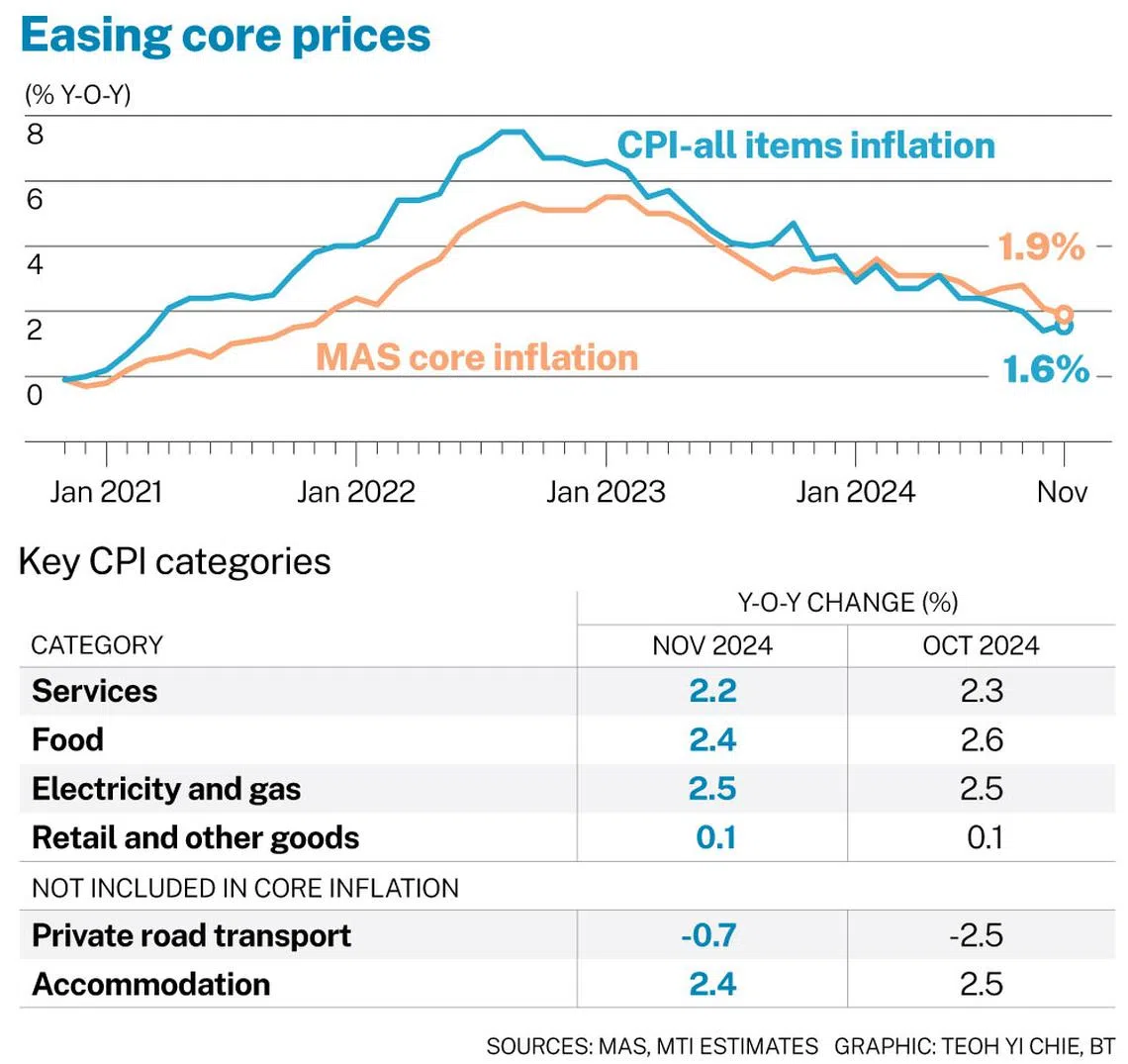
Accommodation inflation moderated to 2.4 per cent, from 2.5 per cent in October, due to a smaller increase in housing rents.
Services inflation also nudged down to 2.2 per cent, from 2.3 per cent the previous month, due to a smaller increase in holiday expenses and a steeper decline in telecommunication services fees.
Food inflation eased to 2.4 per cent, from 2.6 per cent in October, as the prices of non-cooked food and food services rose at a slower pace.
Meanwhile, private transport prices fell to 0.7 per cent, falling at a slower pace than the previous month, when prices declined at 2.5 per cent. This was due to a smaller decrease in car prices.
Electricity and gas inflation was unchanged at 2.5 per cent, and retail and other goods inflation, was unchanged in November at 0.1 per cent.
TRENDING NOW

Singapore identifies 7 firms responsible for haze fires, notices issued urging action: Grace Fu

Philippine power giant First Gen rebuffs foreign offers, plans up to US$2.6 billion in expansion
DBS remains analysts’ pick ahead of Q3 earnings after Singapore banks’ share slump
Indonesia imposes US$116 million in fines over manipulation of Sinar Mas, Prajogo-linked stocks

